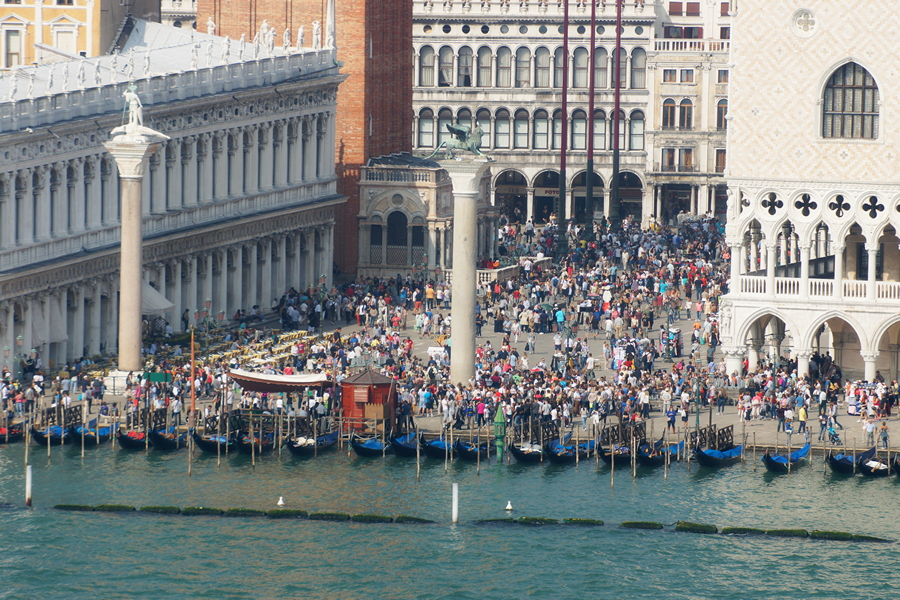
On Sunday, July 27, 2026, this year’s trial period for the Venice access fee (Contributo di Accesso) will end. For the remainder of 2026, Venice can once again be visited on any day without prior registration or payment of a daily fee.
What will happen in 2027?
The exact rules for the coming year have not yet been finalized. Experience has shown that the city council typically makes such decisions only shortly before the start of the new season. One thing is already certain, however: Even in 2027, a flat fee will not be charged starting January 1, but—if the system continues—will again be charged only on selected peak days in the spring and summer.
Speculation in the media
As usual, unclear plans for the future are sparking debate. Media reports sometimes mention drastic increases of up to 30 euros per day. However, such figures are purely speculative. As a local politician, the mayor cannot decide on such an increase on his own; this would require extensive legal amendments and approvals from the Italian government in Rome.
However, one thing remains undisputed in Venice: on days with extremely high visitor numbers, the city can no longer avoid implementing some form of regulation. The only question is what form this regulation should take in the future. Essentially, there are three models under consideration—each with its own distinct weaknesses.
1. Purely Financial Regulation
The first option is simply to raise the admission price—the purely market-based approach, so to speak. You keep raising the fee until it becomes noticeably too expensive for many people. However, a fee of 50 euros per person would mean that a family of four would have to pay 200 euros per day just to enter the city.
This has two significant drawbacks: First, this logic ultimately means that only visitors with high purchasing power can afford to come to Venice. Second, it is precisely this money that is subsequently missing from the budgets of local visitors. Anyone who pays a 200-euro entrance fee will later cut back on a gondola ride, a meal at a restaurant, museum admission, or ice cream for the kids. It is highly doubtful whether such a reduction in spending power is in the best interest of the local Venetian economy.
2. Allocation by the authorities
The second approach would be to implement a quota system with a fixed upper limit—for example, a maximum of 70,000 visitors per day—under which the city administration would grant access permissions upon application. However, with tens of thousands of applications each day, this would entail a massive administrative burden. Hundreds of new administrative staff would have to be hired to manage the system year-round—positions that, as experience shows, are never eliminated. Furthermore, the bureaucratic allocation of travel permits evokes memories of the planned economies of the past. Whether such a model would be accepted is highly questionable.
3. The „first come, first served“ principle
The third option would be to allocate tickets on a first-come, first-served basis: whoever registers first gets the ticket. But here, too, real-world experience quickly reveals the system’s weaknesses. Bots and fake email addresses would flood the system in no time. Tickets for popular dates would be reserved as a precaution, even without any intention of actually traveling—just to resell them later at exorbitant prices on secondary-market platforms like eBay. This would also do nothing to ensure fair and effective visitor management.
Conclusion
Our conclusion: There is simply no single, perfect solution. Every system comes with its own challenges and unintended consequences. We at the Venice Advisory Group will continue to closely monitor developments at City Hall and in Rome, and we’ll keep you updated on all actual decisions with our usual reliability.