A Venetian Merchant Between Europe and Asia
His traces are somewhat harder to find in Venice, since his original home was unfortunately destroyed by fire, but the places themselves still exude his history. He became famous for being one of the first Europeans to describe long journeys to Asia.
1. The Residence: Corte Seconda del Milion
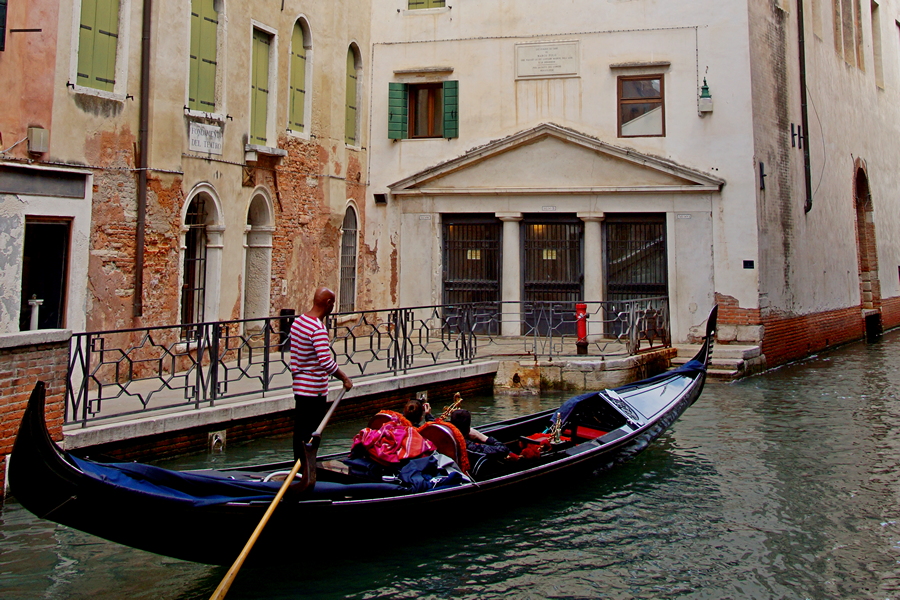
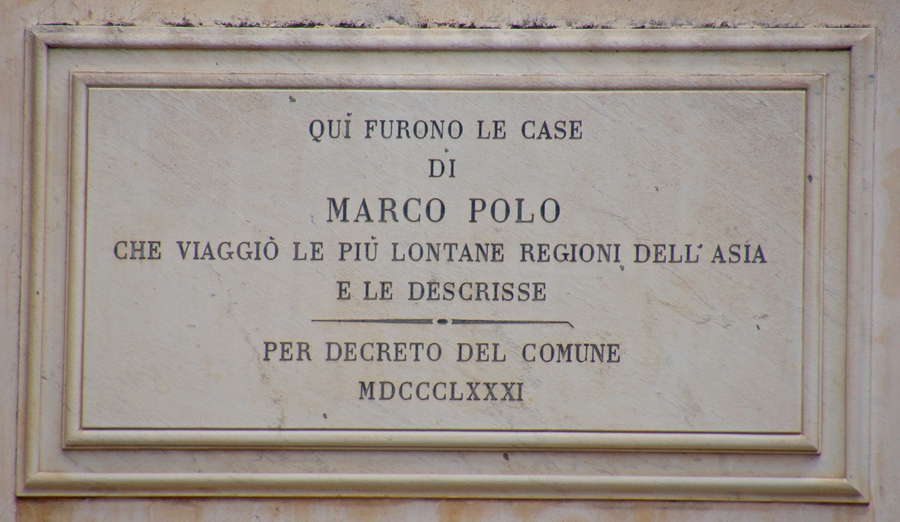
The Polo family's house once stood here. The name „Milion“ comes from Marco's nickname, since he often spoke in his stories of the „millions“ of riches in the East.
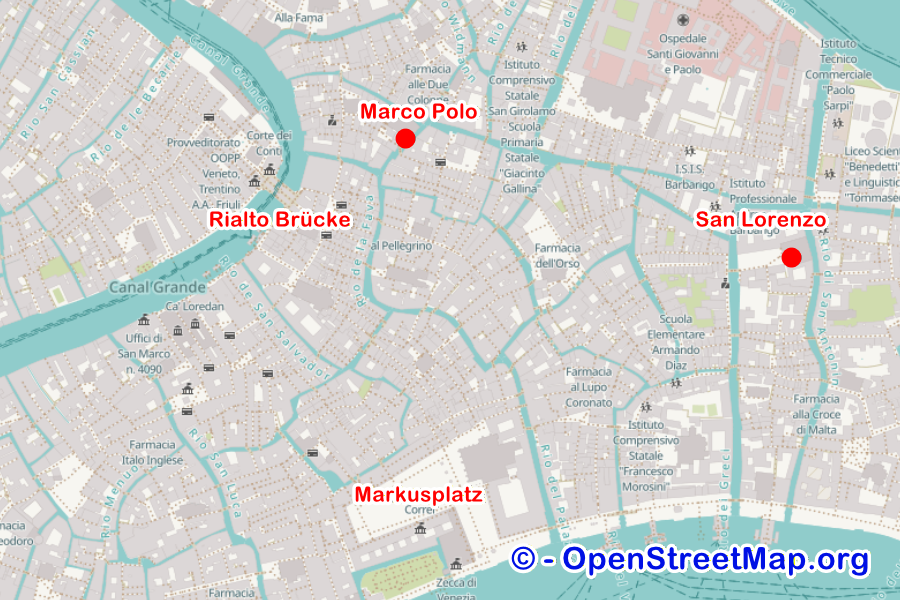
- Location: Corte Seconda del Milion, 5852 (Cannaregio district, near the Church of San Giovanni Grisostomo).
- The motif: The house was built in the 16th century by the Teatro Malibran has been replaced, but in the courtyard you can still see a Gothic archway with Oriental influences, which likely belonged to the original Polo complex. There is also a commemorative plaque there.
The Final Resting Place: San Lorenzo Church
After his death in 1324, Marco Polo was buried in the family crypt in this church.
- Location: Campo San Lorenzo (Castello District).
- The motif: The church was closed for a long time and underwent extensive restoration (today it houses the art center Ocean Space). Unfortunately, the exact location of his grave was lost during renovation work in the 16th century, but a commemorative plaque in the church honors his memory. It’s a place steeped in history—perfect for a photo.
3. The Mosaics in St. Mark's Basilica
Marco Polo not only brought back silk and spices, but also shaped the image Venetians had of the Orient.
- Location: St. Mark's Basilica (Piazza San Marco).
- The motif: Inside the cathedral, there are mosaics that tell the stories Marco Polo described in his book *Il Milione*. Even though he didn’t create them himself, they are a spiritual „sign of life“ from his travels.
4. The Monument at the Airport
Even though it is a modern facility, Venice's international airport bears its name.
- Location: Venice Marco Polo Airport.
- The motif: Whether you're arriving or departing, the name „Marco Polo“ is the first and last „sign of life“ that travelers see in Venice—a lovely nod to the city's most famous traveler.
Tip for your photo project:
The Corte del Milion has a very atmospheric feel. It's a little off the beaten path, but it's just a few minutes from the Rialto Bridge. The narrow alleys and the hidden courtyard are perfect for authentic „Marco Polo in Venice“ shots, as they capture the tranquility of the old city.
History
With Casanova, we were in the 18th century. The same goes for Vivaldi. Marco Polo, on the other hand, was born about 424 years before Vivaldi and about 471 years before Casanova.
His Venice was a different city: medieval, shaped by trade and seafaring, with a burgeoning merchant class and extensive connections throughout the Mediterranean region.
We'll proceed chronologically, examining his family, his living conditions, his travels, his contemporaries, and finally his death. And we'll carefully distinguish between documented facts and the stories that later grew up around him.
1254 – Marco Polo is born in Venice
Marco Polo was born in 1254, most likely in Venice. His exact birthday is unknown. Nor can his birthplace be reliably determined. He came from a Venetian merchant family that already maintained trade ties in the eastern Mediterranean and beyond.
This is an important starting point: Marco Polo was not a poor adventurer who one day decided to set out to discover the world. He grew up in a family whose livelihood depended on trade, travel, and international contacts.
His parents—Niccolò Polo and his unknown mother
His father's name was Niccolò Polo. His uncle, Maffeo Polo, also played a crucial role later on. The two brothers were merchants and had already undertaken long journeys before Marco Polo himself set out.
On the other hand, we know surprisingly little about Marco’s mother. Her name has not been reliably recorded. She died during his father’s long absence, when Marco was still young. Marco therefore spent at least part of his childhood without his parents. We cannot reconstruct with certainty the specifics of his upbringing or with which relatives he lived.
He likely learned the basics of business: goods, measurements, prices, currencies, contracts, and the importance of reliable business partners. But we have no school reports, letters from his childhood, or personal notes that document his education in detail.
Around 1260 – His father and uncle travel east
While Marco was still a child, Niccolò and Maffeo were on an extraordinary trading expedition. Traveling through the Black Sea region and Central Asia, they eventually reached the court of the Mongol ruler Kublai Khan.
Kublai was a grandson of Genghis Khan and ruled over vast territories in Asia. He would later found the Yuan Dynasty in China. According to Marcos’s later travel account, the brothers were warmly received at court. Kublai is said to have shown great interest in Europe and Christianity and sent them back with a message for the Pope.
We are familiar with this story primarily from Polo's travelogue. Not every detail can be independently verified. The key point is this: When Marco was still a boy, his family had already established connections as far away as Asia.
1269 – The Father Returns
After being away for about nine years, Niccolò and Maffeo returned to Venice. Marco was about 15 years old by then.
Just imagine this encounter: A teenager is reunited with his father, who had been away for almost his entire childhood.
His father told him about countries, languages, religions, and rulers that most Venetians knew only from accounts. We do not know how Marco personally reacted to this. But a few years later, he himself would set out with his father and his uncle.
And that marks the beginning of the most famous phase of his life.
1271 – Marco Polo sets out for Asia himself
In 1271, Marco was about 17 years old. He left Venice together with his father, Niccolò, and his uncle, Maffeo. Their destination was, once again, the court of Kublai Khan. The journey first took them across the Mediterranean to the eastern Mediterranean region. From there, they continued overland to Asia.
It was not a journey along a single road. What later came to be known as the Silk Road consisted of an entire network of trade routes, caravan stations, and cities. The three Venetians had to adapt to different languages, territories, climate zones, and modes of transportation.
Nor were they by any means the first Europeans to travel far into Asia. Even before them, Christian envoys and missionaries, among others, had traveled through the Mongol Empire. What later set Marco Polo apart was his detailed account of the lands and societies he had encountered.
1275 – Arrival at the court of Kublai Khan
After a journey lasting several years, the Polos arrived at Kublai Khan's court around 1275. Marco Polo was about 21 years old by then.
Kublai Khan ruled a vast empire. He had founded the Yuan Dynasty in 1271 and ruled over large parts of China. His power was based on the Mongol conquest, but his administration also drew on existing Chinese traditions.
Marco later reported that he had entered the ruler’s service and had undertaken various tasks and journeys on his behalf. Historians disagree on just how high his actual rank was. In particular, the claim that he served as governor of a major Chinese city cannot be sufficiently substantiated.
However, the fact that he lived in Asia for a long time and possessed remarkable knowledge of conditions there is supported by numerous details in his account and by historical research.
What particularly impressed Marco Polo in Asia
Among other things, his account describes major cities, long-distance trade, various religions, the organization of the Mongol Empire, and technical innovations.
Three observations are particularly revealing:
- Paper money: Marco describes how paper money was used under Mongol rule. For readers in Europe, this was a surprising concept.
- Coal: He describes black stones that could be used for heating, just like firewood.
- The Postal and Courier System: He describes an extensive network of stations where couriers could change horses. This made it possible to transport messages over long distances.
These were not Marco Polo's inventions. His significance lay in describing such places in detail to a European readership.
1291–1295 – The Long Journey Back to Venice
After many years in Asia, the three Polos set out on their journey home. A large part of the journey was by sea. They traveled from the Chinese coast through Southeast Asia and across the Indian Ocean toward Persia. After arriving in the Persian region, they made their way back to the Mediterranean via several stops along the way.
In 1295, they arrived back in Venice.
Marco was now about 41 years old. He had left his hometown as a teenager and returned as a middle-aged man. The famous story—that his relatives did not recognize him at first and that the Polos subsequently pulled gemstones out of their clothes—stems from later oral traditions. It is not a verified historical fact.
1298 – Imprisonment and the Famous Book
Just a few years after his return, Marco Polo was taken prisoner during the war between Venice and Genoa. In Genoa, he met Rustichello da Pisa, a writer who specialized in chivalric tales. Their collaboration resulted in the famous travelogue that we know today under the title Il Milione know.
The original text has not survived. Various versions in several languages have been handed down, some of which differ considerably from one another. This is important for the later biography: we must not treat the book as a verbatim diary. It combines personal observations, travel experiences, accounts from other people, and literary creativity.
1299–1324 – Marco Polo Returns to Venice
After his release, Marco Polo returned to live in Venice. He married Donata Badoer. The couple had three daughters: Fantina, Bellela, and Moreta.
Marco took care of business and family matters. Various documents from this period have survived, providing us with a more reliable insight into his life than the later legends. On January 8, 1324, Marco Polo died in Venice at the age of about 69.
He was buried at the Church of San Lorenzo. His grave no longer exists today.
Marco Polo represents medieval Venice as a center of trade, Vivaldi represents Venice as a center of music during the Baroque period, and Casanova represents 18th-century society.
Marco Polo was initially a merchant, not an explorer
Today, we think of Marco Polo primarily as a great world traveler. He himself likely viewed his travels much more as part of his family’s business life.
The Polos were Venetian long-distance merchants. Their business was based on family ties, trust, capital, and long-distance trade connections.
It was by no means unusual for such merchants to live away from home for years and yet remain closely connected to their hometown.
One could say that Marco Polo was a Venetian who worked internationally—not someone who left his Venetian roots behind through his travels.
His return to Venice speaks volumes
In 1295, Marco Polo returned after an absence of about 24 years. He was about 41 years old at the time. He had spent most of his adult life outside of Venice.
And what did he do after he returned?
He remained in Venice, continued his business activities, married Donata Badoer, and started a family with three daughters. The Polos purchased a large house in the San Giovanni Crisostomo neighborhood, not far from the Rialto. That became the family and business center of his later life.
So he spent the last nearly 29 years of his life back in Venice. This is strong evidence of his attachment to the city. It does not prove that he felt homesick, but it does show where he made his permanent home.
He was also part of Venice's political world
Upon his return, Marco Polo became caught up in the war between Venice and Genoa and was eventually taken prisoner by the Genoese. There are differing accounts of the exact circumstances of his capture. Therefore, we should not claim that every detail of his alleged service as a Venetian fleet commander is certain.
In any case, his life story remained closely tied to the conflict in his hometown.
And there's one more important point: In the 13th century, there was no Italian nation-state. Marco Polo would not have considered himself Italian in today's political sense. His sense of belonging was rooted in Venice, his family, his Christian community, and the networks in which he lived.
But Asia was more than just a travel destination for him
This is the other side of his personality. Marco Polo spent about 17 years in Mongol-ruled Asia. He became acquainted with foreign societies and, according to his account, moved in the circles of Kublai Khan.
In a study published in 2025, historian Thomas Tanase explicitly emphasizes that Marco Polo should not be reduced to the role of an ordinary Venetian merchant. His long career in Asia also made him an extraordinary traveler and bridge between different worlds.
Marco Polo likely had a dual identity: While his origins and family ties were Venetian, his life experiences were unusually international. But that is a historical interpretation, not a self-account that has been handed down.
Marco Polo was Venetian by birth, family, and social standing. His decades of travel, however, took him far beyond the familiar world of his hometown. After his return, he settled back in Venice, married, and spent the final decades of his life there. We do not know whether he felt homesick during his travels or saw himself as a citizen of two worlds. His life story shows, however, that a strong connection to one’s homeland and an extraordinary openness toward foreign cultures need not be a contradiction.
And that is exactly what makes Marco Polo so fascinating: He left Venice as a 17-year-old boy and returned as a 41-year-old man who had seen much of the then-known world with his own eyes.
Marco Polo – How Did a Venetian Live and Travel in the 13th Century?
Venice around 1260 · The Silk Roads · Kublai Khan · Truth and Legend
When it comes to Marco Polo, we must be especially careful not to picture the 18th-century world we’ve come to know through Vivaldi and Casanova. Marco Polo was born in 1254. His world was the High Middle Ages. There was neither printing in the European sense nor compass navigation in its later, fully developed form; there were no European voyages of discovery to the Americas; and, of course, there was no modern medicine.
But there were already highly developed trade networks, international financial transactions, large cities, specialized artisans, and people who spoke several languages. And above all: Marco Polo did not travel into an unknown, uninhabited wilderness. He traveled through countries with their own transportation networks, markets, administrative systems, and centuries-old cultures.
What was Venice like when Marco Polo was a child?
Let's imagine Venice around 1260. The city was already a major maritime power. Its merchants maintained trade relations throughout the eastern Mediterranean, as far as Constantinople and the ports of the Black Sea.
But the cityscape was very different from what it is today. The Doge’s Palace had not yet taken on its current Gothic form. The Rialto Bridge was not a stone bridge as it is today. Many magnificent Renaissance and Baroque facades did not yet exist.
In contrast, St Mark’s Basilica was already an imposing structure. Numerous churches, monasteries, commercial centers, and residential buildings also shaped the city.
The alleys were narrow. Goods were transported by boat. Merchant ships were moored along the banks, artisans worked in their workshops, and food, fabrics, and imported goods were sold in the markets.
The neighborhood around the Rialto was particularly important. That’s where shops, money changers, and numerous merchants were concentrated. So Marco Polo didn’t grow up in a romantic tourist town, but in an international commercial metropolis.
And there is one more important point: The Venetians of that era viewed their city as an independent political community—the Republic of Venice. For merchants like the Polos, belonging to this city was also a legal and economic matter.
How did trade work?
Here we discover a surprisingly modern side of medieval Venice. A merchant did not necessarily have to travel with his entire personal fortune. He could obtain money from investors, purchase goods abroad, and divide the profits upon his return.
A particularly important type of Venetian contract was called "colleganza.".
Let's take a simplified example:
A financier provides a traveling merchant with 100 Venetian silver coins. The merchant uses them to buy goods, travels to Constantinople, sells them there, and brings back other goods.
Suppose that, upon his return, the net profit amounts to 40 coins. Under a common type of contract, the financier received three-quarters of the profit, and the traveling merchant received one-quarter.
The original capital investment was returned to the investor. In this simple model, the investor bore the risk associated with the capital invested in the event of losses.
This is not a historical contract from the Polo family, but rather a sample calculation illustrating a form of trade that was actually used at the time. Economic historians have examined such contracts from Venetian archives.
What goods were traded?
Venetian merchants traded in spices, silk, cotton fabrics, dyes, metals, gemstones, glassware, and luxury goods, among other things. Not every commodity traveled the entire distance from China to Venice; often, it was sold several times along the way.
A Persian merchant could purchase goods from a Central Asian merchant and resell them to a merchant from the Mediterranean region.
The Silk Road was not a single, continuous trade route operated by a single entity. It was a network. And this network existed long before Marco Polo.
What was so special about the Polo family?
The Polos were not confined to the ports of the Mediterranean. They established connections as far as the Mongol-ruled regions of Asia.
The fact that Marco and his relatives were indeed engaged in commercial activities is evident not only from his travelogue. Preserved Venetian documents provide insight into the family’s economic activities. Historian David Jacoby has examined these documents in detail.
How did people travel thousands of kilometers?
The amazing thing is: You didn't need a map that was accurate throughout to undertake such a journey. Above all, you needed local knowledge, reliable contacts, money, experience, and time.
The Polos didn’t simply travel from Venice to China with a map and follow a marked route. Depending on the region, travelers used ships, horses, camels, or went on foot. They joined caravans, hired local guides, and inquired about water sources, mountain passes, cities, and political conditions.
How far did a caravan travel in a day?
In well-connected areas, caravanserais were often spaced about 30 to 40 kilometers apart. This gives an idea of typical daily stages, even though the actual pace depended on the terrain, the season, the cargo, and the pack animals.
A caravanserai was much more than just an inn.
There, travelers could spend the night, tend to their animals, store their goods, exchange news, and meet new business partners. There were also dangers: robberies, diseases, deserts, mountain passes, political conflicts, and the loss of pack animals.
But we must not overlook the fact that, in the 13th century, the Mongol Empire at times facilitated travel across large parts of Eurasia. Vast territories were ruled by related dynasties. Letters of safe conduct and the Mongol network of relay stations could facilitate travel for those with the proper credentials.
That did not mean complete safety. However, it created conditions under which long-distance travel over exceptionally great distances was possible.
How did people find their way around?
At sea, experienced sailors relied on their knowledge of the coastline, the stars, the winds, the currents, and their nautical expertise. The magnetic compass had already become widespread in the Mediterranean region by the Middle Ages.
On land, local knowledge, familiar trade routes, and information about the next leg of the journey were particularly important. There were maps, but no widely available, precise road maps like the ones we have today.
So Marco Polo didn't need to know the entire route. It was enough for him and his companions to reach the next reliable waypoints along the way.
What did the travelers eat?
That is a very human question. Anyone who was on the road for weeks on end could not simply take enough fresh food with them for the entire journey. Travelers bought food at markets, in villages, and at caravan stops. They also had to adapt to the cuisine of each region.
Possible food sources included:
- Bread and other grain products, made from wheat, barley, millet, or rice, depending on the region.
- Dried meat, fresh meat, legumes, and dairy products.
- Dates, nuts, dried fruit, and other non-perishable foods.
- Water, tea, or fermented beverages, depending on the region and culture.
In areas with a Mongolian cultural influence, meat and dairy products played an important role. The travelogue also describes fermented mare's milk, known as kumys.
In China, travelers encountered yet other types of grains, dishes, and eating habits. However, we do not know what Marco Polo actually ate for breakfast or dinner on any given day of his journey. Such a description would be a plausible reconstruction, not a personal meal plan.
Did Marco Polo bring spaghetti to Italy?
No. This popular story has no historical basis.
Noodle-like dishes were already known in the Mediterranean region before Marco Polo’s return. Nor does his account prove that he introduced a specific Chinese noodle dish to Venice. This is a good example of how a famous traveler was later made out to be the supposed inventor or bringer of everyday items.
How did Marco Polo communicate?
That is one of the most fascinating questions of all. Marco Polo traveled through regions where numerous languages were spoken, including various Iranian and Turkic languages, Mongolian, and Chinese languages. It was impossible for him to use his native Venetian language everywhere.
Within the Mongol Empire, Persian played a significant role in interregional exchange. Mongolian was the language of the ruling elite. In addition, there were numerous regional languages.
The surviving versions of his book and their linguistic characteristics suggest that Marco Polo had a knowledge of Persian and Mongolian. We cannot determine exactly how well he spoke each of these languages.
He probably needed an interpreter, at least some of the time, for conversations with Chinese-speaking people.
An example
Imagine a Venetian merchant who wants to buy twenty bales of silk in a Central Asian city. He doesn't necessarily have to speak the language of the silk weaver.
Perhaps he speaks with a Persian-speaking intermediary who, in turn, understands the producer’s language. Prices are negotiated, quantities are weighed, and agreements are put in writing if necessary. This isn’t all that different from modern international trade transactions. The only difference is that the effort required for communication was considerably greater.
Did Marco Polo learn Chinese?
There is no evidence to support this. It is noteworthy that his account preserves numerous Asian place names in forms that seem to derive more from Persian or Mongolian influences than from direct Chinese pronunciation.
This suggests that he lived in a multilingual world in which Chinese was not necessarily the most important language of communication for him.
How reliable is his famous book?
Now we come to the most important point for a reliable biography of Marco Polo. His book is not a simple travel chronicle that he wrote himself in a diary every evening. It was written around 1298 in collaboration with Rustichello da Pisa while Marco was a prisoner in Genoa. The original text has been lost. We have numerous later manuscripts, which differ from one another.
The work includes personal experiences, geographical descriptions, information about trade and administration, as well as stories that Marco may have heard from others.
That is why we must make a distinction:
Well-supported by historical evidence
Marco Polo was a Venetian merchant. The Polo family had extensive trade connections. His account contains remarkably detailed information about economic and administrative conditions in Mongol-ruled China.
Not verifiable in every detail
His exact travel routes, the duration of his individual stays, his personal conversations with Kublai Khan, and the offices he is said to have held cannot be fully verified independently.
Legends or unsubstantiated accounts
The introduction of spaghetti in Italy, the alleged recognition of hidden gems, and various miraculous stories are not among the established facts of his biography.
The strongest argument for its credibility: paper money and salt
Hans Ulrich Vogel, a sinologist from Tübingen, has compared Marco Polo’s accounts of paper money, salt production, currencies, and tax revenues with Chinese sources. His analysis revealed that numerous details correspond remarkably closely with historical conditions.
It is particularly interesting that Marco Polo described different forms of currency in different regions. In other words, he did not simply claim that all of China used the same paper money everywhere. His accounts of salt production and certain administrative structures can also be partially corroborated by Chinese sources.
Vogel sees this as strong evidence that Marco Polo was indeed in China.
Why, then, do some historians still have doubts?
Because his report contains glaring omissions. For example, he fails to mention certain things that we associate with China today. The Great Wall of China, foot-binding, and certain aspects of Chinese written culture are often cited.
The historian Frances Wood therefore asked whether Marco Polo had actually been to China at all, or whether he had drawn some of his knowledge from other sources.
These doubts must be taken seriously. But the absence of individual accounts is not proof that the journey was fabricated. Moreover, the Great Wall, in the form for which it is most famous today, was largely built during the Ming Dynasty—that is, after Marco Polo’s time.
Most experts consider Marco Polo's journey to China to be historically credible. Many details of his account, however, remain controversial.
What does all this mean for Marco Polo as a person?
I think we see here a personality who is quite different from Casanova and Vivaldi. Casanova left behind a detailed account of his personal relationships, experiences, and thoughts. Vivaldi, on the other hand, left behind primarily his music and numerous documents related to his professional work.
Marco Polo left behind a description of the world. And this description reveals something about his interests. He mentions trade goods, cities, currencies, taxes, raw materials, transportation routes, and the wealth of various regions with striking frequency.
That fits someone who came from a family of merchants and viewed his surroundings from an economic perspective as well.
But it also reveals his curiosity. He was interested in religions, foreign customs, landscapes, animals, and systems of government. Not all of his descriptions are reliable. His language and judgments are shaped by his time. Nevertheless, his book conveys an exceptionally broad picture of the Eurasian world of that era.
A scene from Marco Polo's daily life on his travels
It is early in the morning at a caravan stop somewhere in Central Asia. The air is cool. Some merchants are already up. They are checking their animals’ loads and discussing the route to the next town.
Marco Polo is traveling with his father and his uncle. They spent the night at an inn where travelers from various backgrounds gather. For breakfast, they might have bread, a milk drink, and dried fruit.
A guide familiar with the area explains how far away the next watering hole is. Before the caravan sets out, the loads are secured and the animals are tended to.
Then another day of travel begins. No one knows exactly when the group will reach its distant destination. It might still take months.
And somewhere at the other end of the trade routes lies Venice, the hometown that Marco left as a teenager.
We shouldn't think of Marco Polo as the man who, alone and before anyone else, discovered an unknown continent. His true historical achievement is more interesting:
He was a Venetian merchant who lived for many years in the commercial and political spheres of Asia, and whose travelogue provided European readers with an unusually detailed understanding of that world.
In doing so, we should clearly distinguish between his own observations, the stories he heard from others, and the legends that arose later.
Taking photos in Venice will be quite a challenge. After all, Marco Polo’s city is much harder to recognize today than the city of Casanova or Vivaldi.
But it is precisely these surviving traces of the Middle Ages—the old trading centers, St Mark’s Basilica, the area around the Corte del Milion, and the waterways—that can help us bring this distant era back to life.
And in doing so, we have indeed explored three very different worlds for the three most famous Venetians: the Venice of medieval long-distance trade, the Venice of Baroque music, and the Venice of the Enlightenment.
Marco Polo Airport
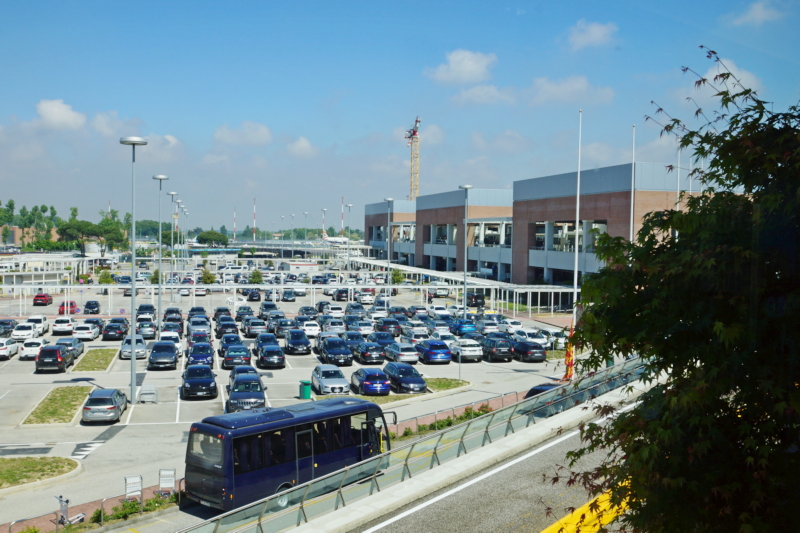
The name „Venice Marco Polo Airport“ is a perfect fit for a man who undertook extraordinarily long journeys as far back as the 13th century.
There is a fascinating historical parallel here: Marco Polo left Venice in 1271 at the age of about 17 and did not return until 1295. Today, millions of travelers begin and end their trips to Venice at Marco Polo Airport.
And there's something else that stands out: Marco Polo represents not only travel itself, but also Venice's connection to the rest of the world. That is exactly the role an international airport fulfills today.
The airport in Tessera opened in 1961 and is actually named after the famous Venetian traveler.
A nice closing sentence:
„More than seven centuries after Marco Polo’s great journey, the international airport in his hometown bears his name. Where Venetian merchants once sought connections to distant lands by ship and caravan, airplanes now take off for destinations all over the world. The name Marco Polo thus continues to this day to serve as a reminder of Venice’s centuries-old history as a trading city and the starting point for great journeys.“
And many tourists have a particularly strong connection to it: the airport, which many visitors to the city experience firsthand upon their arrival in Venice.