The builders of ancient Venice were far-sighted. They knew full well that the large sailing ships of that era, with their protruding yards and sails, could never dock directly at a palazzo without damaging the facades.
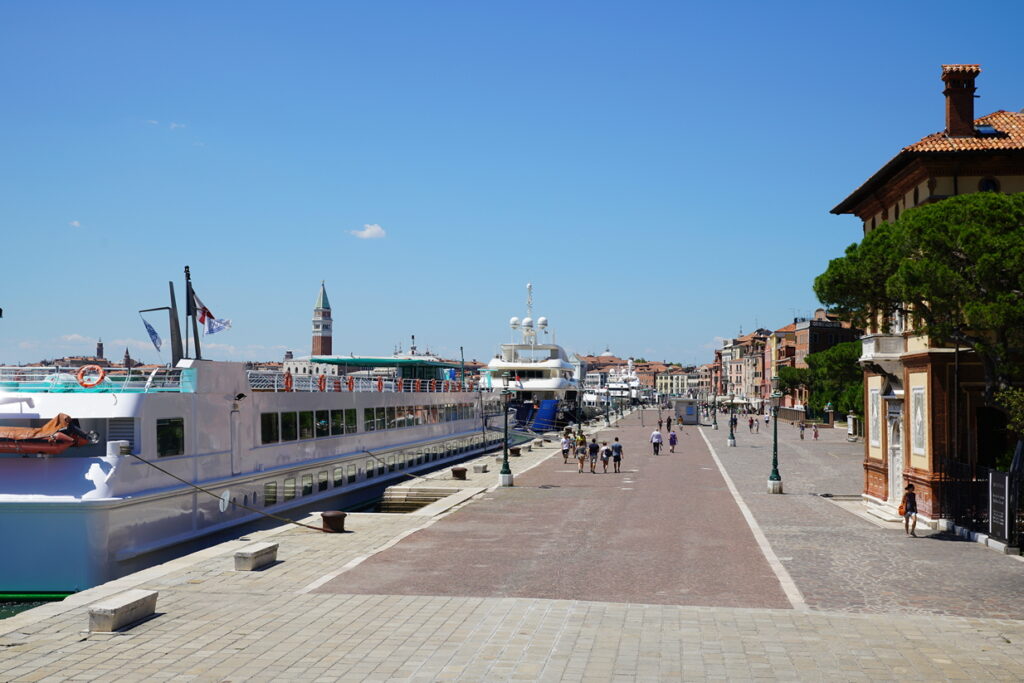
The Solution: Wide Quay Walls as a Buffer Quay walls ranging from 5 to 30 meters wide were built along the entire length of the main entrance for large ships. These provided sailing ships with enough space to dock and unload their cargo, while also serving as a massive protective barrier for the houses behind them.
A look at the city’s plans quickly reveals that the waterfront paths account for 100 % of the entire entry zone. Not only do they protect the houses from the ships themselves, but they also offer a crucial secondary benefit: they serve as a bulwark against storms, floods, and the daily high tide.
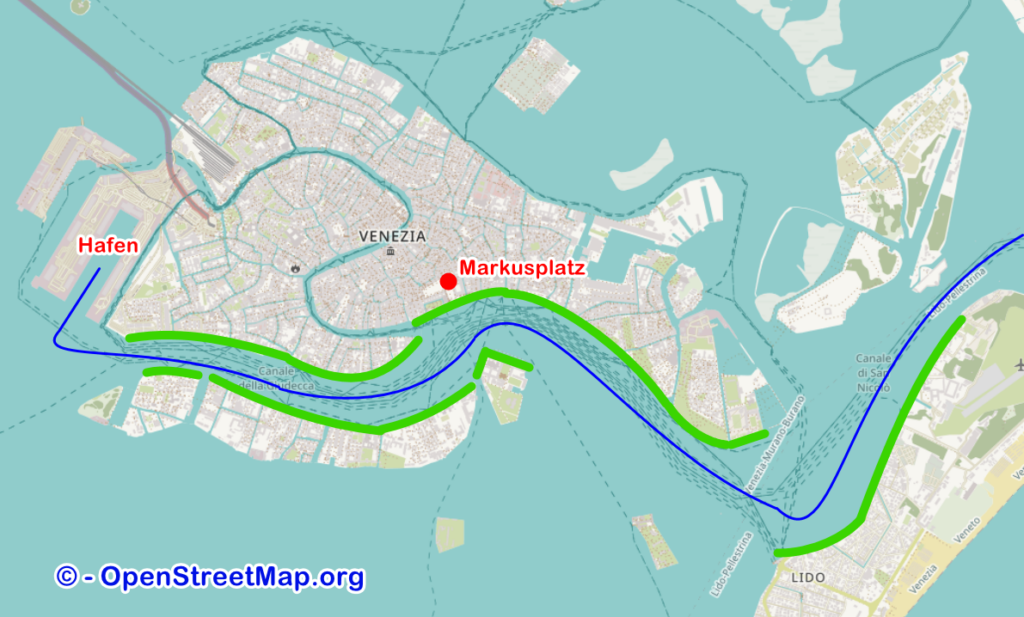
On the map. The blue line shows the ships' route from the lagoon to the harbor. The thick green line is the continuous waterfront path (Foundations) that protects the houses.
A principle that still holds true today Incidentally, this design concept also applies to modern shipping. Cruise ships do not pass directly by a single residential building on their way into the harbor. The entire journey from the sea to the terminal is protected by these wide, safe shore zones.
What used to be purely functional logistics areas are now popular shopping streets for tourists. A well-known example is the magnificent Riva degli Schiavoni, which runs from St. Mark's Square to the Biennale. Likewise, the Zattere in the Dorsoduro district—that long, sunny waterfront path that once served as a landing place for wooden rafts.
The exception: the narrow canals of the Old Town In the countless canals of the historic center—many barely three meters wide—the scene is quite different: Here, the houses stand right in the water. The reason is simple: Large sailing ships could never navigate their way in here. Even maneuvering in the wider Grand Canal was an enormous challenge for sailors.
Interestingly, the Grand Canal—much to the chagrin of many tourists who would like to view the palazzi on foot—has no continuous path along its banks, with the exception of a few short stretches near the Rialto Bridge.
A testament to sound construction I've been visiting Venice regularly for 40 years now. In all that time, I've never seen these waterfront paths here Foundations had to undergo extensive renovation. This is a testament to the exceptionally solid construction of these protected areas, which have withstood the forces of the sea for centuries. In fact, often only the top stones (the trachyte slabs) are repointed as needed, but the foundation beneath is built to last forever.
Conclusion: Historical foresight meets modern challenges
Here one can see the genius of the Venetian urban planners: the wide riverside paths were never merely decorative, but rather a technically necessary protective zone. The fact that these structures require hardly any restoration even after centuries is a striking testament to the engineering prowess of that era.
In today’s debate over wave action and the impact of modern motor vessels on the structural integrity of buildings, it is therefore worth taking a nuanced look: In places where the massive Foundations and Rive While the houses are protected, the palazzi have stood on solid foundations for generations. The real challenge lies instead in the narrow canals within the city, where the houses stand directly in the water and the wide ships of yesteryear never ventured.
Once again, it becomes clear: Anyone who wants to understand Venice today must grasp the logic of its builders of the past.
Behind the Scenes in Venice: What Everyday Life Is Like Here in the City
Overview: Venice Today—A Look Behind the Scenes
Cruise Ships and Public Transportation