Viktor Emanuel II (1820–1878) was the first king of a unified Italy. He was a member of the House of Savoy and became a symbol of the Italian unification movement (the Risorgimento).
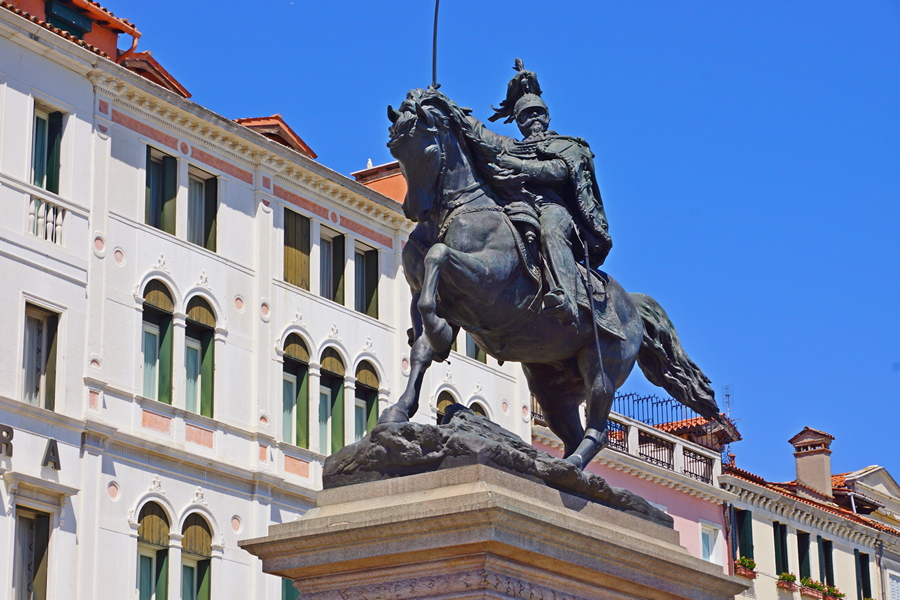
Why is he so important to Venice?
After the fall of the Republic (1797), Venice remained under Austrian rule for decades. Victor Emmanuel II achieved the goal that many Venetians (such as Daniele Manin) had longed for:
- The Liberation: In 1866, after the Third War of Independence, Venice was officially annexed by the Kingdom of Italy.
- Moving In: On November 7, 1866, Victor Emmanuel II made a triumphant entry into Venice. This marked the end of the Austrian era and the beginning of Venice's integration into modern Italy.
What remains of it today?
In Venice, there is a monumental monument and one of the widest streets named in his honor:
1. The Equestrian Statue on the Riva degli Schiavoni
If you walk from St. Mark's Square along the waterfront toward the Arsenale, you'll pass the massive Monument to Vittorio Emanuele II over.
- The Monument: He is depicted on horseback in bronze. At the base of the pedestal, two allegorical female figures can be seen: one represents „oppressed Venice,“ the other „liberated Venice.“.
- An interesting detail: It is one of the few truly large, freestanding equestrian monuments in the city, which underscores its significance.
2. Via Vittorio Emanuele (now Strada Nova)
The wide shopping street in the Cannaregio district originally bore his name. Although it is now usually called „Strada Nova,“ the old names can still be found in some places.
3. St. Mark's Square
After Venice became part of Italy, many symbols of the House of Savoy (the royal coat of arms) were affixed to public buildings, often near the Lions of St. Mark, to demonstrate the new unity.
What are some interesting things for tourists to see today?
For visitors to venedig.com, the topic of Victor Emmanuel II offers some fascinating points of interest:
- Stunning photo opportunities: The equestrian statue on the Riva degli Schiavoni is a spectacular sight, especially in the evening light, with the lagoon as a backdrop.
- Historical Context: It explains to visitors why Venice is part of Italy today and is no longer—as one might assume based on its architecture—an independent city-state or part of Austria.
- A Walk with a View: The monument is located on one of the most beautiful promenades in the world. Here, history blends with the classic Venetian panorama.
Tip for photographers: The equestrian statue on the Riva features very fine details on the accompanying figures (the lions and the female figures). These are perfect for close-ups.