It is „the No. 1 tourist attraction“ in Venice
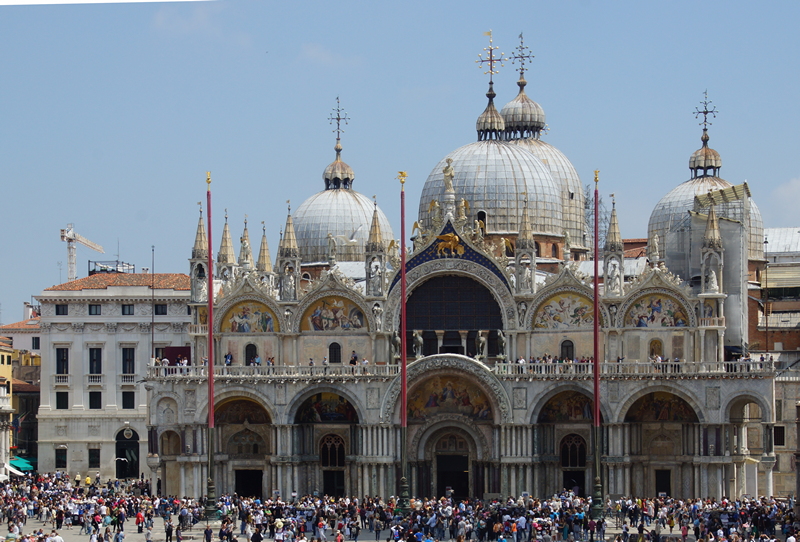
St. Mark's Basilica is the highlight of St. Mark's Square. The church is named after the Apostle Mark, whose remains are buried there. It's hard to imagine visiting the city without seeing the church.
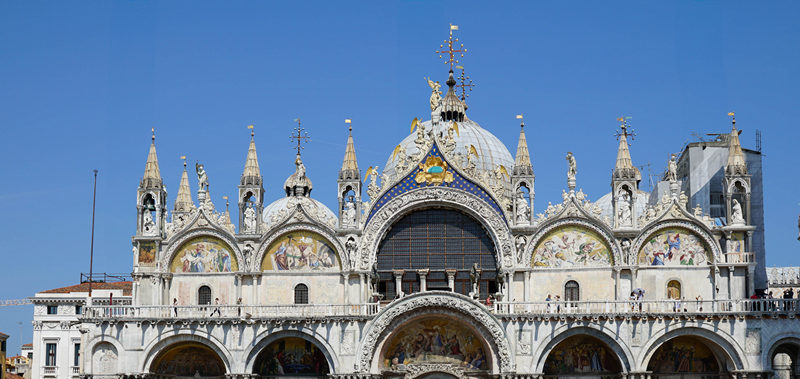
The magnificent St. Mark's Basilica is one of Venice's most important landmarks; it is located on the east side of St. Mark's Square in the San Marco district.
Like all historic districts of the lagoon city, the area around St. Mark's Basilica is also affected by land subsidence, which is why there are several steps leading down from St. Mark's Square to the church entrance.
The origins of St. Mark's Basilica date back to the 9th century. Between 829 and 832, Doge Giovanni I Partecipazio had a palace chapel built to serve as a resting place for the remains of St. Mark the Evangelist.
This first structure was named St. Mark's Church after the city's new patron saint, who
St. Theodore succeeded him as the patron saint of Venice. A major fire destroyed the entire building in 976; the current St. Mark's Basilica was built as its replacement between 1063 and 1094 under Doge Domenico Contarini.
According to legend, upon completion of the construction work, the missing remains of the
St. Mark was rediscovered on June 25, 1094. Until the end of the Venetian Republic in 1797, St. Mark’s Basilica served as a state sanctuary; since 1807, St. Mark’s Basilica has been the cathedral of the Bishop of Venice.
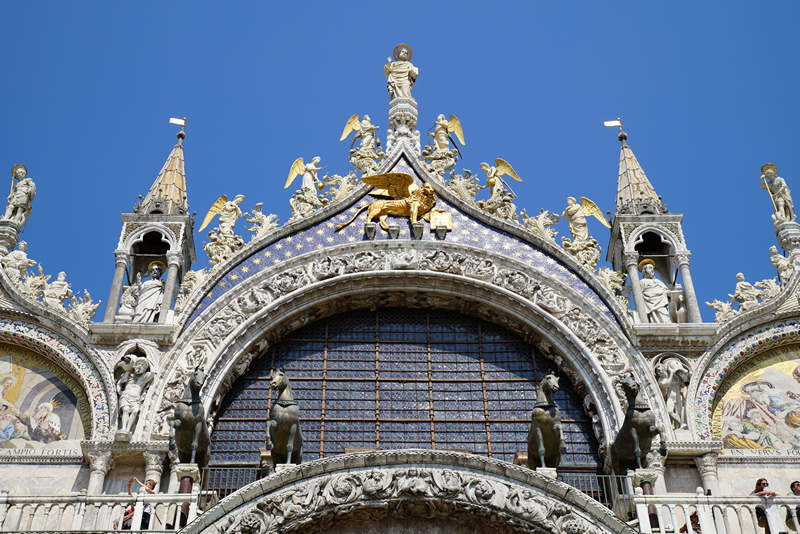
The architecture of St. Mark's Basilica shows a very strong influence from the Byzantine architectural style; the Church of the Apostles in Constantinople may have served as a model for its construction, which attests to the close ties between the two medieval trading centers.
The floor plan of St. Mark’s Church is shaped like an irregular Greek cross, measuring 76.5 m in length and 62.6 m in width. The center and the arms of the cross are covered by a total of five domes, with the central dome at the crossing reaching a height of 45 m.
Modeled after Byzantine architecture, St. Mark's Basilica was given a narthex with eight small domes between 1231 and 1253; the 14th-century additions, however, were built in the Gothic style.
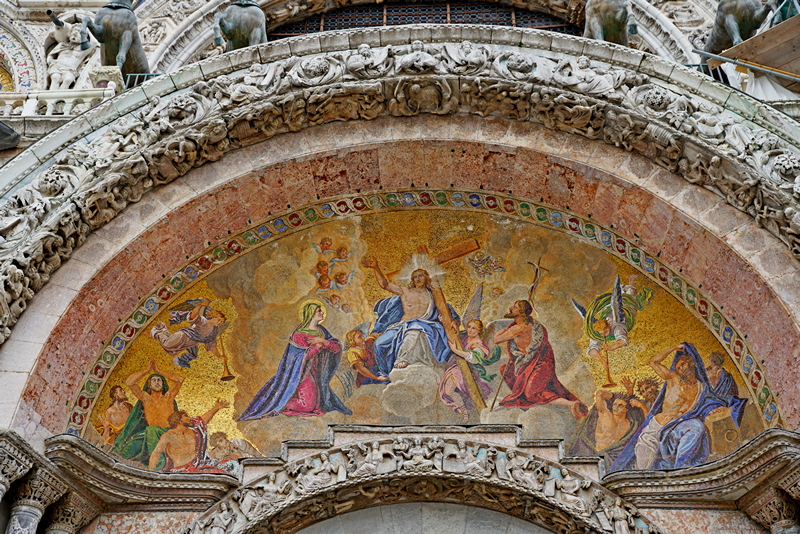
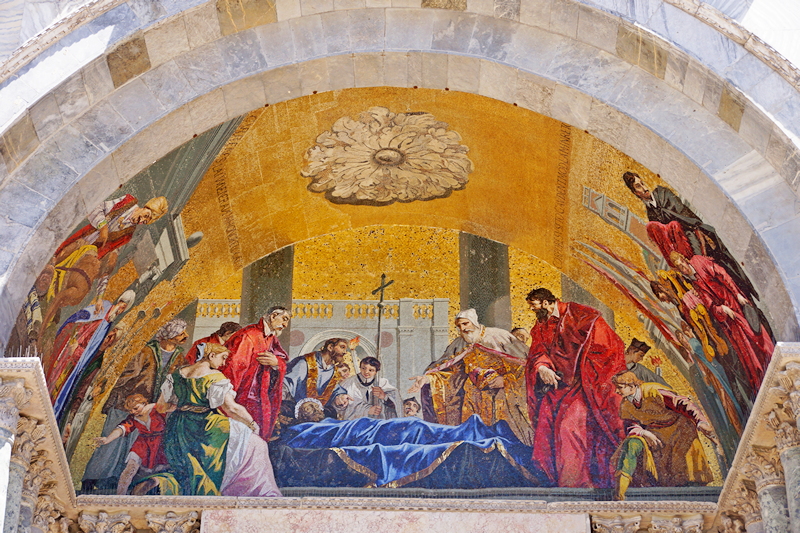
The imposing, two-story main façade facing St. Mark's Square is divided by five portals, whose arches are richly decorated with mosaics.
The mosaics depict mainly biblical and Venetian motifs; of particular note is the northern Porta Sant’Alipio, which features a 13th-century view of St. Mark’s Basilica.
The façade is richly decorated with 2,600 ancient columns and numerous sculptures, such as the Tetrarchs at the Porta della Carta. The decorations are made of marble, serpentine, alabaster, jasper, and porphyry; like the four gilded horses on the upper-floor gallery, they are largely spoils of war from the Fourth Crusade of 1204.
The horses of San Marco were part of an ancient quadriga and date from the 1st century; they were cast in bronze with an extremely high copper content by unknown masters.
To achieve the most natural-looking appearance possible and prevent glare in sunlight, the gold coating features a multitude of engravings.
The interior of the church is divided into three naves by pillars and columns, with the massive pillars supporting the weight of the domes; the arms of the transept are also laid out in three naves.
The interior reflects the wealth and power of the Republic of Venice, which gathered here art treasures from across its entire trading empire.
The mosaics represent a high point in Western mosaic art; together, they cover an area of more than 8,000 m², making them among the largest contiguous mosaic surfaces in the world.
The mosaics depict the entire biblical history of Christianity as well as scenes from the Venetian Republic.
The floor consists of an ornamental marble mosaic, while the upper sections of the walls and the ceiling are covered with colorful glass tiles set against a gold background; this is why St. Mark’s Basilica earned the nickname „Golden Basilica.“.
Other highlights of the interior include the gilded antependium of the high altar (Pala d’Oro), the iconostasis in the choir area, and the double pulpit. St. Mark’s Basilica is open year-round for free tours from 9:45 a.m. to 5:00 p.m. (Sundays from 2:00 p.m. to 5:00 p.m.), during the winter months, the cathedral gates close as early as 4:00 p.m.
In addition to wearing appropriate attire, visitors should observe the ban on photography and videography; visitors are also asked to remain quiet throughout the church, because despite all its splendor, St. Mark’s Basilica also serves a sacred purpose—as a cathedral.
Starting July 1, 2025: No more lines at the entrance

Every visitor must order their tickets in advance online. When placing your order, you must specify a specific date and time within a 30-minute time slot. You must strictly adhere to this appointment. You may arrive up to 5 minutes early or stay up to 5 minutes late within the 30-minute time slot. Otherwise, your ticket will be void!
Current Dates and Prices: As of August 2025
Without an online reservation, you won't be able to no longer in the cathedral. The church leadership has set this effective July 1, 2025.
Your Benefit. There are no more lines that visitors have to stand in. This was often a real ordeal—for adults and even more so for children. And it was hot under the Mediterranean sun, too. The line was very long every day—often stretching all the way to the lagoon.
The downside: You are bound by the date and time you selected. You must adhere to both the date and the time. Otherwise, your ticket will be void. And there are NO refunds.
Prices are as varied as the options for your visit. Prices vary depending on what you want to see in the church.
It starts at €10.00 for a simple, short tour of the church. Of course, you’ll have to pay extra for admission to the museum and the loggia (balcony), which offers a magnificent view of St. Mark’s Basilica, the Piazzetta, and the lagoon. The same applies to a tour of the Pala d’Oro (Golden Altar); children up to 9.9 years old do NOT pay admission. A short guided tour by a tour guide, of course, also comes with a small additional fee.
Note: Please make your reservation well in advance.
There are a great many visitors in the city, especially during peak season and on weekends (Friday through Sunday). And St. Mark’s Basilica remains the main attraction for all visitors. It’s certainly possible that there might still be spots available on the spot. However, this isn’t very likely during peak season or on weekends. Since the price at the door is the same as the online price, you won’t save any money by buying tickets on the spot—and you’ll just risk not being able to get in.
You can purchase St. Mark's Cathedral tickets online at this link.
This includes:
- Skip-the-line ticket for St. Mark's Basilica
- Access to the ground floor
- Digital Audio Guide for St. Mark's Basilica
- Access to the rooftop terrace
- Access to the St. Markus Museum
- Access to the Pala D’oro

Free cancellation up to 24 hours before your visit, with a full refund.
Our tip: Summarize the 3 most popular tickets
This includes
- Skip-the-line admission to St. Mark's Basilica
- Skip-the-line admission to St. Mark's Bell Tower
- Skip-the-line admission to the Doge's Palace
- Admission Ticket for the Venice History 3D Gallery
- Audio Guide
Free cancellation up to 24 hours before your visit, with a full refund.