Information about the city's most important landmark

The Doge's Palace (Palazzo Ducale) in Venice is one of the most important secular buildings in the lagoon city; it is located on the Piazetta San Marco, right next to St. Mark's Basilica, with which it formed the political and religious center of Venice for centuries.
For over 900 years, the Doge's Palace served as the residence of a total of 120 doges of the Republic of Venice, who held council meetings here, received state visits, and hosted lavish celebrations; the palace also housed courtrooms and prison cells.
As early as the beginning of the 9th century, a residence was built on the „Rivo Alto“ as the predecessor to the Doge’s Palace. However, the wooden building burned to the ground in 976 along with the first St. Mark’s Basilica; a new, fortress-like structure with towers, a moat, and a surrounding wall was also destroyed.
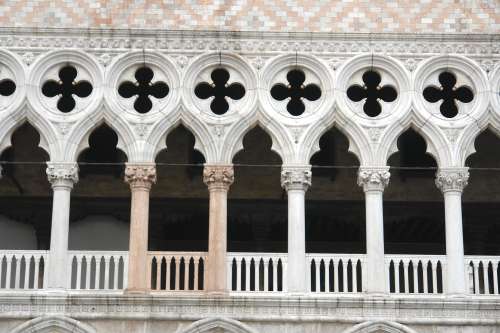
Doge Sebastiano Ziani laid the foundation for the actual Doge’s Palace at the end of the 12th century with a three-winged complex that included, among other things, the Palace of Justice and the assembly hall for the „Great Council.“ Under Doge Domenico Gradenigo, a renovation in the Gothic style began in 1340, which continues to define the appearance of the Doge’s Palace to this day.
Further construction work continued until the mid-15th century, resulting in a building that presents a unique blend of styles, combining early Oriental elements with Gothic and Renaissance influences. After the fall of the Venetian Republic, several government offices and institutions were housed in the palace; since 1923, the complex has been open to the public as a museum.
Visitors pay an admission fee and enter through the Porta del Frumento (Wheat Gate) on the south side near the boat dock (Molo); Opening hours are 8:30 a.m.–7:00 p.m. (summer) and 8:30 a.m.–5:30 p.m. (winter).
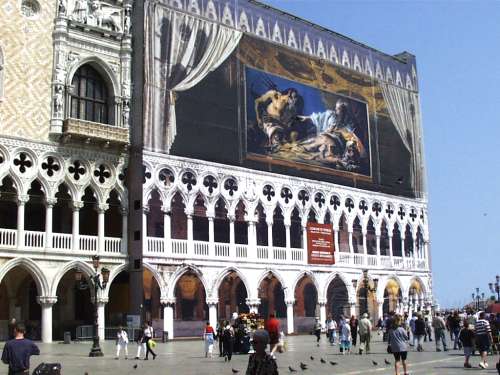
In the history of Western architecture, the architecture of the Doge’s Palace is considered a unique, often-copied example of Gothic secular architecture. The entire four-winged complex rests on tree trunks and foundations made of Istrian stone; the buildings are constructed of brick and completely clad in marble.
The south and west facades have three stories, while the east side has four; the low, rather unassuming north wing adjoins St. Mark’s Basilica directly. The south facade facing the Molo and the west facade facing the Piazetta San Marco are particularly magnificent; they are divided into a lower colonnade, a middle loggia with a colonnade, and an upper story punctuated by large windows.
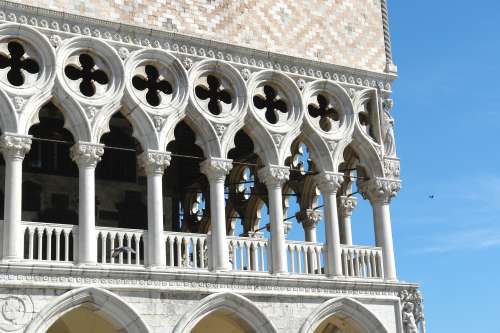
In addition to the predominant Venetian Gothic style (sculptures, ornaments, columns, pointed arches, custom-made windows), there are also Byzantine stylistic elements such as the crenellated crown and the pink-and-white diamond-patterned decoration on the upper floor.
On the middle floor of the west facade are two reddish columns, between which death sentences were announced to the crowd in the Piazetta. While the people were allowed to enter the Doge’s Palace through the Porta del Frumento, entry through the Porta della Carta was prohibited.
This portal between St. Mark's Basilica and the Doge's Palace is a masterpiece of Venetian architecture. The rich sculptural decoration, the buttresses with pinnacles, and the ornate pointed-arch windows were executed in the Late Gothic style; they demonstrate the self-confidence and power of the Republic of Venice.
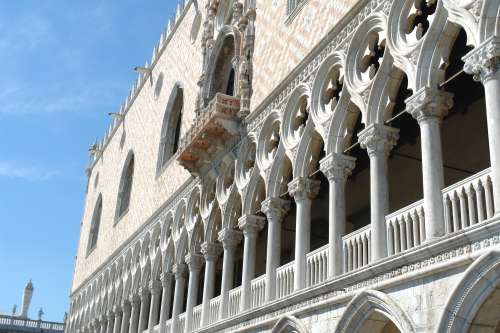
The Porta della Carta and the adjoining six-bay passageway „Arco Foscari“ lead into the inner courtyard directly to the „Scala dei Giganti“ staircase, where the enthronement of the new Doge took place. In addition to a fountain, the small Piazza dei Senatori, and the Chapel of San Nicolò, the courtyard contains several staircases (including the Scala d’Oro) that lead to the interior rooms on the upper floors.
The 54-meter-long „Hall of the Great Council“ is particularly worth seeing; this is where some 1,000 nobles gathered to elect the Doge. The hall’s windows offer a sweeping view of the lagoon, while the entire back wall is dominated by Jacopo Tintoretto’s painting „Paradise“; the work is considered the second-largest oil painting in the world.
One of the most fascinating parts of the Doge’s Palace are the prison cells, which were located beneath the lead-covered roof (Piombi) and on the ground floor (Pozzi). The heat in the Piombi was unbearable, while the Pozzi were often flooded during high water; the conditions in the cells were described by a famous inmate who managed to escape—Casanova.
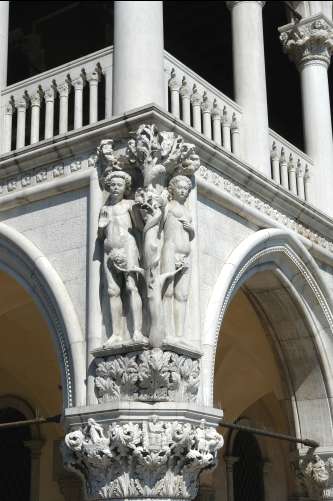
The figures at the corner of the Doge's Palace depict Adam and Eve.
Admission costs €35 per person and is valid at all three museums on St. Mark's Square. Seniors pay €15 per person. The Doge’s Palace is normally open from 9:00 a.m. to 6:00 p.m. during the winter and from 9:00 a.m. to 7:00 p.m. during the summer. There is a separate entrance for customers who don't want to wait in line at the register but have made a reservation online.
You can purchase your Doge's Palace ticket online at this link.
You do NOT have to wait in line on site.

You pay NO processing fees. The price is the same as it is in-store.
The Correr Museum:
Empress Sissi's Residence in Venice
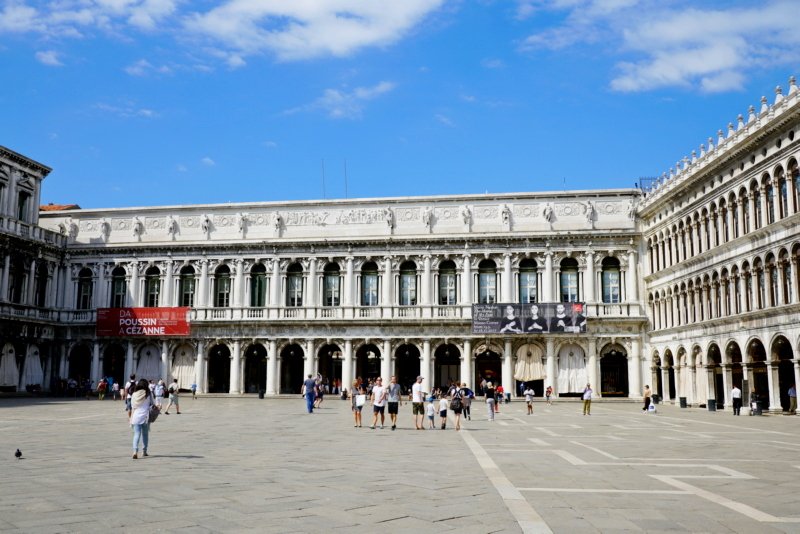
The ticket for the Doge's Palace also allows you to visit the Correr Museum (also located on St. Mark's Square). The Correr Museum, or Museo Civico Correr, is located directly on St. Mark’s Square in the Napoleonic wing of the Procuratie, the medieval building authority of the city of Venice. It is a very large and important municipal museum dedicated to the history of the city. The Correr Museum is named after Teodoro Correr, a renowned son of Venice who lived in the city from 1750 to 1830 and bequeathed his valuable art objects, books, and manuscripts to the city upon his death. Visitors can also tour the rooms where the Austrian emperors stayed during their visits to Venice—rooms in which Emperor Franz Josef and Sissi also spent the night on several occasions.
Everyday life here in Venice:
Line at the entrance to the ticket office
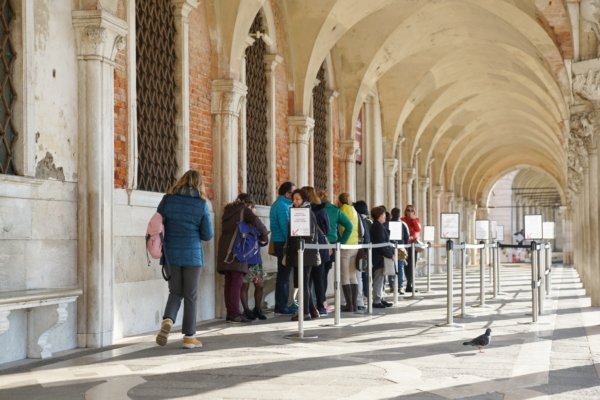
There are four entrances to the Doge's Palace: in the photo, the entrance on the left leads to the ticket office. In our experience, there is often a line here. The other two entrances are for groups and pre-registered guided tours.
Note: Online tickets cost the same as tickets purchased on-site: €35.00 per person. That’s why we recommend that if you want to visit the Doge’s Palace, you book your ticket in advance from the comfort of your own home.
Currently, the entrance for visitors with an online ticket is on the west side of the Doge's Palace. From the Pizzetta, you can quickly reach the Doge's Palace.
Input 1 and Input 2
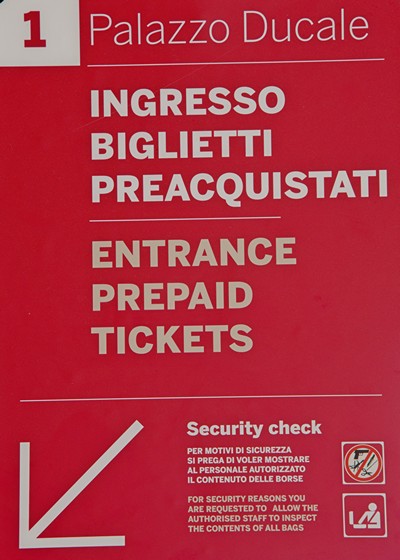
Entrance 1 is for all customers who do NOT want to wait in line and have already reserved their tickets online in advance. This entrance is located on the west side of the Doge's Palace.
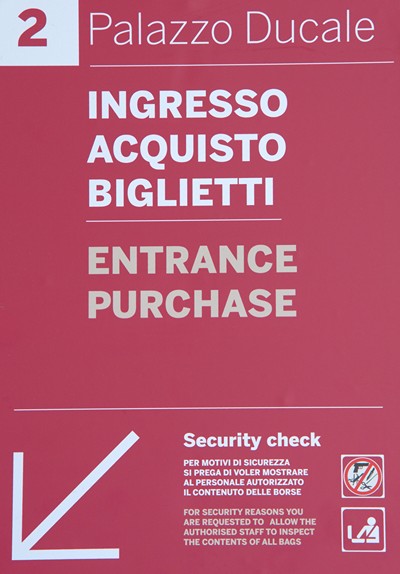
Entrance 2 is for all customers who want to buy a ticket on the spot. This entrance is located on the south side of the Doge's Palace (facing the lagoon).
Decide for yourself: The price is €30.00 each.
Whether you make a reservation online in advance or pay in person.
You pay NO processing fees. The price is the same as it is in-store.
Doge's Palace Hours and Prices, April 2026
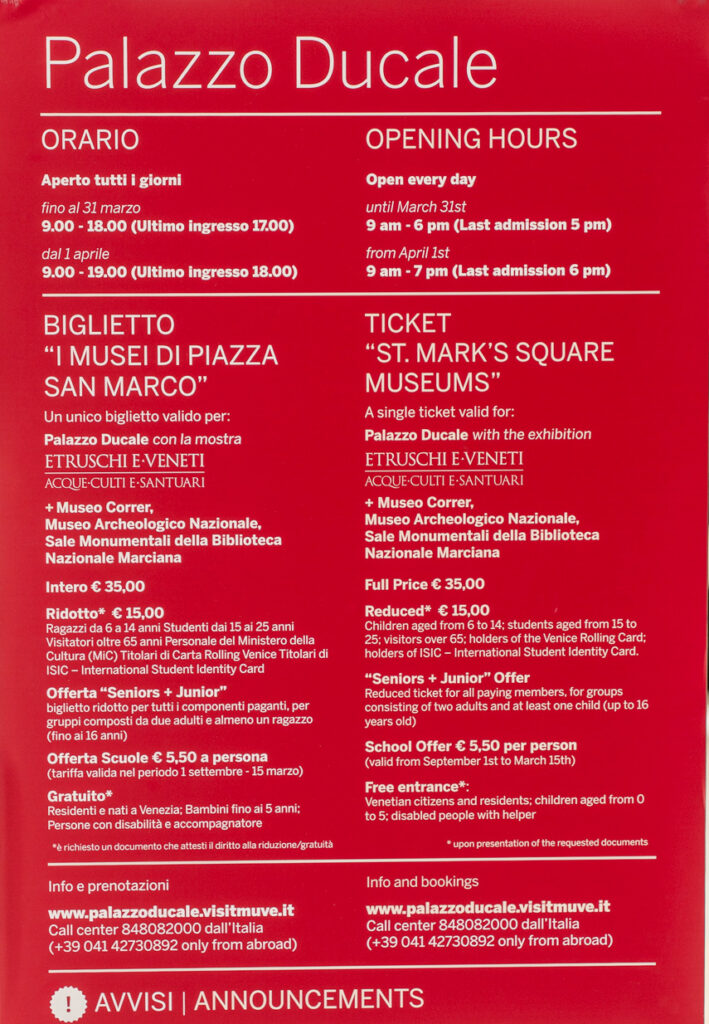
This price list is currently (April 2026) on display at the Doge's Palace
More Information
Price – Admission to all four museums in Piazza San Marco: €30.00 per person.
As far as we know, there are no tickets available for the Doge's Palace alone.
Seniors – Seniors over the age of 65 receive a discount.
15.00 € per person over the age of 65.
Seniors are asked to have their ID ready upon entry.
Validity – One admission ticket is valid for the Doge's Palace and the 3 other
City Museums on St. Mark's Square:
– Correr Museum
– The National Archaeological Museum
– The monumental halls of the National Marciana Library
The ticket is valid for 2 years from the date of the online purchase and
Each ticket allows one visit to the Doge's Palace and the other museums.
Free admission – Free admission for children 5 and under
Free admission for people with disabilities and their companions
Doge's Palace
Address
Doge's Palace (Palazzo Ducale)
1 San Marco Square,
30124 Venice
Hours of Operation
April 1 through October 31, from 9:00 a.m. to 6:00 p.m.
From November 1 through March 31, from 8:30 a.m. to 5:30 p.m. (last admission at 4:30 p.m.)
Closed – on December 25 and January 1
Correr Museum
Address
Correr Museum
52 Piazza S. Marco,
30124 Venice
Hours of Operation
April 1 through October 31, from 10:00 a.m. to 7:00 p.m. (ticket office open from 10:00 a.m. to 6:00 p.m.)
From November 1 through March 31, from 10:00 a.m. to 5:00 p.m.
(Ticket office open from 10:00 a.m. to 4:00 p.m.)
Closed – on December 25 and January 1
The monumental halls of the National Marciana Library
Address
The National Archaeological Museum
San-Marco 52,
30124 Venice
Hours of Operation
April 1 through October 31, from 10:00 a.m. to 7:00 p.m. (ticket office open from 10:00 a.m. to 6:00 p.m.)
From November 1 through March 31, from 10:00 a.m. to 5:00 p.m.
(Ticket office open from 10:00 a.m. to 4:00 p.m.)
Closed – on December 25 and January 1
The National Archaeological Museum
Address
The National Archaeological Museum
San-Marco 52,
30124 Venice
Hours of Operation
April 1 through October 31, from 10:00 a.m. to 7:00 p.m. (ticket office open from 10:00 a.m. to 6:00 p.m.)
From November 1 through March 31, from 10:00 a.m. to 5:00 p.m.
(Ticket office open from 10:00 a.m. to 4:00 p.m.)
Closed – on December 25 and January 1