Violinist and Catholic priest from Venice, Italy. He is one of the most important composers of the Baroque period. His life story is closely linked to specific buildings, churches, and musical institutions in Venice.
The Baptistry: San Giovanni in Bragora
This is where it all began. Vivaldi was baptized in this church in 1678.
- Location: Castello, Campo Bandiera, and Moro.
- The motif: The baptismal chapel is still preserved in the church, and a copy of his baptismal record can be seen in the church register. This is a very powerful „sign of life.“.
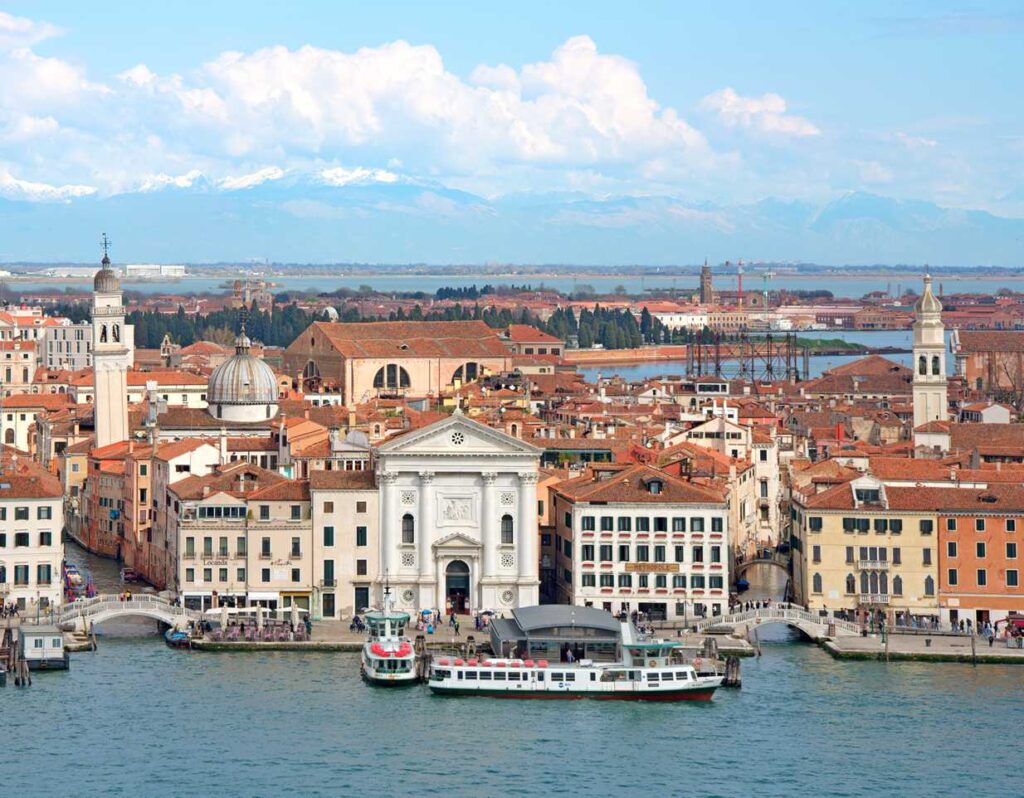
His place of work: The Pietà (Santa Maria della Visitazione)
Vivaldi was „Maestro di Violino“ at the Pietà Hospital, an orphanage. Under his guidance, the girls there became world-famous musicians.
- Location: Riva degli Schiavoni (near St. Mark's Square).
- The motif: Although the current church (Santa Maria della Visitazione) was rebuilt shortly after his death, it stands exactly where he composed and taught for decades. A commemorative plaque on the exterior wall honors his memory.
His birthplace: Near the Church of San Giovanni Battista in Bragora
Vivaldi was born in a house near the church (Sestiere Castello).
- Location: Campo San Giovanni in Bragora.
- The motif: There is a commemorative plaque there that states that he was born in this neighborhood.
The Vivaldi Museum (now located in the Hotel Metropole)
The Hotel Metropole stands on the site where parts of the Ospedale della Pietà once stood.
- Location: Riva degli Schiavoni, 4149.
- The motif: Inside the hotel (you can often ask politely or stop in for a coffee), there is a small but lovely exhibition of antique musical instruments from Vivaldi's time.
Place of ministry as a priest: San Geminiano (no longer exists)
Vivaldi was known as „The Red Priest“ (The Red Priest) is known. He was ordained a priest at the Church of San Geminiano.
- Location: This church used to stand directly across from St. Mark's Basilica (where the Napoleonic Wing, with the entrance to the Museo Correr, is located today).
- The motif: Here you can take a photo of St. Mark's Square from the vantage point of the Museo Correr and mention that the church where the „Red Priest“ began his ministry once stood here.
Tip for a photo project:
The church, in particular San Giovanni in Bragora is a gem. It's often less crowded than other churches and offers a very intimate atmosphere for taking photos of Vivaldi's early works.
Palazzo Pisani
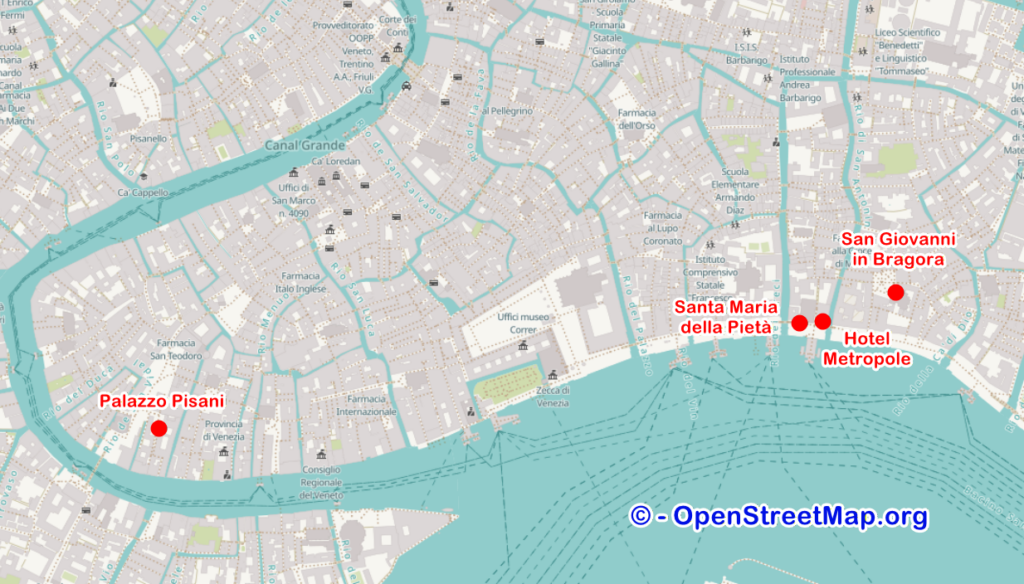
- Currently the headquarters of the Venice Conservatory of Music.
- There, you'll also find Vivaldi Manuscripts and Memories of His Musical Tradition maintained.
Interesting
After his death, Vivaldi's music fell into obscurity for a long time. It wasn't until 20th century It was rediscovered and is now very popular around the world.
Antonio Vivaldi – The Major Milestones of His Life
- Vivaldi was born in Venice on March 4, 1678. His father, Giovanni Battista Vivaldi, was a barber and violinist who later played in the orchestra of St Mark’s Basilica.
- Antonio likely received a significant portion of his musical training from his father. He became a priest, but was best known as a violin virtuoso, composer, and music teacher.
- He spent most of his professional life at the Ospedale della Pietà, a Venetian institution where girls received musical training.
- He composed hundreds of concertos, numerous operas, and sacred music. Today, he is best known for the Four Seasons.
- Vivaldi died in Vienna on July 28, 1741.
The Most Important Vivaldi Sites in Venice
San Giovanni in Bragora – the church where he was baptized
It was here that Vivaldi received the formal baptismal rites on May 6, 1678, after having been baptized in an emergency at home immediately following his birth. Photograph the exterior facade, the campo, the interior, the baptismal font, and especially the commemorative plaque inside the church.
Chiesa della Pietà – Santa Maria della Visitazione – the famous Vivaldi Church
Starting in 1703, Vivaldi worked for many years at the Ospedale della Pietà as a violin teacher and composer. However, construction of the present-day church did not begin until 1745, after his death. Photographs: the facade, the interior, the galleries, and the connection to the former Pietà. This is one of the most important chapters in his biography.
Former Ospedale della Pietà – Site of Today's Hotel Metropole
The former Ospedale extended across the area now occupied by the Pietà and the hotel. This was a central part of Vivaldi’s working world. Take photos of the hotel building, details of the facade, calle della Pietà, and the Rio della Pietà. The spatial relationships are particularly interesting.
St Mark’s Basilica—his father's workplace
Giovanni Battista Vivaldi, Antonio’s father, played the violin in the famous orchestra of St Mark’s Basilica. Photographing: St Mark’s Basilica, particularly details associated with the Venetian musical tradition. We will see later how Antonio was musically influenced by his father.
San Pietro di Castello – Vivaldi's Religious Education
Vivaldi was ordained in the area of what was then the Patriarch's Palace. Unlike Casanova, he was actually ordained as a priest. Photo opportunities: the church, the former Patriarch's Palace, and the expansive campo.
Teatro Sant’Angelo – Vivaldi as an Opera Composer
Vivaldi was not only a composer of violin concertos but was also deeply involved in the opera world. Beginning in 1713, he was associated with the Teatro Sant’Angelo. The theater no longer exists today. Photo: Campo Sant’Angelo and the theater’s historic site
Campo San Filippo e Giacomo – a documented settlement
A rental record from 1719 shows that Vivaldi lived here in a house that belonged to the San Zaccaria monastery. Take photos of the campo and its historic houses.
Museo della Musica – Historical Musical Instruments
Historic string instruments are on display in the former Church of San Maurizio. While it was not a central part of Vivaldi’s personal life, it offers an interesting insight into the history of Venetian instrument-making.
Two Additional Vivaldi Motifs
The Birthplace or, more precisely, his birthplace: According to biographical research, Vivaldi was born in the Bragora area. Other sources cite San Martino di Castello.
The residential buildings on campo San Filippo e Giacomo: Here is a particularly interesting research paper by Micky White. It even identifies the houses where the Vivaldi family lived between 1705 and 1722, based on historical rent records and photographs. This is an excellent subject for documentaries.
Antonio Vivaldi – His Background and Family
Both Casanova and Vivaldi had fathers who were professionally involved in music and theater. However, they belonged to different generations and grew up in different family circumstances.
His parents
Antonio Lucio Vivaldi was born on March 4, 1678, in Venice. His parents were Giovanni Battista Vivaldi and Camilla Calicchio. They had been married on June 11, 1676.
His father: Giovanni Battista Vivaldi (c. 1655–1736)
Giovanni Battista came from a family in Brescia, Lombardy. As a child, he moved to Venice with his widowed mother and his older brother. He first trained as a barber. At that time, the role of a barber was broader than that of a modern hairdresser: barbers could also perform basic medical and personal care tasks.
His true talent, however, lay in music. He became a respected violinist and, in 1685, was appointed to a permanent position in the St Mark’s Basilica orchestra. This was a significant professional achievement, as the St Mark’s Basilica orchestra was one of the most renowned musical institutions in Europe.
His mother: Camilla Calicchio (1653–1728)
Camilla also came from a family of artisans. Her father, Camillo Calicchio, was a tailor and originally came from Pomarico in the southern Italian region of Basilicata. Her mother, Zanetta Temporini, was Venetian. Much less is known about Camilla’s personality and daily life than about her husband. There is no reliable evidence that she was active as a musician herself.
Was Vivaldi an only child?
No, quite the opposite.
According to research by musicologist Michael Talbot, Antonio was the second child in a family with a total of ten children. Their first child, a daughter, died as an infant. After that, eight more siblings were born.
Older biographical accounts sometimes mention only nine children. There are discrepancies in the count because children who died at a young age were not always included.
So the family was large. It stands to reason that the household was quite bustling. What we don't know, however, is: How harmonious family life was, how the siblings got along with one another, or what parenting methods the parents used. Such personal details are scarcely documented.
Where did the family live in Venice?
The family lived in the Castello district, in the parish of San Giovanni in Bragora. Research by Karl Heller and other Vivaldi biographers places the family’s early home on what was then known as Campo Grande, now Campo Bandiera e Moro. The family remained in the Bragora area until 1705.
This is particularly interesting for a photography trip because this isn't just any church—it's the immediate neighborhood where he grew up.
An Unusual Beginning: Vivaldi's Emergency Baptism
On the day of his birth, Antonio was baptized in an emergency at home by the midwife Margarita Veronese. The baptismal record explicitly cites danger to his life as the reason. It was not until May 6, 1678, that the remaining church baptismal rites were performed at San Giovanni in Bragora.
According to his own accounts, Vivaldi later suffered from chest discomfort that made it difficult for him to walk. It is often assumed that he had asthma. However, it is not possible to make a definitive medical diagnosis in retrospect.
There is also the oft-repeated story that an earthquake shook Venice on the day of his birth, prompting his mother to demand an immediate baptism. This explanation is not sufficiently supported by historical evidence. For a biography, I would therefore stick to the documented reason for the emergency baptism: the fear that his life was in danger.
The Father as a Musical Role Model
For me, this is the key difference from Casanova's childhood. Casanova's parents were often on the road as actors. Vivaldi, on the other hand, grew up in a family where his father held a permanent position as a musician in Venice.
Giovanni Battista was not only a violinist at St Mark’s Basilica. He also played in theater orchestras and was a member of a Venetian musicians' association. It is considered very likely that Antonio learned to play the violin from his father.
Another interesting fact: Giovanni Battista had red hair, which is why he was called Rossi. Antonio inherited this hair color and, later in life, as a priest, earned his famous nickname, „Il Prete Rosso“—the Red Priest.
This makes it clear that Vivaldi's musical career did not begin by chance. His father opened the door to the professional music world for him.
Vivaldi did not come from a noble or particularly wealthy family. His roots lay in the Venetian artisan and musical community. His father rose from the position of barber to become a professional musician at San Marco. Building on this foundation, Antonio was able to develop a career that eventually made him famous far beyond Venice.
Antonio Vivaldi – Childhood, Musical Training, and the Path to the Priesthood
Vivaldi’s childhood holds a remarkable story: a boy whose life was in danger immediately after birth went on to become one of Europe’s most renowned violin virtuosos. At the same time, he embarked on a career in the church.
At first glance, that sounds contradictory. But if we look at living conditions in Venice from around 1680 to 1700, a lot of things become clearer.
A boy at risk of health problems
Antonio was born on March 4, 1678. Because there were fears for his life, he received an emergency baptism on the very day of his birthday. It was not until May 6 that the full baptismal rites were performed at San Giovanni in Bragora. Even as an adult, Vivaldi reported health problems. He described them as “strettezza di petto,” meaning a tightness or constriction in the chest. Today, it is commonly believed that he suffered from asthma. However, this diagnosis cannot be proven with certainty.
It is important to note that we do not know whether he was constantly ill throughout his childhood or to what extent his ailments actually limited him at the time. The sources are too sparse to provide that information.
His first music teacher was probably his father
Giovanni Battista Vivaldi was a professional violinist. He had been a member of the St Mark’s Basilica orchestra since 1685. Antonio was seven years old at the time.
It’s easy to imagine that music was often played in this household. Unlike most children, Antonio had direct access to a professional musician, to instruments, and to one of the city’s most important musical institutions.
Researchers believe that his father taught him to play the violin. It has not been definitively proven whether Antonio also had another teacher. The famous Venetian composer Giovanni Legrenzi is occasionally cited as his teacher; however, there is no clear evidence to support this.
The key factor was probably not a single extraordinary moment in a lesson, but rather years of musical training within the family.
When did his extraordinary talent become apparent?
Here we must distinguish between the young Antonio and the later, famous Vivaldi.
We have no reliable accounts of a six-year-old child prodigy who was already captivating all of Venice. But by the time he was a teenager at the latest, Antonio had advanced so far musically that he was able to stand in for his father during performances. His work as an additional violinist at San Marco is documented for the Christmas season of 1696. Antonio was 18 years old at the time. This provides us with an important historical reference point: Even before he became a priest, he was already active in Venice's professional music scene.
That says much more about our life story than the usual tale of the mysterious child prodigy.
Why should Antonio become a priest?
That is perhaps the most interesting question of his youth. Today, we usually think of a career in the priesthood as a personal religious calling. In 17th-century Venice, however, education, social status, and financial security also played a major role.
For a family without noble origins, a career in the clergy could offer advantages to a son: an education, social prestige, and possibly a steady income. Musicologist Michael Talbot explicitly notes that this was a common path for sons from less affluent Venetian families. We do not know whether Antonio himself necessarily wanted to become a priest. Nor is the frequently expressed assumption that his father made this decision supported by any clear personal statement.
It would therefore be wrong to claim that his parents made him a priest against his will.
Music and priestly formation took place at the same time
That is the real key to his youth. Vivaldi did not have to choose between the church and music. In Venice, the two careers were compatible. In September 1693, at the age of 15, he received the tonsure, an ecclesiastical rite signifying his admission to the clergy.
This was followed by several stages of ecclesiastical training and ordination. Unlike a student at a modern seminary, Vivaldi received his training within the context of Venetian churches and clergy. Throughout this time, he remained musically active.
Why did the priest become, above all, a musician?
After his ordination, Vivaldi did indeed celebrate Mass at first. Later, however, he largely ceased this activity. In a letter dated 1737, he explained that chest pains had prevented him from celebrating Mass regularly. He continued his musical work, however.
This has given rise to a story that remains popular to this day: Vivaldi is said to have suddenly run into the sacristy during a Mass to write down a musical inspiration. This anecdote is not a verified historical fact. While it fits perfectly with the image of the obsessed composer, it should not be taken as an explanation for his behavior.
His own statements about his health problems, on the other hand, are documented. The fact that he was able to perform, compose, and travel despite these problems has led historians to differing assessments. There is no clear-cut answer.
Another key factor is: Vivaldi did not simply give up his priesthood. He remained a priest while also becoming an internationally renowned musician.
Former Church of San Geminiano
Vivaldi worked here during his early religious training. The church stood at the western end of St Mark’s Square and was demolished in 1807. Today, the Ala Napoleonica, part of the Museo Correr, stands on that site.
San Pietro di Castello
Here, on the grounds of the former Patriarch's Palace, Vivaldi was ordained. The Patriarch's Palace, the church, and especially the chapel adjacent to the palace, to the extent that they are accessible
San Giovanni Novo (San Giovanni in Oleo)
This church was associated with Vivaldi’s later religious education. The building still stands today, though it was significantly remodeled after his lifetime. The brick facade and the small campo.
Key Milestones in Vivaldi's Life
Vivaldi’s story cannot simply be described as the triumph of a musical genius over a serious illness. We know too little about his childhood for that. What can be clearly demonstrated, however, is the unique interplay of three circumstances:
- A father with an exceptional network in the music world, early professional training, and a career in the church that opened up social opportunities for him without hindering his musical pursuits.
- And so, in 1703, we find ourselves at a turning point: In March, Vivaldi is ordained a priest, and in September, he is appointed violin teacher at the Ospedale della Pietà.
- That is where the next major chapter of his life begins. And that is also where one of the most remarkable stories in European music history awaits us: how young women in a Venetian care facility became an orchestra of international renown.
Antonio Vivaldi—His Years at the Ospedale della Pietà
The year is 1703. Antonio Vivaldi is 25 years old, a newly ordained priest, and already a highly skilled violinist. And now begins the chapter of his life that would later make him world-famous.
1703: A young priest becomes a violin teacher
In September 1703, Vivaldi was appointed to the position of violin maestro, that is, as a violin teacher, at the Ospedale della Pietà in Venice. It was no ordinary music school.
The Pietà was an institution for taking in and caring for children, especially foundlings. It was one of the major Venetian welfare institutions. Some children were cared for there only temporarily. Others spent a large part of their lives at the institution.
This presented Vivaldi with an unusual opportunity: he was able to train young people musically over the course of several years and try out his own compositions with them.
Who were these girls?
The Pietà took in children of both sexes. However, the musical education for which the institution became famous was primarily reserved for a select group of girls and women, known as the figlie di coro.
Some of these female musicians received training at a level that was otherwise accessible to only a few people. They learned not only to sing, but also to play the violin, cello, oboe, bassoon, and other instruments. Some went on to become exceptionally talented musicians.
In this context, we should avoid a common misconception: The Pietà was not a convent, and the female musicians were not automatically nuns. It was a charitable institution with a religious character, strict rules, and a remarkable musical tradition.
Why was the *Pietà* so important to Vivaldi?
For a composer, this position was nearly ideal. He had an ensemble that rehearsed regularly. He was able to develop new musical ideas, try out difficult passages, and specifically nurture the skills of individual musicians.
The Pietà, in turn, benefited from his virtuosity and his compositions. The concerts drew large crowds. Visitors to Venice spoke enthusiastically about the performances.
It is noteworthy that during church services and concerts, the female musicians often played behind bars or screens in the galleries. The audience could hear them without necessarily being able to see them.
That was part of the social conventions of the institution at that time. For a biography, this is much more interesting than simply noting that Vivaldi was employed there.
1704–1708: Vivaldi develops as a composer
As early as 1704, his responsibilities at the Pietà were expanded. In addition to the violin, he also taught other string instruments, particularly the viola all’inglese. His work was evidently appreciated: his annual salary was increased from 60 to 100 ducats. A resolution by the administration dated August 17, 1704, documents this.
But Vivaldi didn't just want to teach music. He began publishing his own compositions.
1705 – His first printed works
His first published collection, Opus 1, consisted of twelve trio sonatas. These were not yet the famous violin concertos with which we associate him today. But it was an important step: his music could now be performed outside of Venice as well.
Back then, printers and music publishers were just as important to a composer as sound recordings and digital releases are today: they made it possible to disseminate his works beyond the immediate performance venue.
1709: The First Professional Setback
And then something unexpected happened. The Pietà's administration did not renew Vivaldi's contract in February 1709.
Why?
In the past, people speculated whether the person had been dissatisfied with their work or behavior. Recent research, however, considers economic reasons to be more likely.
The Pietà had to keep its expenses under control, and Vivaldi's position was not a tenured, lifetime appointment. It is noteworthy that he was rehired as early as 1711. Apparently, there was still a need for his skills.
Incidentally, this reveals a less romantic side of a musician's life in the Baroque era: even a highly talented musician was dependent on contracts, patrons, and the decisions of his employers.
1711: Vivaldi's music gains international recognition
In 1711, a collection of twelve concertos was published in Amsterdam under the title *L’estro armonico*—roughly „Harmonic Inspiration.“ This publication marked a major step forward in Vivaldi’s career. The concertos spread beyond Italy. Even Johann Sebastian Bach studied them closely and arranged several concertos for other instruments.
This means that while Vivaldi was composing and teaching in Venice, musicians north of the Alps were already studying his works. His influence thus extended far beyond the lagoon city.
1713: Vivaldi Discovers Opera
Now his career takes another turn. Up to that point, we know him primarily as a priest, violin teacher, virtuoso, and composer of instrumental music. In 1713, his first opera, *Ottone in villa*, was performed in Vicenza.
That same year, he and his father took on responsibilities at the Teatro Sant’Angelo, a Venetian opera house. Vivaldi was not merely a composer there; he was also involved in organizing performances, selecting works, and managing the financial risks associated with running the theater.
This is an important new aspect of his personality: Vivaldi was also an entrepreneur. And back then, an opera house was a business. Singers had to be hired, costumes had to be procured, musicians had to be paid, and tickets had to be sold.
Success could bring in a lot of money. Failure could result in significant losses.
1716: From Violin Teacher to Maestro de‘ Concerti
In May 1716, Vivaldi was appointed maestro de‘ concerti at the Pietà. This shifted his focus more toward composing and preparing performances.
That same year, he composed his famous oratorio *Juditha triumphans*, which was performed at the Pietà. It tells the story of Judith, who saves her people from an enemy army. The work took on additional political significance in light of the Venetian war against the Ottoman Empire. Particularly impressive: the various vocal parts were performed by female musicians from the Pietà—including the male roles.
Mid-Career Review: Vivaldi at 38
By 1716, Antonio Vivaldi had already achieved an astonishing amount. He was a priest, an internationally published composer, a sought-after violinist, a teacher, a conductor of concert performances, and active in the opera world. And yet some of his most famous works were still to come.
„The Four Seasons“ had not yet been released.
Chronologically, his life’s journey now takes us out of Venice: In 1718, Vivaldi went to Mantua, where he secured a position as a musician at the court of the imperial governor. There, another decisive phase of his career began.
The following point is particularly important for his biography so far: Vivaldi did not become famous because of a single masterpiece. His career developed over many years through teaching, public performances, composition, publications, and entrepreneurial activities.
His time.
This is at least as interesting in Vivaldi's case as it is in Casanova's. After all, Vivaldi lived at a time when European music was undergoing fundamental changes.
Antonio Vivaldi (1678–1741) belongs to the era of the Baroque. He was a contemporary of Johann Sebastian Bach, George Frideric Handel, and Georg Philipp Telemann. But at first, his musical world was a completely different one: the bustling, theater-loving Venice.
And contrary to what one might assume, the great composers did not all know one another. Some influenced one another through printed sheet music, while others collaborated or competed for commissions, singers, and audiences.
Vivaldi and His Time—The Musical World of the Baroque
Venice was a musical metropolis
Around 1700, Venice was one of the most important musical cities in Europe. Music could be heard in churches, noble palaces, theaters, and the four great Venetian ospedali. Public opera performances drew large crowds, especially during the Carnival season.
It’s important not to imagine the musical life of that era as being like today’s concert scene. Operas were often produced for just one season. Successful melodies could be reused, singers negotiated their performances, and theater impresarios had to make sure their revenues covered their expenses.
Vivaldi was right in the thick of it all. He was not only an artist, but also a teacher, an organizer, and a businessman.
The most important composers of his time
Johann Sebastian Bach (1685–1750) – Bach was seven years younger than Vivaldi. Based on what we know today, the two never met in person. However, Bach studied Vivaldi’s concertos and arranged several of them for organ or harpsichord. Of particular interest is Bach’s Concerto for Four Harpsichords, BWV 1065, which is based on Vivaldi’s Concerto for Four Violins, RV 580. The relationship: a clearly demonstrable musical influence, but no documented personal acquaintance.
George Frideric Handel (1685–1759) – Handel spent several years in Italy and was also active in Venice around 1709–1710. His opera *Agrippina* was a great success there. Handel and Vivaldi thus moved in the same Venetian opera circles at times. However, there is no definitive evidence of a personal encounter between them. Their relationship: contemporaries in the international opera world, with no documented direct rivalry.
Georg Philipp Telemann (1681–1767) – Telemann was only three years younger than Vivaldi and was one of the most prolific composers of his time. Both were representatives of the instrumental music that was considered modern at the time. There is no evidence that they ever met in person, but their music spread through shared European networks of musicians and publishers. Their relationship: artistic contemporaries with indirect connections.
Arcangelo Corelli (1653–1713) – Corelli belonged to an older generation of composers. His violin sonatas and concerti grossi shaped European instrumental music. Vivaldi’s early works also show influences from this tradition. Research suggests, however, that many of these influences likely reached him through other Italian composers. The relationship: A significant musical predecessor, but not a documented personal teacher.
The Competition Right in Venice
Tomaso Albinoni (1671–1751) – Albinoni was seven years older than Vivaldi and was also a Venetian. He composed instrumental music and numerous operas. In a broader sense, both competed for the attention of musicians, publishers, and opera audiences. There is no evidence of a personal feud between them. Albinoni is particularly interesting because his professional profile resembled Vivaldi’s in some respects
Antonio Lotti (c. 1667–1740) – Lotti was a prominent Venetian composer and later became the music director at San Marco. He composed operas and sacred music, working in musical fields that overlapped with Vivaldi’s activities. The relationship: professional rivalry within the Venetian music scene, but no confirmed personal animosity.
Benedetto Marcello (1686–1739) – Venetian patrician, composer, and writer. In 1720, he published the satirical work *Il teatro alla moda*, in which he mocked the contemporary opera scene. The title page contains a reference to Vivaldi. This makes Marcello a particularly interesting figure when considering contemporary criticism of Vivaldi’s theatrical work.
Francesco Gasparini (1661–1727) – Gasparini was Vivaldi’s immediate professional predecessor and colleague at the Pietà. He served as musical director there, while Vivaldi was employed as a violin teacher. Both were affiliated with the same institution at times, but had different roles. Their relationship: a verifiable professional connection, not simply rivalry.
Who did Vivaldi actually know personally?
Johann Georg Pisendel (1687–1755) – Pisendel was a German violin virtuoso and later concertmaster of the famous Dresden Court Orchestra. He came to Venice in 1716 and studied with Vivaldi. The two engaged in a direct musical exchange. Vivaldi wrote works for him. Pisendel, in turn, brought numerous Italian compositions back to Dresden and played a significant role in spreading Vivaldi’s music throughout the German-speaking world.
This is one of the most fascinating connections in European music history: A German violinist comes to Venice, studies under Vivaldi there, and brings Vivaldi’s music to one of the most important German courts. And thanks to the surviving handwritten scores, we can still trace this connection today.
Another important personal and professional connection was the singer Anna Girò. Beginning in the 1720s, she was part of Vivaldi’s close artistic circle and took on roles in his operas. Rumors of a romantic relationship circulated, but there is no evidence to support them.
Why was Vivaldi's music so innovative back then?
Vivaldi was one of the composers who played a decisive role in further developing the solo concerto. The contrast between a single solo instrument and the orchestra became a particularly distinctive feature.
The solo violin was able to play passages that were technically extremely demanding for that time. Added to this were strong rhythmic impulses, clear musical contrasts, and a structure that often consisted of three movements: fast—slow—fast.
This musical language influenced numerous composers, including Bach.
An important historical feature
Today, we regard Bach, Handel, and Vivaldi as great classics. But their contemporaries heard them differently. In many cases, audiences wanted new music. Opera houses were constantly in need of new productions, Virtuosos wanted to showcase their skills, and wealthy patrons expected original compositions.
A composer could not, therefore, make a living from a single famous work alone. He had to keep creating new works. Vivaldi was extraordinarily productive in this regard. His music was at once art, a profession, and a commercial product.
For *Die Biografie*, one idea in particular deserves special mention:
Antonio Vivaldi was not a solitary composer who wrote his masterpieces in isolation. He lived in a city full of outstanding musicians, collaborated with them, learned from his predecessors, competed with his contemporaries, and influenced composers throughout Europe.
Antonio Vivaldi – From Mantua to „The Four Seasons“ (1718–1725)
1718 – Vivaldi leaves Venice and goes to Mantua
In 1718, Vivaldi accepted a position as Maestro di Cappella da Camera at the court of Landgrave Philipp of Hesse-Darmstadt, the imperial governor of Mantua.
That was a remarkable step. Vivaldi had made a name for himself in Venice, but working at a princely court offered him a different kind of musical career.
He composed and directed music for the court and continued his work for the opera theater.
At that time, Mantua was no longer an independent Italian princely residence but was under Habsburg rule. Italy still consisted of numerous states and territories; there was no Italian nation-state.
Vivaldi remained in Mantua until about 1720. His connection to the Venetian Pietà remained intact, even though his duties there were reorganized at times.
Mantua—a new musical setting
In Mantua, Vivaldi met other musicians and singers and was able to bring new opera projects to life.
This period also saw his collaboration with the young singer Anna Girò—or Giraud—who later became one of his most important performers.
She sang numerous leading roles in his operas. Vivaldi apparently particularly valued her expressiveness and her ability to bring dramatic roles to life.
There was speculation about the nature of their relationship even during their lifetimes. However, there is no evidence that they were lovers.
For our biography, her long-standing artistic collaboration is particularly significant.
Around 1720 – Were the „Four Seasons“ composed in Mantua?
Here, we need to correct a common misconception.
It is often said that Vivaldi composed *The Four Seasons* during his stay in Mantua. That is certainly possible, but neither the exact date nor the location of its composition is known for certain.
In any case, the concertos already existed before their publication in 1725. Vivaldi’s dedication indicates that the person to whom he later dedicated them was already familiar with them. Some music historians believe they were composed between 1716 and 1720.
It would therefore not be historically accurate to identify a specific landscape in Mantua as a proven source of inspiration.
1720–1722 – Back in the Venetian Music Scene
After his time in Mantua, Vivaldi once again became deeply involved in the Venetian opera scene. He composed, organized performances, and continued to maintain ties with the Pietà. His career was not simply a series of transitions from one permanent position to the next. Rather, he worked for various clients and institutions.
Yet he had long since become more than just a local musician. His published works circulated throughout Europe, and his operas required travel, negotiations, and contacts with singers and theater impresarios.
That, in particular, is a key difference between our modern conception of a composer and what the profession was like back then: Vivaldi also had to market his music.
1723–1724 – Vivaldi in Rome
During those years, his work in opera also took him to Rome. Among other works, *Ercole sul Termodonte* (1723) and *Giustino* (1724) were performed there. Vivaldi later reported that he had played for the Pope. The details of this encounter have not been independently verified in every respect.
For the priest and composer from Venice, such performances certainly marked another step into the international music scene. One musical detail is particularly interesting: Vivaldi had already used a motif from the later „Spring“ in his opera *Giustino* as early as 1724. This confirms that at least some of the musical ideas existed before the 1725 publication.
1725 – „The Four Seasons“ is published in Amsterdam
In 1725, Michel-Charles Le Cène published Vivaldi's eighth printed collection of works in Amsterdam:
Il cimento dell’armonia e dell’inventione. Roughly translated, this means „The Contest Between Harmony and Invention.“ The collection contained twelve violin concertos. The first four were published under the titles Spring, Summer, Fall, and Winter.
The work was dedicated to the Bohemian Count Wenzel von Morzin, who was already familiar with Vivaldi's music.
What was so extraordinary about it?
Vivaldi didn't just want to compose beautiful melodies. He used musical means to depict specific events and natural phenomena.
Spring – La primavera
Birdsong, babbling brooks, a thunderstorm, and a joyful dance. The violins imitate birdsong; rapid sequences of notes bring the sound of lightning and thunder to life.
Summer – L’estate
Sweltering heat, insects, restlessness, and finally a violent storm. The dramatic conclusion is particularly noteworthy: the music almost becomes a natural phenomenon.
Fall – L’autunno
Harvest festival, wine, sleep, and hunting. Vivaldi depicts not only nature but also the lives of the people in the countryside.
Winter – L’inverno
Cold, shivering, an icy wind, the comfort of a fire, and unsteady steps on slippery ice. The music shifts between the unpleasant cold and the warmth of home.
The four poems—almost even more interesting than the music
Each of the four concertos was accompanied by an Italian sonnet. These poems describe the respective scenes. Letters in the musical notation refer to specific passages in the text. This allowed the listener to understand which natural phenomenon Vivaldi was currently depicting musically. It is not known for certain who wrote the poems. It may have been Vivaldi himself.
What makes this work special, then, is not that no one had previously attempted to imitate nature in music. Such musical representations already existed. What is extraordinary is the consistent integration of poetry, musical form, and specific sounds of nature across four complete violin concertos.
Why did Vivaldi publish his works in Amsterdam rather than in Venice?
At that time, Amsterdam was a major center of European music publishing. The publishers there had an international distribution network. A work printed in Amsterdam could reach musicians and buyers in numerous countries.
Vivaldi had already had successful collections published there in the past. This demonstrates once again just how international the music business was in the early 18th century.
That last thought, in particular, could fit well with a photographic approach. Not the usual romantic images of Venice, but rather, for example, wind, rain, light, the movement of water, and seasonal changes.
And for the videos, it would be interesting to record natural sounds from the lagoon: the wind in the alleys, rain on the water, or birdsong. That way, you could show what it means to portray nature through artistic means.
Mid-Year Review in 1725
Vivaldi is now 47 years old. He received a religious education, taught young female musicians for many years, made a name for himself as a violin virtuoso, composed operas, worked at a princely court, and published his music throughout Europe.
With *The Four Seasons*, he created a work that would endure for centuries.
But we must not forget: in 1725, no one knew that these four concertos, of all things, would one day become his most famous work. To the people of his time, Vivaldi was above all an extraordinarily prolific, virtuosic, and internationally active musician.
Antonio Vivaldi—The Final Years of His Life and His Death in Vienna (1726–1741)
His final years, in particular, deserve special attention. For the end of his life stands in striking contrast to his great successes: a composer whose music was known throughout Europe left his hometown of Venice at the age of over 60 to try once again to establish himself professionally in Vienna. But things turned out differently.
1726–1730: Vivaldi at the Height of His European Fame
After the publication of *The Four Seasons* in 1725, Vivaldi remained a sought-after composer and violinist. He continued to write concertos and operas, maintained relationships with European royal courts, and traveled for performances and musical commissions.
In 1727, his collection *La cetra*, Opus 9, containing twelve violin concertos, was published. It was dedicated to Emperor Charles VI. In 1728, Vivaldi met the emperor in Trieste. Charles VI appreciated his music and honored him. For Vivaldi, the encounter was not only a personal honor but also a valuable connection to the Habsburg court.
At that time, Vivaldi was about 50 years old. His international career was therefore by no means over.
1730–1735: New operas, but also a shift in musical tastes
In the 1730s, Vivaldi continued to compose operas and organize performances in various Italian cities.
Notable works from this period include:
- La fida ninfa (1732): An opera that was performed for the opening of the new Teatro Filarmonico in Verona.
- L’Olimpiade (1734): An opera based on a libretto by Pietro Metastasio, which premiered at the Teatro Sant’Angelo in Venice.
- Griselda (1735): An opera for which Vivaldi collaborated with the Venetian playwright Carlo Goldoni on the libretto.
The collaboration with Goldoni is particularly interesting. It brings together two prominent figures in Venetian cultural life. But by then, musical tastes had changed.
Younger composers such as Johann Adolf Hasse, Leonardo Vinci, and Nicola Porpora increasingly shaped the Italian operatic style. New vocal forms, melodies, and dramatic conventions gained prominence.
Vivaldi had not suddenly become incompetent or unknown. But he had to hold his own against a younger generation. Scholars see this as a major reason why his standing in Venetian musical life gradually weakened.
1736: The Death of His Father
Giovanni Battista Vivaldi died on May 14, 1736. Antonio was 58 years old at the time. His father had encouraged his musical development from childhood onward. Later, the two had also worked together in the opera world.
With his death, Vivaldi lost not only a loved one but also a longtime musical companion. We do not know how deeply this loss affected him personally. Private records that could provide us with reliable information on this are largely missing.
1737–1739: The Conflict of Ferrara
A particularly difficult phase is now beginning. Vivaldi wanted to organize an opera season in Ferrara. Contracts had been signed and significant financial commitments had been made for this purpose. However, Cardinal Tommaso Ruffo, who wielded both ecclesiastical and political power there, forbade him from working in Ferrara in person.
Two circumstances in particular were cited as reasons: Vivaldi was no longer conducting Masses, and his close relationship with the singer Anna Girò caused a stir. Vivaldi tried to reach a solution through his patron, Guido Bentivoglio. The surviving letters show just how much this matter weighed on his mind.
Some of the opera projects failed; in 1739, another performance was canceled following a failure. This resulted not only in a loss of prestige but also in financial difficulties.
Here we see once again the contradiction in his life story: Vivaldi was an ordained priest whose livelihood had long depended primarily on music and the theater.
1738–1739: Still in Demand Internationally
Despite these difficulties, Vivaldi was by no means completely forgotten.
In 1738, he took part in the celebrations marking the centennial of the Amsterdam Theater. He contributed music for the festive occasion.
In 1739, his last known opera, *Feraspe*, was performed in Venice.
That same year, the French traveler Charles de Brosses visited Venice. He met Vivaldi and wrote about his remarkable skills as a violinist.
De Brosses also noted, however, that Vivaldi no longer received the recognition in his hometown that, in the Frenchman’s opinion, he deserved. This is a particularly revealing contemporary account: Vivaldi remained an extraordinary musician, but Venice was becoming increasingly interested in other musical developments.
1740: The Last Great Performance at the Pietà
On March 21, 1740, a festive concert was held at the Pietà in honor of Frederick Christian, the Saxon Crown Prince. Vivaldi contributed several instrumental concertos and a sinfonia.
This event is particularly interesting because it shows that his connection to the Pietà lasted until the very end. On April 29, 1740, the institution’s administration noted that Vivaldi intended to leave Venice. In May, he sold more than twenty concertos to the Pietà.
These sales are among the last documented transactions of his life in Venice.
The Pietà was not only the place where his career had begun in 1703, but also one of his last documented musical posts in his hometown.
1740: Why did Vivaldi go to Vienna of all places?
Vivaldi had already established contacts with the Habsburg court. His meeting with Emperor Charles VI in Trieste in 1728 had been particularly significant in this regard. In Vienna, he apparently hoped to find new career opportunities.
It was once commonly believed that he was primarily seeking a permanent position at the court there. More recent research suggests that he likely wanted to stage operas at the Kärntnertortheater in Vienna. So it was probably not about a quiet retirement, but rather about making a fresh start in his career.
But in October 1740, Emperor Charles VI died. The emperor’s death triggered a political crisis. Maria Theresa succeeded to the Habsburg hereditary lands, and the court’s mourning regulations also disrupted theatrical life in Vienna. These were extremely unfavorable circumstances for Vivaldi’s plans.
It cannot be determined with complete certainty whether he had already arrived in Vienna before the emperor's death. His presence there is documented by February 1741 at the latest.
1741: Vivaldi's Final Months in Vienna
Vivaldi lived in a rented apartment near the Kärntnertortheater. He continued to try to earn an income through his music.
A remarkable document dates from June 28, 1741: Vivaldi confirmed receipt of twelve Hungarian ducats for music he had sold to Count Collalto. This is important evidence that he was still working just a few weeks before his death.
However, we do not know whether he composed any other major new works while in Vienna. It is therefore not possible to identify a specific concerto as his very last composition. His last known opera was *Feraspe*, from 1739.
His Death on July 28, 1741
Antonio Vivaldi died in Vienna on the night of July 27–28, 1741. He was 63 years old.
Historical records list internal inflammation as the cause of death. It is no longer possible to determine with certainty what this meant from a medical standpoint.
On July 28, he was buried in what was then the Bürgerspital Cemetery, also known as the Spitaller Gottesacker. His funeral was a simple affair. However, the oft-repeated story that Vivaldi was buried in a pauper’s grave in a completely undignified manner oversimplifies the historical circumstances. The surviving fee records confirm that he received a proper, if modest, burial.
His grave no longer exists today either.
What happened to his music after his death?
This is actually where a second story begins. Vivaldi's music did not disappear entirely after 1741. But his style went out of fashion, and many of his works were no longer performed regularly.
The world of music was changing. New composers and new forms increasingly shaped the concert scene. It was not until the 20th century that many of his manuscripts were rediscovered, studied by scholars, and published.
The work of Italian musicologists, in particular, and the cataloging of extensive manuscript collections contributed to his rediscovery.
Today, these include The Four Seasons among the world's best-known works of classical music. But Vivaldi's significance extends far beyond that: he left behind hundreds of instrumental concertos, operas, sacred works, and chamber music.
Antonio Vivaldi spent most of his life in Venice. It was there that he was born, educated, and ordained as a priest. It was here that he developed his musical skills, taught young musicians, and composed numerous works. He spent the last months of his life in Vienna, where he died in 1741. His music, however, outlasted changing musical tastes and, centuries later, once again became an integral part of the international concert scene.
Antonio Vivaldi, the Man
What was Antonio Vivaldi's life actually like?
What was it like to wake up in a Venetian house in the morning? Was it cold in the winter? How did people wash themselves? What did they wear under their clothes? How comfortable were their shoes? And what happened if someone got sick?
We'll stay in Venice from around 1680 to 1740—that is, exactly during Vivaldi's lifetime.
We must distinguish between wealthy patricians, affluent citizens, artisans, and poor families. They lived in the same city, but often under completely different conditions.
Daily Life in Venice During the Time of Antonio Vivaldi
Housing—beautiful palaces, but often with little comfort
Venice already had the palaces, narrow alleys, and multi-story residential buildings that we know today. Behind those facades, however, life looked very different.
A wealthy household had several rooms, elegant furniture, mirrors, carpets, and sometimes elaborate wall paneling. Poorer families often had only a few rooms at their disposal. Living, cooking, sleeping, and working were not always separated into different rooms.
Many houses had glass windows, especially those belonging to wealthy residents. However, the buildings were not as well-sealed as modern houses. In winter, cold air seeped in through doors and windows. Living spaces could become damp. The lower floors, in particular, were vulnerable due to water and the city’s location.
And what about Vivaldi himself?
He came from a family of musicians and artisans, not from the Venetian aristocracy. We should therefore not imagine his childhood as having been spent in a magnificent palazzo, nor necessarily in abject poverty.
Later on, he earned a good living at times. However, we don't know how comfortably his various apartments were furnished.
Heating—a Venetian winter could get quite unpleasant
There was no central heating. People heated their homes with fireplaces, hearths, and portable heat sources such as coal braziers. In Venice, fuel had to be brought in from the surrounding countryside or via trade routes.
This had significant consequences:
- Not all rooms were heated.
- People sat as close as possible to the heat source.
- Bedrooms could get very cold.
- Smoke and carbon monoxide were dangerous when ventilation was inadequate.
Back then, a particularly cold winter day in Venice was a very different experience than it is today. That’s why people wore extra layers even indoors. And even in an elegant palazzo, a large fireplace didn’t necessarily mean that the entire room was comfortably warm.
Clothing—many more layers than today
Clothing was heavily influenced by social status. A man from upper-class circles often wore a linen shirt, with a vest and a long skirt over it, along with knee-length pants, stockings, and leather shoes with buckles.
Women wore an undershirt, several skirts, and a form-fitting top, which, depending on the fashion, might also include stiffening elements. Wealthy women owned dresses made of silk or other precious fabrics.
Artisans and poorer people preferred durable materials such as wool and linen. Clothing was valuable; it was mended, altered, and often worn for a long time.
And what about Vivaldi's clothes?
As a priest, he wore clerical attire, at least when it was appropriate for his role and the occasion. His red hair earned him the nickname Il Prete Rosso—the Red Priest.
However, we do not know how he dressed on an ordinary workday. Priests, too, could dress differently depending on their duties and the social occasion.
Shoes—elegant, but not particularly comfortable
Shoes were made primarily of leather. Among the wealthy, buckles, embellishments, and heels were common.
There were shoemakers who custom-made or repaired shoes. Modern rubber soles and today’s cushioning systems did not exist. Walking on the uneven Venetian cobblestones, the bridge steps, and the often damp paths was not always comfortable.
The famous high-heeled Venetian platform shoes, known as chopines, are primarily associated with the fashion of earlier centuries. They should not be portrayed as the everyday street shoes of Vivaldi’s time.
Showering, Washing, and Bathing
There were no modern showers with running hot water. People washed themselves using water from bowls, jugs, and basins. They cleaned their faces, hands, and specific parts of their bodies. Linen played an important role in personal hygiene because it absorbed sweat and skin oils and could be washed.
Full baths were possible, but more labor-intensive: one needed a suitable container, enough water, and, if necessary, fuel to heat it. It is impossible to generalize about how often individual Venetians bathed. It would be wrong to claim that people never washed at all.
Venice's most distinctive feature was its fresh water.
The city was situated in the middle of saltwater and had no conventional central drinking water supply. Rainwater was collected in underground cisterns and filtered through layers of sand. Water was drawn from these cisterns at the wellheads on the campi, which are still visible today. Water was a precious commodity. Not every household had its own cistern.
By the way, this makes for a wonderful photo opportunity on any visit to Venice: A Venetian fountain was not just a decorative feature, but also part of the city’s vital water supply.
Toilets and Sewage
There were no modern flush toilets or a citywide sewer system that met today's standards. People used chamber pots and outhouses. Depending on the building, sewage pipes or drains led either into the sewers or into the surrounding soil. Conditions varied considerably.
The lagoon and its tides helped with water exchange, but by no means made wastewater disposal hygienically unproblematic.
The odors were likely particularly unpleasant in warm weather and in areas with poor ventilation. However, one shouldn't make a sweeping generalization that all of Venice constantly stank.
Medicine—Amazing Insights, but Dangerous Limits
Vivaldi lived before the advent of modern bacteriology, antibiotics, and effective anesthesia. There were trained physicians, surgeons, pharmacists, and midwives. Venice also had organized healthcare facilities and a public health administration that was remarkable for its time.
Treatments could include herbal remedies, diets, bloodletting, laxatives, and surgical procedures. Some measures were helpful, while others were ineffective or harmful.
Infectious diseases, pneumonia, wound infections, and complications during childbirth were particularly dangerous. Infant mortality was high. Venice had already developed measures to combat epidemics over the course of centuries, including quarantine and the use of isolation islands. So, medically speaking, the city was not simply backward.
What did that mean for Vivaldi's breathing difficulties?
Vivaldi himself mentioned his *strettezza di petto*, or tightness in the chest. This is often interpreted as asthma, but a definitive diagnosis is not possible.
Modern asthma inhalers or targeted anti-inflammatory treatments were not available to him. If his symptoms were indeed caused by a chronic respiratory disease, he had to live with significantly limited treatment options.
Eating, Drinking, and Cooking
The diet depended heavily on income. Bread, vegetables, legumes, rice, fish, and, increasingly, corn-based dishes were part of many people’s diets. Wealthier households could afford meat, fine baked goods, imported spices, and elaborate dishes more often.
Food was sold at markets such as the Rialto, and Venice benefited from its extensive trade network. Cooking was done over open fires, in fireplaces, and using charcoal. Without a refrigerator, food had to be preserved by drying, salting, or other methods.
Coffee was also already a part of Venetian urban culture. The famous Caffè Florian opened in 1720, when Vivaldi was 42 years old.
Sleep, Light, and Daily Routine
Nights were darker than they are today. People used candles and oil lamps for light. Good-quality candles were expensive. Households had to use light sparingly, and open flames posed a fire hazard.
Beds might have been made up with straw mattresses, down comforters, and wool blankets, depending on one’s means. Occasionally, several people would share a bedroom. The daily routine was more closely tied to daylight, work, church services, and social obligations.
However, Vivaldi also worked as a musician in the evenings. Opera performances, rehearsals, and social events likely made his life more irregular than that of an ordinary craftsman.
How old did people live to be?
Here, it is important to distinguish between life expectancy at birth and the maximum age that can be reached. High infant and child mortality rates significantly lowered the average. Those who survived childhood could easily live to be 60, 70, or even older.
Vivaldi died at the age of 63. For his time, that was not an exceptionally high age, but it was by no means an unusually low one either.
A thought experiment:
A winter morning in Venice in 1720
Let's imagine an ordinary winter morning—not as a documented account of Vivaldi's daily routine, but as a historically plausible scene.
It's cold. Very little daylight comes in through the windows. The room isn't heated yet. You put on some clothes—maybe several layers—and warm yourself by the fire.
Water for washing is available in a pitcher. To get warm water, you'd first have to start a fire.
In the alley, you can hear footsteps, voices, and the sound of boats passing by. Vendors are starting their day. Church bells set the rhythm for the day.
Vivaldi is on his way to the Pietà. Perhaps he has some sheet music with him. The musicians are waiting for him at rehearsal.
In a room, violins can be heard playing; voices are being warmed up; a difficult passage is being repeated.
And while people outside are fetching water, buying food, or gathering firewood, music is being created inside that we can still hear more than 300 years later.
That is the key point: The people of that time were probably much more similar to us in their feelings, abilities, and needs than their living conditions would suggest.
They wanted warmth, security, good food, good health, recognition, and a comfortable life. But to achieve that, they had to devote a significantly larger portion of their daily lives to it.