His „mark“ at the Porta della Carta
When you're standing in front of the Doge's Palace, you'll be looking at the Porta della Carta (the magnificent Gothic gate between the palace and St. Mark's Basilica).
That's where, on the morning of November 1, 1756 the end of his spectacular escape from the „lead chambers“ (I Piombi) from:
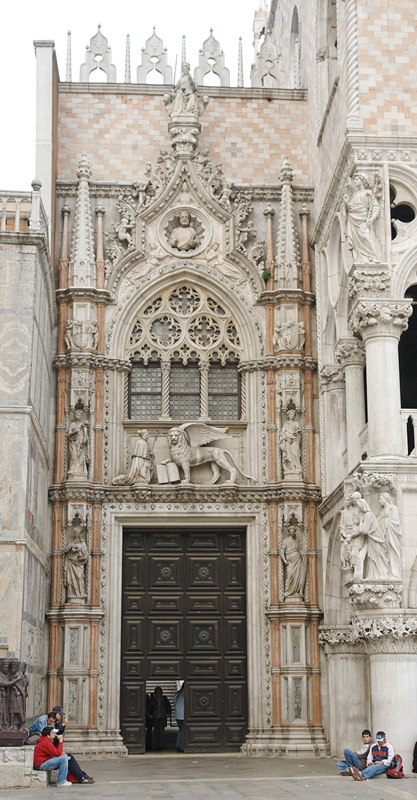
- Casanova and his fellow prisoner, Father Balbi, had escaped over the roof of the palace and made their way back inside through a window.
- They walked down the stairs and finally found themselves standing in front of the locked doors of the Porta della Carta.
- A guard thought they were officials who had been accidentally locked in, so he opened the gate for them.
- Casanova—elegantly dressed in a taffeta coat trimmed with lace—simply walked out onto the Piazzetta, turned around briefly, and climbed into a gondola to leave the city.
A photography tip for you: Take a picture of the Porta della Carta. When you get home, you can tell everyone that this is the exact spot where Casanova breathed the air of freedom again after 15 months in prison.
More visible traces of Casanova for your photo list:
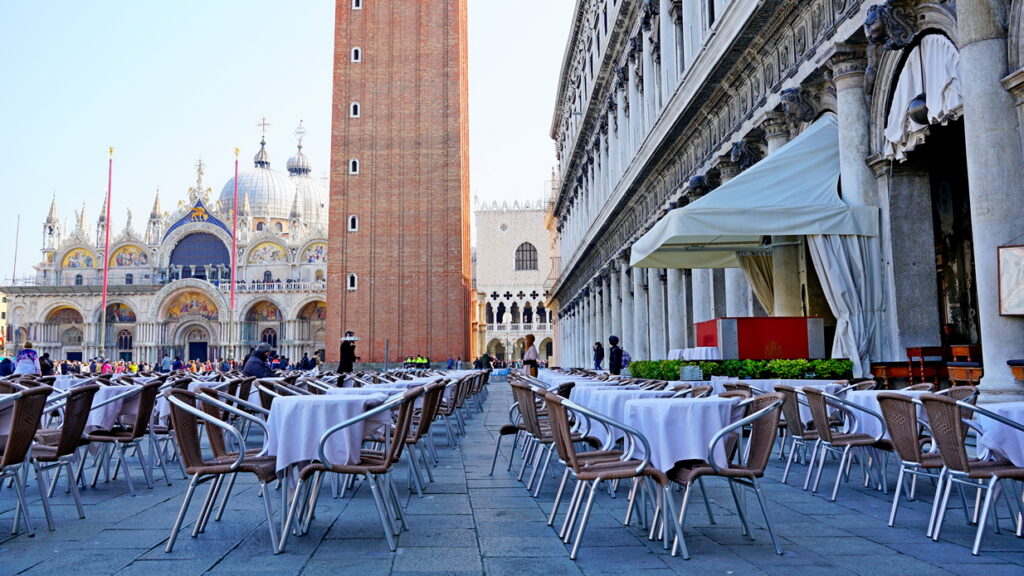
If you'd like to take photos of the „Sichtbarkeiten,“ here are three more spots that are just around the corner:
- Café Florian (Prokuratien): Casanova was a regular here. At the time, it was the only café where women were allowed—which, of course, was a decisive factor for him.
- The commemorative plaque on Calle Malipiero (San Samuele): This is probably the most important plaque. It marks the site of his birth. The inscription reads: „Giacomo Casanova was born on April 2, 1725, at number 2993 on this street.“. Historical research links house number 2993 to calle de le Muneghe. The exact location of his birthplace is a matter of debate.
- The Bridge of Sighs: Even though he was „only“ led through here, it symbolizes his journey into the dark dungeons before he managed to escape.
Location: Giacomo Casanova's Birthplace
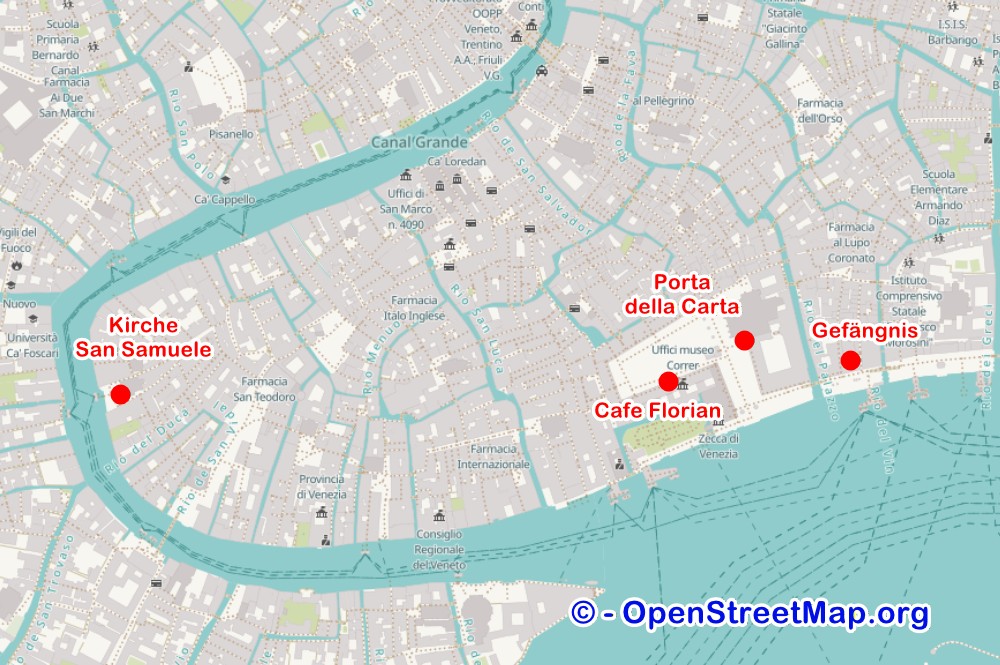
- Address: Calle Malipiero, San Marco 2993, 30124 Venice.
- Directions: The alley is very close to the church San Samuele and the famous palace Palazzo Grassi. If you take the vaporetto (Line 2) and get off at the „San Samuele“ stop, it’s just a few steps away.
- The motif: On the wall of the house, you'll find a marble plaque. It's simple, but for Casanova fans, it's a true pilgrimage site.
- Historical Context: Casanova was born here to a family of actors. The neighborhood was rather modest at the time, which makes his later rise to the highest circles of the nobility all the more impressive.
Giacomo Casanova – His Family Home and Childhood
His parents were actors
Giacomo Casanova was born on April 2, 1725, in Venice. His mother, Giovanna Maria Farussi—known as Zanetta—was an actress who later performed at various European theaters.
His legal father, Gaetano Casanova, was also an actor, dancer, and musician. Both worked at the San Samuele Theater in Venice. There are doubts as to whether Gaetano Casanova was actually his biological father. The Venetian nobleman Michele Grimani has been named as a possible father. This is historically interesting, but has not been conclusively proven.
The lives of actors in the 18th century were marked by travel, changing engagements, and frequent moves. When Giacomo was about a year old, his parents traveled to London. They left him in the care of his grandmother. His father died while Giacomo was still a child. His mother continued her successful stage career and was therefore often away from Venice.
His most important caregiver was his grandmother
Marzia Farussi, his maternal grandmother, played a major role in his upbringing. She took care of the boy, who had health problems in early childhood and suffered from recurring nosebleeds, some of which were severe.
Casanova later described an unusual incident in his memoirs: His grandmother took him to a woman on the island of Murano who was supposed to cure his illness through mysterious rituals. Whether this treatment actually had any effect cannot be determined. It is noteworthy, however, that Casanova wrote this story down in detail decades later. The encounter with supposed magic and mysterious rituals was among his earliest memories.
A difficult start—and a surprising turn of events
Casanova described himself as a sickly child whom people initially did not expect much from. At about the age of nine, he was sent to Padua to receive an education. There, he was tutored by the clergyman Antonio Gozzi.
That was when his extraordinary ability to learn became apparent. He studied Latin, classical literature, and numerous other fields of knowledge. The boy, who had initially been frail, grew into a well-rounded young man who later stood out for his language skills, his social grace, and his curiosity.
How did that childhood influence his later life?
1. His parents' frequent absences
Casanova had to cope without his parents' immediate presence from an early age. His later memoirs suggest that this experience weighed heavily on his mind. Whether this shaped his later behavior in romantic relationships, however, cannot be reliably determined.
2. The Theater as a Family Setting
His parents belonged to a world in which social graces, role-playing, socializing, and travel were part of everyday life. This is an interesting parallel to Casanova’s later life, but it is not proof of a direct influence.
3. Early Support for His Education
This is where the connection is most evident. His training under Antonio Gozzi laid an important foundation for the well-rounded education that would serve Casanova well time and again later in life.
Casanova's Birthplace – San Samuele in Venice
The neighborhood around San Samuele is located in the San Marco sestiere, on the Grand Canal. It is one of Venice's historic residential areas and was closely linked to the city's theatrical life in the 18th century.
1. The House Where Giacomo Casanova Was Born
Giacomo Casanova was born on April 2, 1725, in the area of what was then known as Calle della Commedia. Today, the alley is called Calle Malipiero and is located just a few steps from Campo San Samuele. The name Calle della Commedia was no coincidence. The Teatro San Samuele, where Casanova’s parents worked as actors, was located very nearby.
A commemorative plaque on calle Malipiero now marks the site of his birth.
However, there is one historical peculiarity: the exact location of his birthplace has not been definitively established. Research into historical documents cites, among other locations, what is now calle de la Muneghe 2993 as a possible birthplace or as the home of his grandmother. The commemorative plaque therefore primarily marks the historically verified area of his origins, not necessarily the exact building that has been definitively identified.
2. The Church of San Samuele—an important place for his family
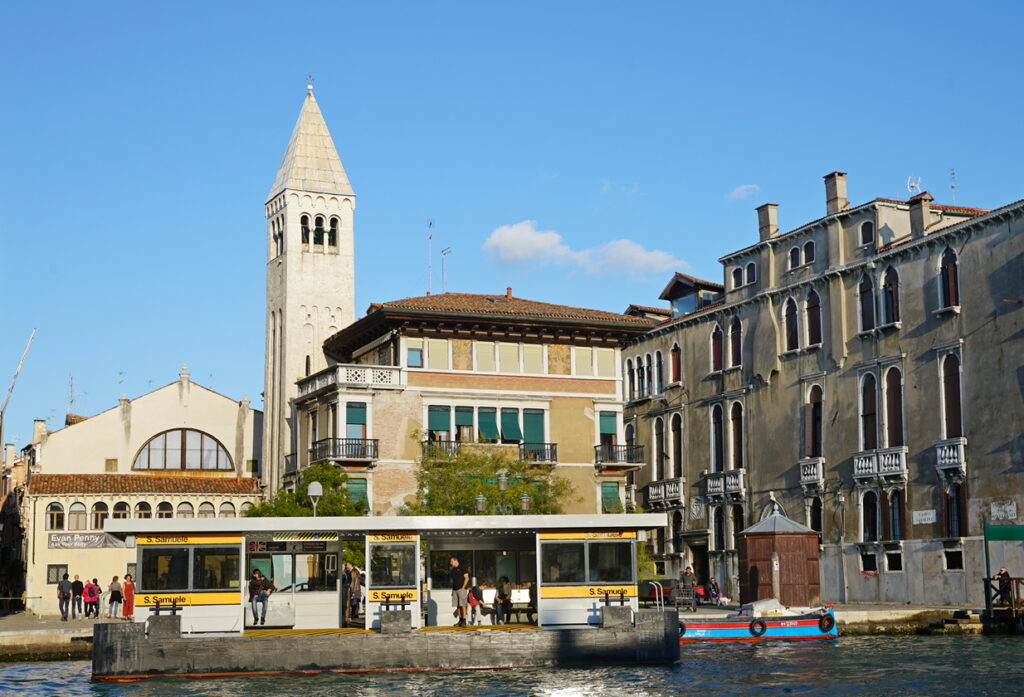
The Church of San Samuele is one of Venice's oldest places of worship. Its origins date back to around the 11th century. After being destroyed and rebuilt several times, it took on its current form over the course of the centuries.
It held special significance for the Casanova family. On February 17, 1724, Giacomo’s parents, Gaetano Casanova and Giovanna Maria Farussi, were married in this church. In May 1725, their son Giacomo was also baptized here. This makes the Church of San Samuele one of the few places that can be directly and unequivocally linked to Casanova’s earliest life story.
3. The Teatro San Samuele—His Parents' World
In the 18th century, San Samuele was not only a residential area but also a vibrant hub of Venetian theater life. The Teatro San Samuele was one of the city’s most important theaters. Plays, comedies, and operas were performed there.
Casanova’s parents were part of this theatrical milieu. His mother, Zanetta, was a successful actress, and his father, Gaetano, also performed on stage. The theater was later demolished. Today, a school building stands on the Fondamenta de le Scuole where it once stood. Casanova’s connection to the theater remained significant: as a young man, he himself worked for a time as a violinist at the Teatro San Samuele.
Just a few steps away from Casanova’s former neighborhood stands the Palazzo Malipiero. This historic noble palace later played an important role in his life. Starting around 1740, the young Casanova was a regular guest at the home of Senator Alvise II Malipiero, known as Gasparo. There, he met people from influential Venetian families.
This acquaintance gave him insights into a social world to which his family of actors did not naturally belong. His relationship with the senator, however, ended in a quarrel after Casanova had become involved with a young woman named Teresa Imer, in whom Malipiero was also interested. The palazzo is thus a remarkable example of how closely the worlds of artists and the nobility were physically intertwined in Venice.
What is particularly interesting is that Casanova was introduced here (in the area around San Samuele) to three different worlds within a small area: middle-class family life, his parents’ theater world, and, later, the Venetian aristocracy.
Some interesting Casanova sites in modern-day Venice.
Palazzo Bragadin Carabba
While in the Santa Marina area, Casanova lived for a time under the protection of Senator Matteo Bragadin, who supported him financially. This connection was crucial to his rise in society.
Photo subject: The palace facade, the entrance, and the area around Campo Santa Marina.
Ridotto di San Moisè – the historic casino
The famous state-licensed gambling house was located on Calle Vallaresso. Casanova was a passionate gambler and frequented the establishment, mingling with members of the Venetian upper class.
Photo opportunity: Hotel Monaco & Grand Canal, particularly the historic rooms of the Ridotto, provided that permission to take photos can be obtained.
Santa Maria degli Angeli Monastery on Murano
One of the most unusual settings in Casanova's life. In his memoirs, he describes his secret encounters with a nun, whom he referred to by the initials M. M.
Photo opportunity: The former monastery complex, the church, and the fondamenta Venier. A very appealing subject for a chapter of its own.
Casanova Official Museum at Palazzo Zaguri
A particularly recent addition: In October 2026, a new Casanova interactive museum was announced here, featuring 36 themed rooms and historical exhibits.
Photo subject: The exterior facade and, if permitted, the exhibition. The palazzo is also associated with the circle of important figures from Casanova’s youth.
Palazzo Soranzo on Campo San Polo
This palace, too, is associated with Casanova and his patron, Bragadin. Today, events are held there that recreate 18th-century Venice.
Photo opportunity: The Gothic palace facade and the large Campo San Polo.
Barbaria de le Tole – Casanova's later home
At Barbaria de le Tole, No. 6673, a residential building is associated with Casanova’s final Venetian years.
Photo subject: House number, entrance, and the historic alley.
Rialto and the Sotoportego dei Do Mori
The Rialto area was a hub of everyday life in Venice. The historic tavern Do Mori is mentioned in Casanova tours as one of the places he frequented.
Photo caption: The Sotoportego, the old tavern, and the market district. Casanova’s personal connection to this area is less well documented than, for example, his connection to the Ridotto.
One more note: Not all buildings advertised as „Casanova sites“ are equally well documented in historical records.
Casanova as a Priest in San Samuele (1740–1744)
Why would Casanova become a priest?
Casanova came from a family of actors. Although his mother was successful, the family did not belong to the Venetian nobility. His mother wanted a prestigious and financially secure future for her talented son.
At that time, a career in the church offered precisely this opportunity. Clergy could receive a good education, earn a steady income, and establish connections with influential figures.
Casanova himself would have preferred to study medicine. However, his family initially steered him toward law and a career in the church. So it was less a proven religious calling than a socially sensible decision.
How long was he a clergyman?
In February 1740, at the age of just 14, Casanova received the tonsure, the traditional sign of entry into the clergy. In 1741, he received the four minor orders. This entitled him to call himself an “Abate,” a title roughly equivalent to “Abbé” at that time.
Important: He had been ordained neither as a deacon nor as a priest and was therefore not permitted, for example, to celebrate Mass as a priest. His ecclesiastical career lasted about four years. Around 1744, he gave it up for good.
Casanova preached at the Church of San Samuele
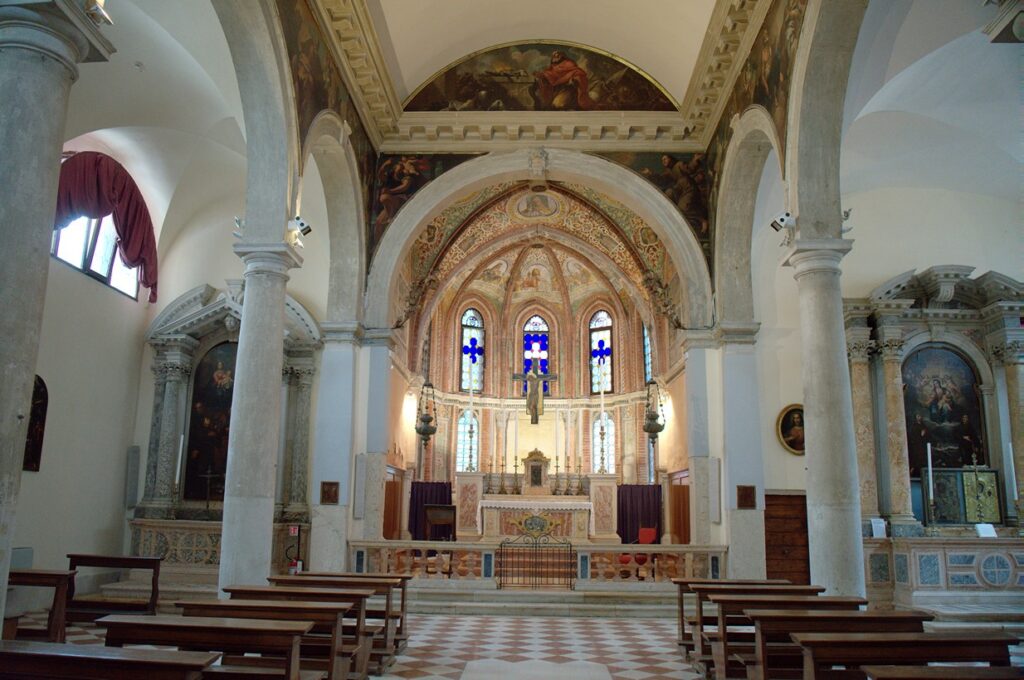
It is particularly noteworthy that Casanova also delivered sermons at his home church, San Samuele. According to a historical account, his first sermon, delivered on Christmas Day 1740, is said to have been a great success.
Casanova later proudly reported that his listeners had been thrilled. He said that, in addition to money, the offering basket had even contained love letters. The second sermon, however, went quite differently.
On March 19, 1741, after a lavish meal accompanied by plenty of wine, Casanova is said to have forgotten the text he had prepared while standing at the pulpit. To escape the embarrassing situation, he feigned fainting, according to his own account.
The story is entertaining, but it is based largely on his memoirs and cannot be independently verified in every detail.
Why did he give up his career in the church?
Casanova found himself increasingly drawn to elegant society, travel, and social pleasures. Even during his time as an abbé, he frequented the Palazzo Malipiero and became acquainted with the world of the Venetian nobility.
Later, he attempted to continue his ecclesiastical career outside Venice, including in the service of a bishop in southern Italy. However, these prospects apparently did not meet his expectations. Eventually, he laid aside his clerical garb and chose a different path in life.
„Casanova as a Priest-in-Training—An Unusual Youth in San Samuele“
There is an important biographical connection here: the Church was supposed to enable the son of an acting family to climb the social ladder. Indeed, his position as an abbé gave him access to influential circles, but his ecclesiastical career remained unfulfilled.
Giacomo Casanova (1725–1798) lived during one of the most intellectually stimulating periods in European history: the Enlightenment.
And yet there is a striking contradiction: while philosophers debated reason, freedom, and human rights, kings, princes, and a privileged aristocracy still ruled over large parts of Europe.
Casanova experienced both. He moved in the circles of the nobility, took an interest in science and philosophy, enjoyed the freedoms of his time, and at the same time found himself at odds with strict social and political norms.
Casanova—a child of his time
The Enlightenment—Europe Begins to Think Differently
The 18th century is often referred to as the Age of Enlightenment. More and more scholars, writers, and philosophers began to question traditional ideas. They no longer wanted to explain the world solely through religion, traditional authorities, and social hierarchies. Instead, reason, observation, scientific experiments, and critical thinking gained in importance.
The key questions included, for example:
- Should a person be allowed to decide for themselves how they want to live?
- Do we have to believe everything the church or the government tells us?
- Are all people equal by nature?
- Can society and the government be improved through sensible laws?
- What role do education, science, and personal freedom play?
However, these debates by no means reached all segments of the population equally. For farmers, domestic servants, artisans, and many women, life continued to be strongly shaped by their background, economic constraints, and social norms.
Casanova was one of those who benefited from this new intellectual flexibility. He was well-educated, spoke several languages, and was able to move in various social circles.
Venice—Between Freedom, Pleasure, and Government Control
Venice was an extraordinary city during Casanova’s lifetime. The Republic of Venice had already existed for many centuries. It was headed by the Doge, but political power lay primarily with a small number of noble families. While France was ruled by a king, Venice had an aristocratic system of government with complex power structures.
Venice was also famous for its theaters, opera houses, playhouses, festivals, and Carnival. Here, people who were otherwise separated by strict class boundaries could come together. Especially during the Carnival, masks made it easier for different social groups to interact.
But this freedom had its limits.
The Republic had a well-developed system of political surveillance. The State Inquisitors and the Council of Ten could take action against individuals who were considered a threat to public order.
Casanova experienced this other side of Venice firsthand: in 1755, he was arrested and imprisoned in the Doge’s Palace.
This is key to understanding his life: Venice offered him extraordinary social opportunities, but it could also take away his freedom.
What did people actually do back then?
When we imagine life around 1750, we shouldn’t just think of philosophers and nobles. Most people worked hard. Venice thrived on trade, crafts, shipping, services, and the production of high-quality goods, among other things. There were glassblowers on Murano, gondoliers, merchants on the Rialto, printers, tailors, servants, artisans, and numerous people employed in the theater and music industries.
Those who had enough money and social standing could lead a completely different daily life: attending the opera, accepting social invitations, playing cards, going to dance parties, and engaging in conversation at coffeehouses. Coffeehouses, in particular, became important venues for social interaction. Caffè Florian, which opened in 1720, already existed when Casanova was born. It was thus part of the coffeehouse culture of his era.
And one more thing: Venice was a city of music back then. Operas, concerts, and theater performances were an important part of public life. This brings us to Antonio Vivaldi.
Which famous people lived at the same time as Casanova?
Voltaire (1694–1778)
French philosopher, writer, and critic of religious intolerance. Casanova visited Voltaire in Ferney, near Geneva, in 1760. He admired Voltaire’s intellectual stature but also engaged in controversial discussions with him. For him, Voltaire was an important intellectual figure, but by no means an uncontroversial role model.
Jean-Jacques Rousseau (1712–1778)
A philosopher and writer who explored the themes of freedom, education, society, and human nature. His autobiographical *Confessions* are particularly interesting when compared with Casanova’s own memoirs. Casanova engaged with Rousseau’s ideas and writings.
Carlo Goldoni (1707–1793)
Venetian playwright and reformer of comedy. Goldoni sought increasingly to portray real people and their everyday lives on stage, rather than just the traditional characters of the Commedia dell’arte. He was part of the theatrical world from which Casanova’s family also hailed.
Pietro Longhi (1701–1785)
A Venetian painter who depicted everyday scenes, social games, masks, and the lives of wealthy citizens and nobles. His paintings are among the most vivid visual sources for the social world in which Casanova lived.
Antonio Vivaldi (1678–1741)
Venetian composer and violinist. When Vivaldi died, Casanova was 16 years old. Thus, both lived in the same city and during the same era at times, albeit in different generations. It is not certain that they ever met in person.
Wolfgang Amadeus Mozart (1756–1791)
Mozart was born when Casanova was already 30 years old. Both lived in the European world of opera, the nobility, and courtly society. There is no historical evidence that the two ever met.
Other Notable Contemporaries These were Denis Diderot (1713–1784), Immanuel Kant (1724–1804), Frederick II of Prussia (1712–1786), and Catherine II of Russia (1729–1796).
Casanova even came into personal contact with Frederick II and Catherine II. This shows the extraordinary social circles in which he was able to move.
Who were Casanova's role models?
We need to be careful here. Casanova didn't leave behind a simple list of people he wanted to emulate throughout his life. However, we can identify some of his intellectual influences.
To him, Voltaire was a preeminent figure in European intellectual life. Casanova deliberately sought him out, but also disagreed with him.
Ludovico Ariosto (1474–1533), the Italian poet of *Orlando Furioso*, was among the writers he held in particularly high esteem. Casanova admired literature, linguistic elegance, and intellectual wit.
For Casanova, the educated European aristocrats served as important social role models. He adopted the manners, clothing, and behaviors of these circles, even though he himself was not of noble birth.
It is important to distinguish between personal admiration and the desire to be recognized within a particular social sphere.
Casanova was not merely a follower of the Enlightenment. He took part in its debates, developed his own ideas, and occasionally took contradictory positions.
This is even being studied scientifically today. In 2016, the Voltaire Foundation at the University of Oxford published its own research volume titled *Casanova: Enlightenment Philosopher*.
Casanova witnessed the transition to a new world
It is particularly striking to see which historical events coincided with his life. Europe during Casanova’s lifetime (1725–1798):
1751 – The Great Encyclopedia
Diderot and d’Alembert began publishing the French *Encyclopédie*. The goal was to systematically collect and disseminate knowledge.
1755 – The Lisbon Earthquake
The disaster has shaken Europe and sparked debates about religion, science, and human destiny.
1776 – Declaration of Independence
In North America, a new political order is emerging that is based on freedom and fundamental rights, even as slavery continues.
1789 – French Revolution
The old social order is being fundamentally challenged. Casanova is already 64 years old at this point.
1797 – The End of the Republic of Venice
Napoleon Bonaparte brings about the end of the centuries-old republic. Casanova lives to witness the downfall of the state in which he was born.
1798 – Casanova's Death
On June 4, he died at Dux Castle in Bohemia—now known as Duchcov—far from his hometown.
What does this mean for Casanova's image?
Casanova was not simply a womanizer, as many people today perceive him to be. He was also a writer, traveler, gambler, temporary clergyman, violinist, political observer, and conversational partner to prominent figures.
His memoirs are therefore not only the story of a single individual, but also a comprehensive account of 18th-century European society.
It is precisely his contradictions that make him interesting: He valued personal freedom, sought the company of powerful nobles, took an interest in new scientific ideas, and at the same time delved into magic and esoteric concepts.
So he was very much a child of his time—an era in which old beliefs and new ways of thinking coexisted.
Casanova was born in 1725 in a republic whose political system had been in place for centuries. By the time he died in 1798, that republic no longer existed. Meanwhile, the Enlightenment, the American Revolution, and the French Revolution had profoundly transformed Europe.
Casanova's life thus bridges the gap between old aristocratic Europe and the dawn of the modern world.
What was it about Casanova that made him so interesting to women?
Was he particularly handsome? Was he rich? Did he have an extraordinary charisma? Or did he have the ability to give women something that other men of his time didn't give them?
That last question, in particular, leads us to an interesting aspect of his personality.
And let's get one thing straight: Casanova was by no means the irresistible heartthrob whom every woman instantly fell for. This image is primarily a product of his later legend.
Was Casanova a particularly handsome man?
We know more about his actual appearance than one might expect. Contemporary descriptions and historical documents paint the following picture:
- At about 1.90 meters, Casanova was unusually tall for his time.
- He had a strong, imposing build.
- His complexion was dark, and his eyes were lively.
- His nose was strikingly large and prominent.
- He placed great importance on elegant, sometimes expensive clothing.
He didn't necessarily fit the ideal of a delicate, aristocratic heartthrob of that time. But he was a striking figure who was hard to miss. His strength lay not in conventional beauty, but in his presence.
He was a great conversationalist
Casanova was exceptionally well-educated. He was fluent in several languages and had an interest in literature, philosophy, mathematics, and science. He could converse with nobles, scholars, and artists without feeling inferior. He also possessed a sense of humor, quick wit, and a talent for storytelling.
These were significant advantages, especially in 18th-century society, where conversation was considered an art form. A man who made a woman laugh, entertained her, and took an interest in her thoughts could certainly seem more attractive than a man who was more physically handsome but boring.
He paid attention to women
This may hold an important clue. Casanova did not describe women solely in terms of their physical beauty. In his memoirs, he often expressed interest in their personalities, their desires, their education, and their circumstances. His biographer, Ian Kelly, emphasizes that Casanova had the ability to focus entirely on his conversation partner during an encounter.
That must have made a strong impression on some women. However, we must keep in mind that our most important source is Casanova himself. He described his relationships from his own perspective and, of course, wanted to come across as a desirable man.
He was unusually self-assured
Casanova was not shy about making contact with people from different social backgrounds.
He moved in the company of ordinary people as well as in the highest circles of the European nobility.
This self-confidence was also evident in his interactions with women.
He didn't just wait for an opportunity to arise by chance. He sought out encounters, accepted invitations, paid compliments, and took risks.
His elegant attire, his social connections, and, at times, his considerable financial resources helped him in this regard.
So his successes were by no means just a matter of luck.
Was he always successful?
No. And that's important.
Casanova experienced rejection, disappointment, jealousy, and failed relationships.
His memoirs also describe situations in which he made a fool of himself or failed to live up to his own expectations.
He was by no means successful with every woman.
But he was exceptionally skilled at turning his encounters into stories. And in doing so, he later shaped the image that future generations would have of him.
The Less Romantic Side of the Womanizer
Here, we need to take a particularly critical look at this widespread stereotype.
Casanova could be attentive and generous. But he could also deceive women, make promises he didn't keep, and take advantage of his social or financial superiority.
Some of the encounters he describes involve coercion, manipulation, or sexual violence. Historians such as Leo Damrosch explicitly point out that these behaviors are incompatible with the romantic image of a charming seducer.
Precisely because we want to understand Casanova as a product of his time, we should neither ignore the social conditions of that era nor romanticize problematic behavior.
Why did his name, of all names, become synonymous with a womanizer?
That might be the most interesting question of all.
In the 18th century, there were many men who had numerous romantic relationships. Casanova was by no means unique in this regard.
What made him unique was that he recorded his experiences in literary form across thousands of pages.
His autobiography, *Histoire de ma vie*, made him famous long after his death.
So he was not only a seducer, but also an extraordinary storyteller of his own life story.
Later literature, theater, and finally film transformed this complex figure into the legendary Casanova.
Final Thoughts
Casanova was probably successful less because of his physical beauty than because of his his self-assured demeanor, his education, his charm, and his ability to win people over. But his relationships with women also had a dark side. The fact that his name is now regarded worldwide as synonymous with a womanizer is due in no small part to his extraordinary ability to tell his own life story.
The Period Following His Church Career
Between about 1744 and 1756, Casanova evolved from a young, penniless adventurer into a man who moved in the highest social circles of Venice—and who ultimately escaped from the Doge’s Palace as a state prisoner.
Casanova's Venetian Highlights After His Career in the Clergy
About 19–20 years old—From aspiring priest to violinist.
After his ecclesiastical career came to an end, Casanova made a living doing various jobs. Among other things, he played the violin in the orchestra of the Teatro San Samuele. It is worth noting that this marked his return to the theatrical world of his parents. It was a social decline compared to the ecclesiastical career he had hoped for, but at the same time a new beginning.
21 Years Old – Meeting Senator Matteo Bragadin
Casanova helped a Venetian patrician who fell ill during a gondola ride they were taking together. The man was Senator Matteo Bragadin. Bragadin was so grateful to him that he took him under his wing and supported him financially. For Casanova, this was a turning point: Suddenly, he had money, social connections, and access to a world that had previously been largely closed off to him. The details of this dramatic encounter are based primarily on Casanova’s own memoirs.
The late 1740s and early 1750s—Gambling, Masks, and High Society
Thanks to Bragadin's support, Casanova was able to participate in the social life of the Venetian upper class. He attended theaters, gambling houses, and social gatherings. Gambling, in particular, fascinated him. It was here that he developed that blend of social grace, a willingness to take risks, and self-promotion that would later become his trademark.
About 28–30 years old – The Mysterious Encounters on Murano
In his memoirs, Casanova describes a romantic relationship with a nun whom he refers to as M. M. Their encounters took place in the vicinity of the Santa Maria degli Angeli convent on Murano. The story is one of his most famous Venetian love affairs. It also offers insight into the social constraints to which women in 18th-century convents might have been subjected. Here, too, a distinction must be made between his literary account and independently verifiable facts.
July 26, 1755 · Age 30 – Arrest by the State Inquisitors
Casanova was arrested and taken to the so-called Piombi, the prison cells beneath the lead roof of the Doge’s Palace. The exact reasons for his arrest are not entirely clear from a historical perspective. The allegations included, among other things, his behavior, his religious views, and his interest in forbidden or suspicious writings. For a man who had previously enjoyed social freedoms, this was a dramatic turning point.
The night of October 31 to November 1, 1756—The Spectacular Escape from the Lead Chambers
After about 15 months in prison Casanova managed to escape together with the clergyman Marino Balbi. The two made their way through the roof structure of the Doge’s Palace to other parts of the building and finally out into the open. Casanova later published a detailed account of his escape, which brought him even greater fame throughout Europe. He then left Venice and began a new phase of his life as a traveler throughout Europe.
But that's not the end of his Venetian story!
In fact, there is a second, lesser-known phase of his life in Venice that I find almost as interesting for our biography.
Casanova returns to Venice in 1774
After spending about 18 years abroad, Casanova was allowed to return to his hometown in 1774. By then, he was 49 years old. His former patron, Bragadin, had passed away; his financial situation was precarious; and the glorious years of his youth were behind him. To earn a living, he tried his hand at various occupations, including writing and publishing.
A former political prisoner becomes an informant
This is one of the most astonishing turns in his life. Casanova, who had been arrested by the Venetian State Inquisitors in 1755, began—upon his return—to provide information to those very same authorities. Starting in 1776, he passed on information; in 1780, he was finally hired as a paid informant. Among other things, he reported on social events and individuals of interest to the authorities.
The Final Farewell to Venice in 1783
His final Venetian years came to an end following a conflict with members of the nobility. Casanova published a scathing satirical work in which he specifically attacked the influential Grimani family. In early 1783, he was forced to leave Venice once again. He would never see his hometown again.
A Timeline of Casanova's Life
| year | Event | Age |
|---|---|---|
| 1745 | Military service, trips to Corfu and Constantinople | 20 |
| 1746 | Violinist at the Teatro San Samuele | 21 |
| 1746 | Meeting with Senator Bragadin | 21 |
| 1749 | A Temporary Farewell to Venice | 24 |
| 1750–1752 | Stay in Paris | 25–27 |
| 1753 | Return to Venice | 28 |
| 1755 | Arrest and Imprisonment | 30 |
| 1756 | Escape from the Doge’s Palace | 31 |
| 1774 | Return After 18 Years | 49 |
| 1780 | Paid informant for the state inquisitors | 55 |
| 1783 | A Final Farewell to Venice | 57 |
The ages given are approximate. The chronology is based primarily on the biographical account in the Enciclopedia Treccani and on research into Casanova’s work for the State Inquisitors.
What is increasingly fascinating about his life story is that Casanova was, in succession, a would-be clergyman, a soldier, a musician, a social climber, a gambler, a prisoner, a refugee, a writer, and even an informant. This is far more than just the story of a womanizer.