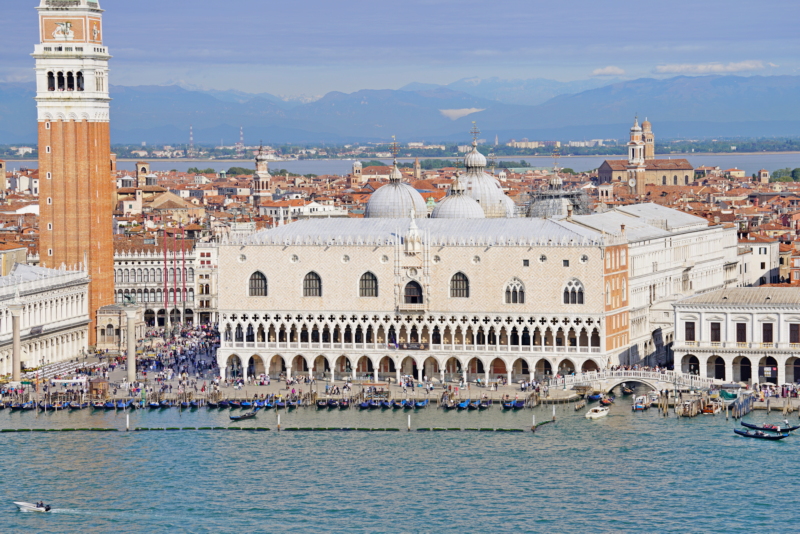
The Doge's Palace (Palazzo Ducale) is one of the most important secular buildings in the lagoon city. It is located on the Piazetta San Marco, right next to St. Mark's Basilica, with which it formed the political and religious center of Venice for centuries.
For over 900 years, the Doge's Palace served as the residence of a total of 120 doges of the Republic of Venice, who held council meetings there, received state visits, and hosted lavish celebrations.
Admission to the Doge's Palace costs 35.00 euros per person. This price also includes admission to the three other museums on St. Mark's Square.
If you want to visit the Doge's Palace without waiting in line, it's a good idea to buy a ticket online in advance. Or you can read our tip on how to get into the Doge's Palace without waiting in line, even when you're there in person.
Two colored columns at the Doge's Palace
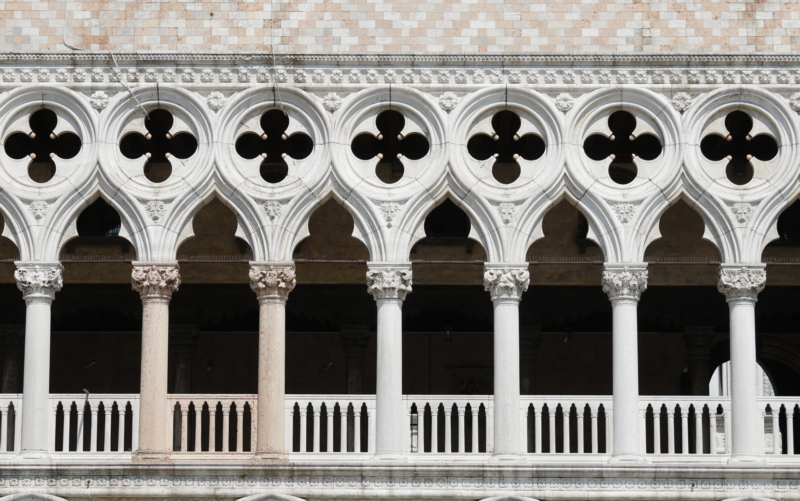
On the west facade of the Doge's Palace, two columns are not made of the usual white marble. These two columns and the balcony railing between them are a light pink color. The reason for this is that some death sentences were once pronounced here and, in some cases, carried out.
Yeah, that's how it was: the good old days.
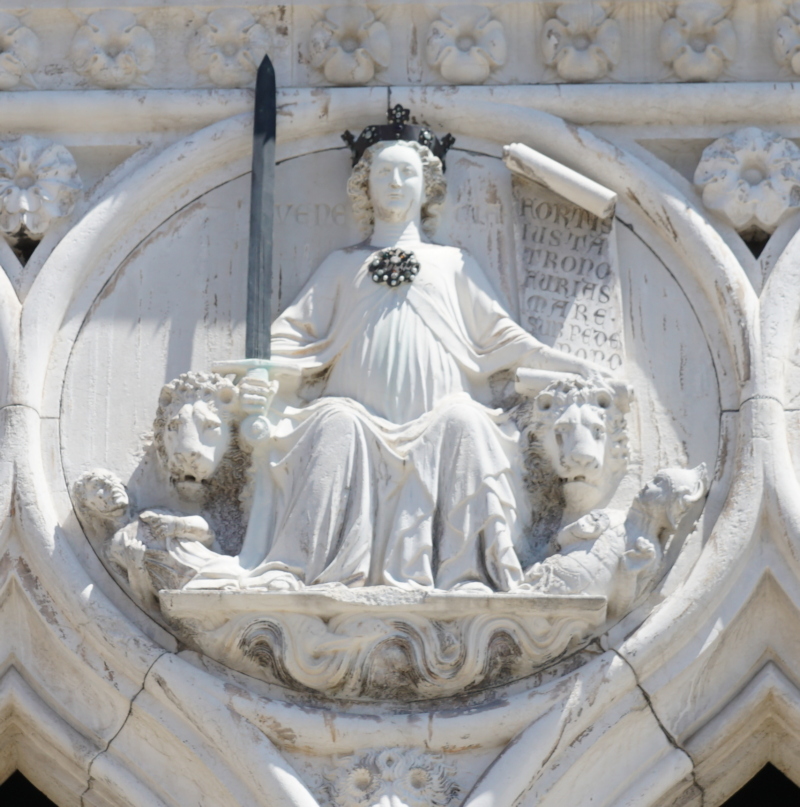
Also note the statue of Justitia, located right next to the two red columns.
She is holding a sword in her right hand and a scroll in her left, and is seated between two lions
Often copied: Four-leaf clovers
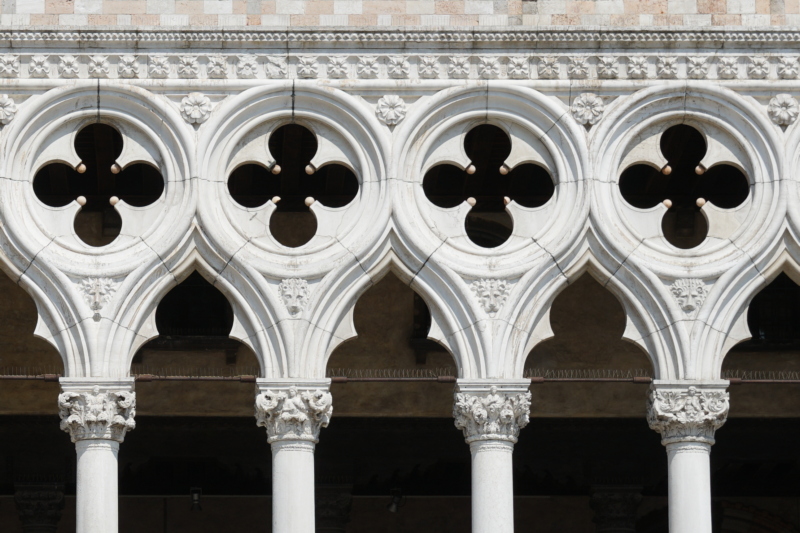
This motif is a four-leaf clover. It was used quite often during the Gothic period. It first appeared at the Doge’s Palace in the 14th century and set a trend for Venice, since, after all, the Doge’s Palace is the seat of government. Many noble families took this as their model.
On the Grand Canal, including at Ca' Foscari, Ca' Pisani, and others.
Turned upside down.
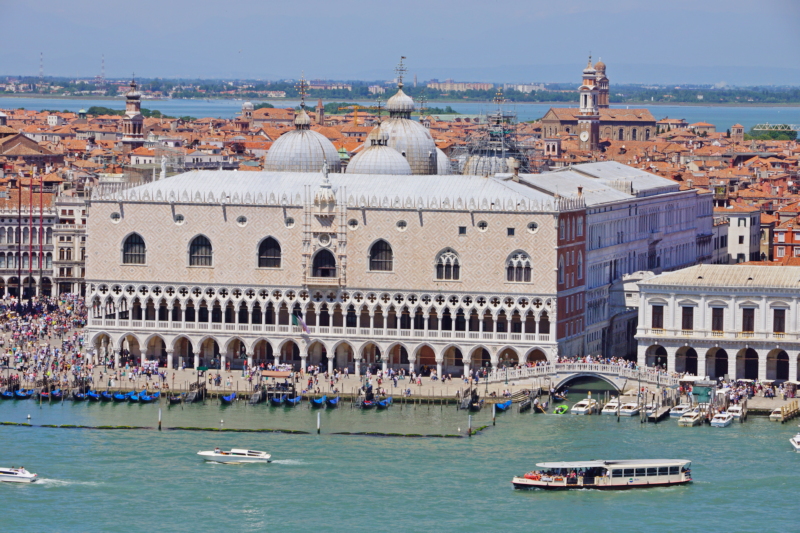
The ground floor of a building is usually very solid and sturdy—after all, it has to bear the entire load. Each floor above it can be built to be lighter and more open, with balconies, loggias, arcades, etc.
At the Doge's Palace, this principle appears to have been reversed. The ground floor appears much more open and delicate due to its 17 large pointed-arch arcades, offering the largest open spaces and gaps.
The floor above features a continuous loggia across its entire width, with twice as many keel arches adorned with quatrefoils (clover leaves), and appears to be more massive and densely constructed.
Finally, the top floor is exactly as high as the sum of the two rows of arcades below it and, with its continuous masonry, appears to be the most stable and solid.
As a result, the Doge's Palace appears exactly the opposite of what one would normally expect—namely, upside down. The Doge's Palace seems to float above the water, thereby conveying a sense of invincibility.
Strange Figures at the Doge's Palace
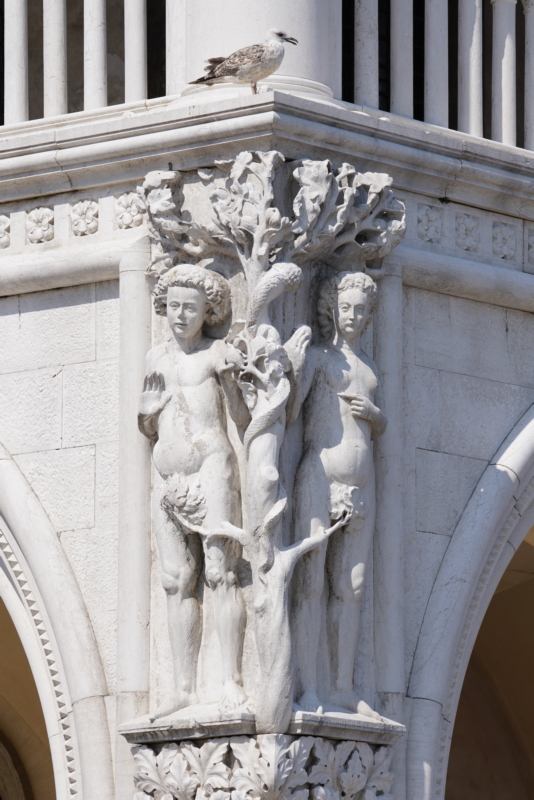
Here, too, almost everyone walks right past it without noticing: Right next to the corner pillar of the Doge's Palace, between the south side facing the lagoon and the two columns on the Piazetta, you'll see this statue.
It depicts the Fall of Man in the Garden of Eden. In the picture, you can see Adam (left) and Eve (right), who is pointing to the forbidden fruit she is holding in her other hand. Between them is a tree trunk around which a snake is coiled.
By the way: The seagull at the top of the picture is no longer part of the group, even though on that day she went out of her way to put on her white-and-gray marble-colored plumage, which perfectly complemented her figure.
The Winged Lion at the Doge's Palace
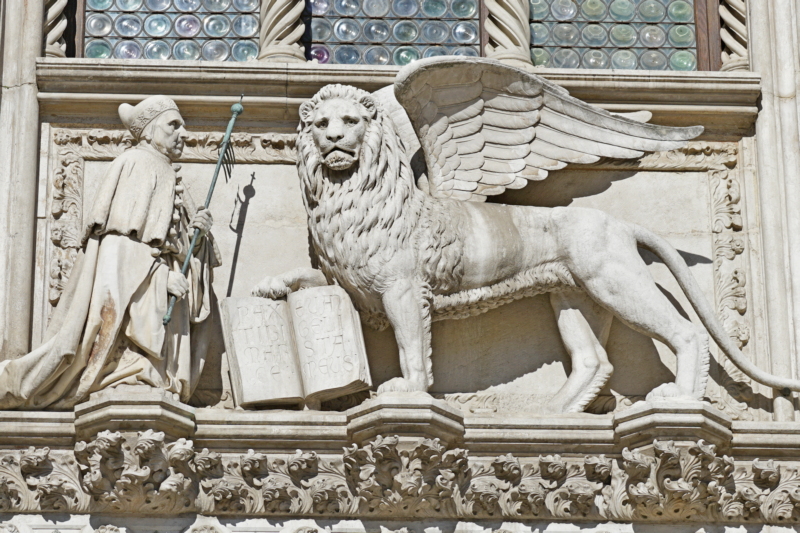
Almost everyone knows that the evangelist Mark is the patron saint of the lagoon city. The names St. Mark’s Square and St. Mark’s Basilica are a direct reference to this. But how did Mark come to be associated with the lion, and why does the lion have wings?
Right at the beginning of the New Testament, the Bible contains four different accounts of Jesus’ life. The authors (evangelists) are Matthew, Luke, John, and Mark. The Gospel of Mark begins with the story of Jesus going into the desert. And the animal of the desert is, of course, the lion. The lion symbolizes courage and strength and is the king of the animals.
The other evangelists were depicted with the faces of a bull, an eagle, and a human (or angel). In almost all depictions of the lion, he rests his forepaw on an open book that reads: PAX TIBI MARCE EVANGELISTA MEUS This means: Peace be with you, Mark, my evangelist.
The relics of Mark were brought back from Alexandria (Egypt). Later, a story emerged that Mark had a dream in which an angel revealed to him that his body would find its final resting place in Venice, and that he would find peace there.
The Symbols of the Evangelists: They come from the Book of the Prophet Ezekiel: „And I looked, and behold, a stormy wind came from the north, with a great cloud full of fire, which shone all around; and in the midst of the fire there was a bright light. And within it were four living creatures, and they looked like human beings. Each had four faces and four wings. Their faces were like those of a human being in front, and like those of a lion on the right side” (Ezekiel 1:4–20)
The Golden Heart of the Republic
The Doge’s Palace is far more than just a museum—it is the very memory of the lagoon city set in stone. For centuries, it served as the seat of the Doge and the government council chambers. Here, world history was made, justice was administered, and the legendary Venetian diplomacy was conducted. A tour takes you through magnificent halls with ceiling paintings by the greatest masters, across the famous Bridge of Sighs, and down into the dark dungeons.
Why You Should Visit It
- Architectural masterpiece: The palace is the finest example of Venetian Gothic architecture. The combination of pink marble and delicate arcades is unique in the world.
- Experience the power of Venice: In the vast halls, such as the Grand Council Hall (Maggior Consiglio), the Republic's former political and economic dominance becomes palpable.
- Art at the highest level: Admire one of the world's largest oil paintings—Tintoretto's „Paradise“—as well as masterpieces by Veronese and Titian in their original settings.
- The Legend of the Bridge of Sighs: This is the only place where you can cross the bridge and enjoy the same view of the lagoon that the prisoners once had on their way to their cells.
Important Information for Your Visit
- The Golden Staircase: The Scala d’Oro is decorated with 24-karat gold leaf and was once the official entrance for guests of honor.
- The Grand Council Chamber: It is 54 meters long and has no supporting columns whatsoever—a masterpiece of Renaissance engineering.
- The Secret Passages: In addition to the state rooms, there is a network of hidden offices and torture chambers that can only be seen as part of special guided tours (Secret Itineraries) are available.
- Snapdragons: Look for the stone mail slots (Bocche di Leone), where citizens could submit anonymous complaints against fellow citizens.
My tip: Visitors to the Doge’s Palace usually have the „St. Mark’s Square Ticket,“ which also includes admission to the Museo Correr, the Archaeological Museum, and the Biblioteca Marciana. Take advantage of these to get a complete picture of Venetian culture.
An Overview of the Museums
- The Doge's Palace: The Golden Heart of the Republic
- Museo Correr: A Window into Life in the Republic
- Galleria dell’Accademia: The Pantheon of Venetian Art
- Peggy Guggenheim Collection: Modern Art on the Grand Canal
- Museo Storico Navale: The Art of Engineering on the World's Oceans
- Ca‘ Rezzonico: The Magnificent Museum of 18th-Century Venice
- Ca‘ Pesaro: Modern Art and Oriental Treasures in a Baroque Palace