
Murano is an island near Venice. Everything here is a size or two smaller: the island itself, the canals, and even the houses. Murano is best known for its glassblowing artistry and its many glass factories.
Murano is only about 1 km from the main island of Venice. The best way to get to Murano is by taking vaporetto line 4.1 or 4.2. These vaporettos depart from Venice every 20 minutes. You can also take line 13 directly from the train station.
The Glass Factories

The relocation of the glass factories from the main island of Venice was carried out primarily for fire safety reasons. This took place as early as the year 1300.
Contrary to the common belief that flooding poses a major threat to Venice, fire is a far more serious danger to the city’s densely packed buildings. That is why the glass factories were relocated to a separate island. The Venetians have been accustomed to flooding for centuries.
Confidentiality

Another advantage of the glass factories on Murano, as a separate island, was that it allowed for better secrecy regarding the art of glassblowing. Because of the island’s isolated location, the master glassmakers could be much more closely monitored. Glassblowers have always been very well paid, and under threat of the death penalty, they were strictly forbidden from passing on their knowledge. With the rise in tourism, the art and craft of glassblowing began to flourish once again.
Murano as „Little Venice“

Like Venice itself, Murano is crisscrossed by numerous canals and narrow alleys. Here in Murano, too, people and goods are mostly transported by boat. You’ll notice that on all of Venice’s neighboring islands, the houses are much lower than on the main island of Venice.
In Venice, most buildings have three to four stories. In the Ghetto, they can be as high as eight stories. It’s fair to say that people were crammed together in the Ghetto. Because the buildings on the neighboring islands are lower, the light there seems brighter and the space more open.
Murano Center

Murano is part of a group of islands northeast of Venice and is easily accessible by vaporetto from Venice. Seven islands—separated by canals and connected by bridges—make up Murano, which covers an area of just over 1 km² and is famous for its glass art.
Anyone spending a few days in Venice—a dream destination for many people—should definitely plan a trip to the island of Murano. There are many private boat tours organized from Venice that take visitors not only to Murano but also to the other islands of Burano and Torcello.
At a glass factory in Murano
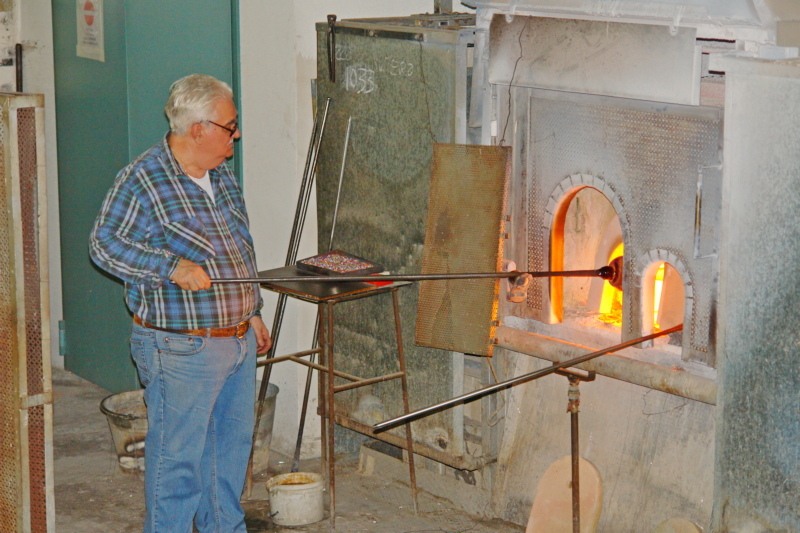
Of course, you visit Murano for its glass factories, glass shops, and glass museum. You'll probably take Line 4.1 or 4.2. from Venice (Fondamente Nove stop) to here. And everyone has the same question: How do I find the glass factories in Murano?.
The ACTV link to the schedules for all vaporetti is:
http://actv.avmspa.it/it/content/orari-servizio-di-navigazione-0
Vaporetto Line 12 also runs from Fondamente Nove to Murano, but it stops at the Murano stop Faro (Lighthouse).
Getting to Murano

The plan is from https://www.OpenStreetMap.org – © OpenStreetMap contributors
From the bus stop, take Fondamente Nove Line 4.1 to the first stop this line in Murano, named Colonna. Get off there. And as you can see on the map, keep to the left on the riverside path. There are several glass factories—or glass demonstration rooms—where, for a small fee of 2–3 euros, you can watch live as a small figurine, usually a little standing horse, is magically created from a hot lump of glass.
Several glass factories

Right at the first stop in Murano Colonna, you’ll already see the first signs pointing you toward the glassblowing factories, where demonstrations are held. So you don’t have to go looking for a glassblowing demonstration at all. On the contrary: you’re already expected there, and the factories are eager to have you.
After getting off the vaporetto at the Murano Colonna stop, keep to the left. Walk along the waterfront for 100 or 200 meters until you find the glass factory of your choice. Go inside to watch the demonstration.
Fornace: Here in Murano, you'll see the word "Fornace" on many houses. It means: oven, kiln, brickworks, distillery, or charcoal kiln.
Glassblowing Art

Even in Venice, at St. Mark’s Square, employees of the glass factories offer you a free boat ride from Venice directly to a glass factory stop in Murano. The reason for this free ride to Murano is quite simple: The glass factories hope that you’ll buy a glass sculpture after the demonstration. The demonstrations do NOT have fixed start times. Depending on the vaporetto schedule and as individual boats arrive in Murano, the next demonstration begins shortly afterward, once enough interested spectators have gathered.
Glassblowing Demonstrations

In the past, the demonstration was free. In exchange, after the demonstration, you were led through several exhibition rooms in the hope that individual customers would buy something. That was pretty pushy. Of course, there is NO obligation to buy. It was simply an expectation—or rather, a hope—on the part of the manufacturers that customers would buy a small item in return. In my experience, many spectators buy NOTHING.
Reciprocity: Incidentally, this type of sales is very widespread and, as a result, is naturally also common on the Internet: Give first, then take Or „What goes out comes back around“! There’s even a specific term for this: the law of reciprocity.
Visitors' Stand

The demonstrations do not follow a set schedule. Depending on the number of visitors, or once the viewing stands are full, a demonstration will begin. It lasts 20–30 minutes. So you may have to wait a bit, or you might arrive right in the middle of a glassblowing demonstration. Expect to pay 3–5 euros.
Highly sought-after, but…

Typically, a small standing horse, like the one pictured here, is crafted right before your eyes from a lump of red-hot glass. This particular piece is highly sought after by customers, but….
To prevent the glass from cracking, it must be cooled very, very slowly. And that often takes several hours.
So here's our tip: For just a handful of euros, you can buy a ready-made, cooled jar of "Pferdchen" that's for sale. It's wrapped so well and securely in paper that it will NOT break during shipping.
Murano Center

The plan is from https://www.OpenStreetMap.org – © OpenStreetMap contributors
After watching one or two glass figurines being made live, walk back to the Colonna vaporetto stop and from there follow a small canal all the way to the center of Murano. A stroll across the island sometimes takes you off the beaten path into small alleys that aren’t crowded with tourists, unlike in Venice. It’s quieter here. You can also find truly delicious Italian food in the many small restaurants.
A modern glass sculpture could become a new landmark of Murano. At Campo Santo Stefano, a structure called *Cometa di Vetro*, which shimmers in many shades of blue, stands out in stark contrast to Murano’s historic buildings.
The Glass Museum in Murano

Glassmaking was already known in ancient times. Glassmaking in Central Europe has its origins in Venice. In 1295, all the glass furnaces were moved from the city to Murano. The risk of fire among the closely packed houses in the city was too great.
Glassmaking was a closely guarded secret and was not to be revealed. Nevertheless, information found its way to other countries, and glass production and glassworks also emerged in Germany, the Netherlands, and later in Bohemia and Silesia. Murano glass remained, however, something unique and special, the production of which was mastered only by glassmakers in Murano.
At the Museo Del Vetro in the Palazzo Giustinian, interested visitors can learn all about the thousand-year history of glass art.
Murano = Little Venice

Life here on the island of Murano is much more laid-back, quieter, more village-like, and more traditional than on the main island. Goods are sold, as shown in this picture, directly from the boat. From the wholesale market in Venice, they’re transported by boat directly to customers on Murano.
Murano Glass Shops

Of course, there are also plenty of glass shops in Murano. If you take a stroll through Murano after the glassblowing demonstration, you’ll see for yourself. We don’t even need to give you any special tips here. Murano is small. Any glass sculptures you buy will be wrapped in plenty of newspaper or bubble wrap.
You don't need to worry that it will break in your luggage on your trip home. For larger items above a certain price, shipping is even free.
The Islands of the Lagoon
Island Overview: Lido, Murano, San Michele, Burano, and Torcello
The Lido of Venice
To the glassblowers in Murano
San Michele Cemetery Island
To the colorful houses in Burano
To the Roots of Venice: Torcello