The history of Venice truly comes to life through the people who shaped it—and it’s especially fascinating for your readers to know where they can still „encounter“ these great figures today.
Here are Venice’s most significant historical figures, listed according to the traces of their lives that you can still experience here in Venice today:
The Three Best-Known
Giacomo Casanova: Venetian adventurer and notorious lover
Antonio Vivaldi: Italian composer
Marco Polo: famous merchant, traveler, and storyteller from Venice
The Three Masters of Light: Venice's Great Painters
Venice is not just a city of stone and water, but above all a city of colors. We owe our perception of this lagoon city today as so magnificent and artistically significant primarily to three men. They captured the light of Venice on canvas for eternity.
As you stroll through Venice’s churches and palaces today, you’ll come across these three names time and again. Each of them had his own unique specialty:
Three Styles, One City
Here's a handy rule of thumb to help you spot the differences right away, even if you haven't studied art:
- Giovanni Bellini is the master of the Harmony. His paintings exude a deep sense of calm. He brought the gentle, golden morning light of the lagoon into the churches.
- Titian was the King of Colors. He made the canvases glow, especially with his famous „Titian red.“ His works are magnificent, powerful, and full of self-assurance.
- Tintoretto was the Rebel of Drama. His work features action, quick brushstrokes, and a play of light and shadow that almost resembles a modern movie.
Experience the Legacy
What makes this special for you as a visitor: Many of these masterpieces still hang today in the very same places where they were painted centuries ago—in large churches such as the Frari Church or San Zaccaria. So you don't need to buy a museum ticket to see world-class art; often, a respectful visit to one of Venice's magnificent churches is enough.
Join us on a journey through the most important milestones in the lives of these three geniuses and discover where you can still find traces of them in Venice today. 2. The Great Painters (The Colors of Venice)
Venice was the center of Renaissance painting. Traces of it can be found in almost every major church.
- Titian (Tiziano Vecellio): He is the „King of Painters.“ His monumental tomb is located in the Frari Church (Santa Maria Gloriosa dei Frari). His famous masterpiece, the „Assunta,“ is also on display there.
- Tintoretto (Jacopo Robusti): Known as „the Furious One“ because of his fast painting style. His grave is located in the church Madonna dell’Orto in the Cannaregio district. Almost the entire church (and the nearby Scuola Grande di San Rocco) is his personal monument.
- Giovanni Bellini: He is considered the founder of the Venetian style. His grave is located in the church Santi Giovanni e Paolo (San Zanipolo), the „Church of the Doges“ Tombs.”.
3. The Musical Geniuses (Besides Vivaldi)
- Claudio Monteverdi: The man who invented opera. He served as music director at St. Mark’s Basilica. His grave—very simple and moving—is in the Frari Church (set into the floor in one of the side chapels).
- Richard Wagner: Although he wasn't born in Venice, he died there. The house where he died is the Palazzo Vendramin-Calergi (today's casino). On the side of the building facing the Grand Canal, you'll find a commemorative plaque. Although his grave is in Bayreuth, his spirit lingers throughout this palace.
4. Science and Education
- Elena Lucrezia Cornaro Piscopia: A must-have for this site! She was the the world's first woman, who received a doctorate (1678). Her monument and a commemorative plaque can be found in the Palazzo Loredan (now the seat of the city council) on the Grand Canal.
- Christian Doppler: The discoverer of the Doppler effect. He died in Venice. A commemorative plaque at the house where he died, near the church San Giovanni in Bragora reminds me of him.
5. The „Iron“ Doges
- Enrico Dandolo: The 41st Doge, who (blind!) led the Fourth Crusade. Although he is buried in the Hagia Sophia in Istanbul, traces of him (and the spoils from Constantinople, such as the quadriga atop St. Mark's Basilica) can be found throughout St. Mark's.
- Francesco Foscari: The Doge with the longest tenure. His magnificent tomb is also located in the Frari Church, directly across from that of Doge Niccolò Tron.
5. Modern Tranquility on San Michele
If you take the vaporetto to Cemetery Island San Michele As you explore, you'll find traces of cosmopolitan figures who loved Venice so much that they wanted to be buried there:
- Igor Stravinsky: The famous composer.
- Ezra Pound: The prominent (and controversial) poet.
- Sergei Diaghilev: Founder of the Ballets Russes.
Daniele Manin: Venice's Hero of Freedom
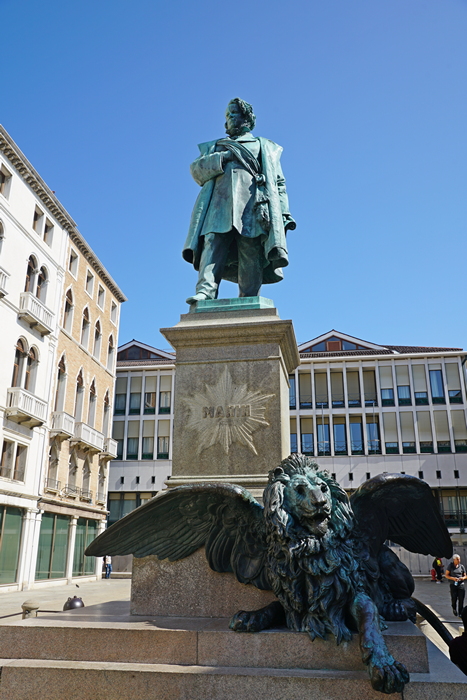
Daniele Manin (1804–1857) is one of the central figures in modern Venetian history. He was not a doge of the old Republic, but rather the man who briefly led Venice to independence in the 19th century. For many Venetians, he remains to this day a symbol of resistance and civil liberty.
Niccolò Tommaseo: The Scholar with the Books
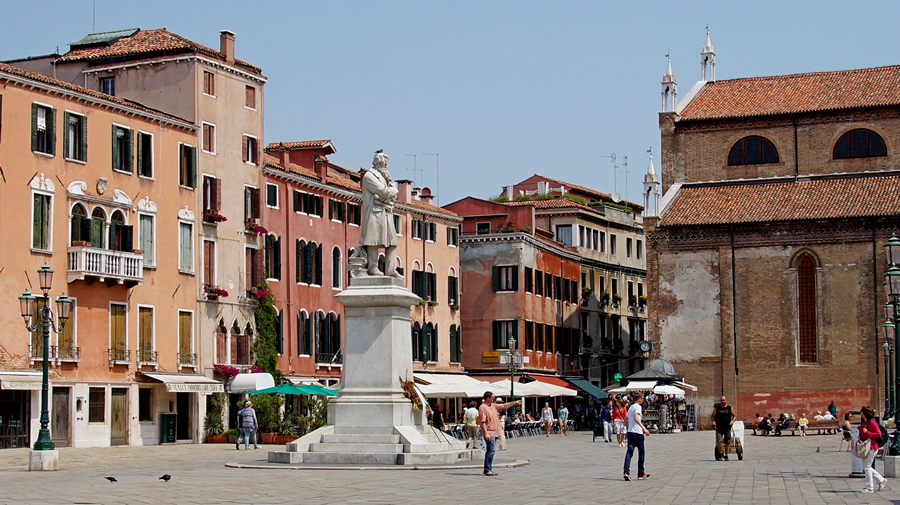
Niccolò Tommaseo (1802–1874) was much more than just a politician. He was one of Italy’s most prominent linguists and writers. In Venice, he is remembered above all as a close associate of Daniele Manin and as a champion of intellectual freedom.
San Bortolomio: The patron saint of merchants
When people in Venice talk about „San Bortolo,“ they mean the Saint Bartholomew (San Bartolomeo). He was one of Jesus’ twelve apostles and is omnipresent in Venice—not only as a religious figure, but also as the namesake of one of the city’s liveliest gathering places.
Viktor Emanuel II: The „Father of the Fatherland“
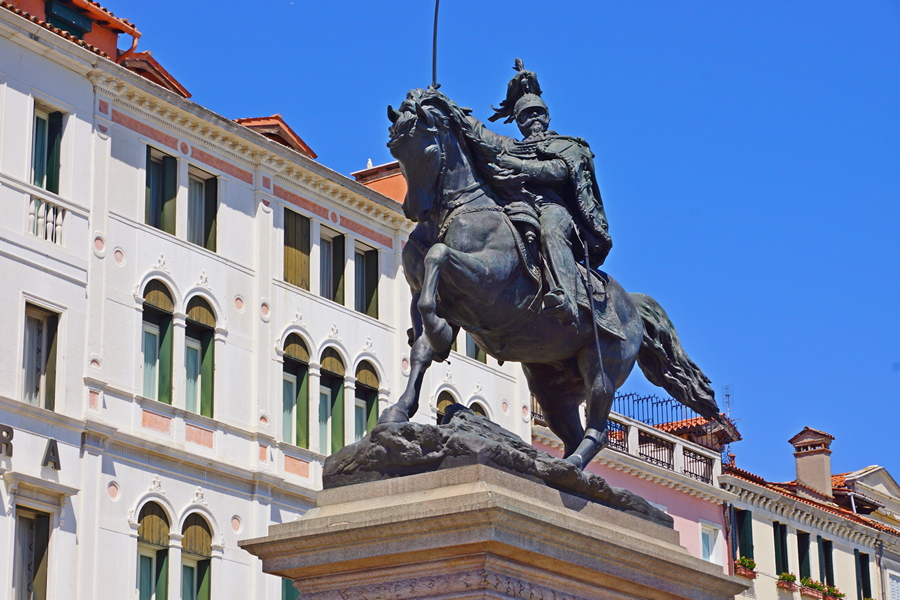
Viktor Emanuel II (1820–1878) was the first king of a unified Italy. He was a member of the House of Savoy and became a symbol of the Italian unification movement (the Risorgimento).