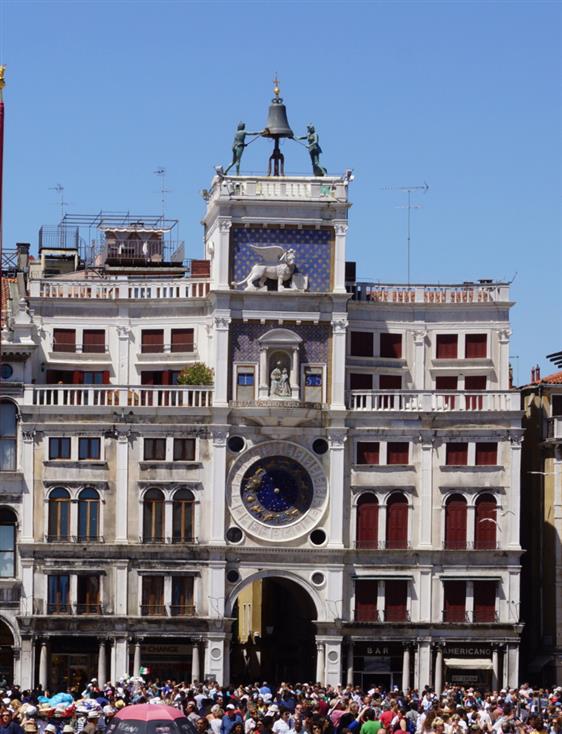
The famous Venice Clock Tower (Torre dell’Orologio) It stands on the north side of St. Mark's Square, right next to St. Mark's Basilica. It is one of the most famous landmarks of the lagoon city and one of the most impressive examples of Venetian Renaissance architecture.
The one between 1496 and 1499 The tower is famous above all for its extraordinary astronomical clock. It displays not only the time, but also the phases of the moon and the sun's position in the zodiac.
At the very top of the tower stand two large bronze figures, the so-called The Moors of Venice. They strike a massive bell with their hammers, announcing the hours so that everyone can hear them from far away.
Another distinctive feature is the ornate dial with its golden stars on a blue background.
Through the large gate beneath the clock tower, you can go directly from St. Mark's Square into the Merceria, one of Venice's most historic shopping streets, which leads toward the Rialto Bridge.
The clock tower is thus much more than just a historic building: it uniquely combines Architecture, Astronomy, Technology, and Venetian History.
The spire of the clock tower—the two Moors and their bell
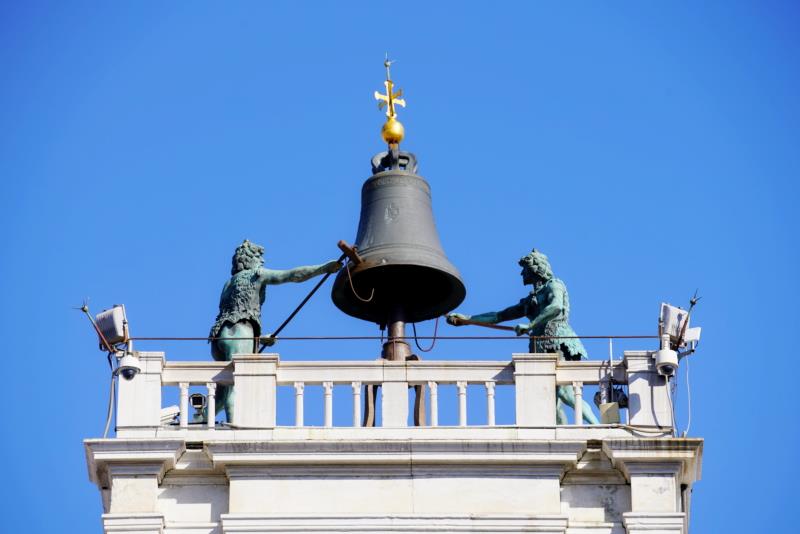
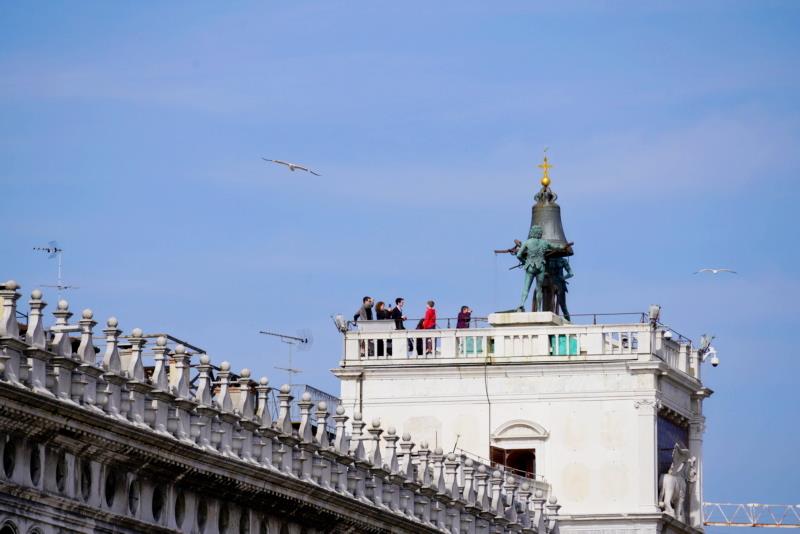
At the very top of the clock tower, visitors will find one of Venice’s most famous landmarks: two enormous bronze figures striking a massive bell with their hammers. The Venetians affectionately call these figures I Mori – the Moors. For more than 500 years, they have been part of the distinctive character of St. Mark's Square.
The Two Moors of Venice—they have been striking the hours since 1497
At the top of the clock tower on St. Mark's Square stand two bronze figures about 2.5 meters tall. Hanging between them is a large bell, which they strike with massive hammers. The figures are known as The Two Moors (I Mori) ...are called. In fact, however, they depict two shepherds. They owe their name to the dark patina on their bronze surface.
The Old and the Young Moor
If you take a closer look at the two figures, you'll notice an interesting difference: One figure has a beard; the other does not. The bearded Moor symbolizes old age, while the beardless one symbolizes youth.
They also differ in the way they strike the bell. The old Moor strikes the hour about two minutes before the hour, while the young Moor strikes it about two minutes after the hour. According to traditional interpretation, the old Moor thus symbolizes time already passed, while the young Moor represents the future. In this way, a seemingly simple clock becomes a symbol of the inexorable passage of time.
How do the giant bronze figures move?
The two Moors are no ordinary statues, but mechanically moving figures, known as automata. Their bodies have a joint at the waist. This allows them to rotate their upper bodies and strike the bell with their hammers. This design was already a remarkable technical achievement by the end of the 15th century.
Who created the two Moors?
The bronze figures were Cast in 1497 by Ambrogio delle Ancore. However, it is not entirely clear who originally sculpted the figures. Art historians have identified various sculptors. The figures were deliberately designed with robust physiques and striking contours. This makes them easily recognizable even from a distance.
The Big Bell Among the Moors
The bell also dates from the year 1497. It was created by a bell founder named Simeone, who left his name in an inscription on the bell. Above the bell are a gilded sphere and a cross. For centuries, the tolling of the bell served as a time signal audible from afar to the people in St. Mark’s Square.
A Change in the 19th Century
Interestingly, the figures no longer stand exactly at their original height. During renovation work on the spire in the 19th century, the two figures—along with the bell—were raised by about one meter. As a result, the silhouette of the clock tower has changed slightly over the course of its long history.
A Tip for Visitors to Venice
When you’re standing in St. Mark’s Square, you shouldn’t just look at the famous astronomical clock face—you should also look all the way up. It’s especially interesting to watch the two bronze figures just before the hour and observe their movements. It’s a spectacle whose origins date back more than 500 years.
The winged Lion of St. Mark on the clock tower.
Venice's symbol against a golden starry sky
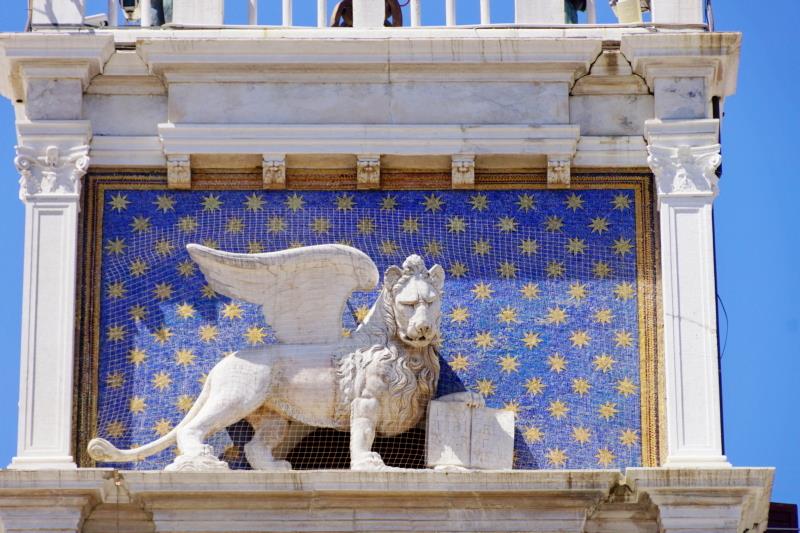
Directly below the two Moors is one of Venice's most important symbols: the winged Lion of St. Mark (Leone di San Marco). The mighty lion stands against a deep blue background adorned with numerous golden stars. His wings are spread wide, and one of his front paws rests on an open book.
This depiction is not merely a magnificent piece of Renaissance art. It serves as a reminder of the centuries-long power of the Republic of Venice, which La Serenissima —the Most Illustrious—called her.
Why is the lion the symbol of Venice?
The lion is the traditional symbol of St. Mark the Evangelist, the patron saint of Venice. According to Christian tradition, the four evangelists are associated with four winged creatures: Matthew is represented by a human or an angel, Mark by a lion, Luke by a bull, and John by an eagle.
When Venetian merchants brought the alleged remains of St. Mark the Evangelist from Alexandria to Venice in 828, St. Mark became the city’s most important patron saint. His winged lion became the official emblem of the Republic of Venice. To this day, he can be seen everywhere in the lagoon city: on columns, on palaces, above archways, on churches, and on historic flags.
What does the open book symbolize?
The Lion of St. Mark on the clock tower holds an open book under its front paw. In many depictions of the Lion of St. Mark, the book contains the Latin words:
PEACE BE WITH YOU, MARCUS THE EVANGELIST
In German, this means:
Peace be with you, Mark, my evangelist.
The phrase refers to a Venetian legend according to which an angel announced to the evangelist Mark that he would one day find his final resting place in the lagoon. It is often claimed that an open book signifies peace and a closed book signifies war. Although this interpretation is widespread, it cannot be historically upheld as a universal rule. The open book refers primarily to the evangelist and his Christian message.
Why is the background blue and decorated with gold stars?
The deep blue background is a particularly striking design element. The golden stars against the blue evoke the sky and lend the image a significance that transcends the earthly realm. As a result, the Lion of St. Mark does not simply appear against a colored wall, but rather, as it were, against the vault of heaven.
This combination of blue and gold was particularly popular in Venetian art. It can also be found in numerous mosaics, churches, and religious works of art throughout the city. Blue evokes the sky and the heavenly realm, while gold evokes light, radiance, and dignity.
On the clock tower, this creates a particularly striking combination: the Lion of St. Mark embodies Venice’s political identity, while the starry sky alludes to a higher, cosmic order. The large astronomical dial below the lion also features the colors blue and gold. In this way, the façade links the power of the Republic with the depiction of the heavens and the passage of time.
The Lion of St. Mark wasn't always alone
A remarkable historical detail is barely recognizable today. Originally, there was a kneeling statue of the Doge next to the Lion of St. Mark Agostino Barbarigo, who ruled the Republic of Venice from 1486 to 1501. The doge was depicted before the symbol of Saint Mark. This made it clear that even the most powerful man in the republic was under the protection and authority of the city’s patron saint.
When Napoleon overthrew the Republic of Venice in 1797, numerous symbols of the old regime were removed. The decoration on the clock tower was no exception. The statue of the Doge was destroyed and the Lion of St. Mark was removed. It was not until the 19th century that the lion was returned to its place. The statue of the Doge, however, was never restored.
The blue background also has a story behind it
Nor has the design visible today been preserved in its entirety from the 15th century. In the 18th century, the original blue-enameled copper background was replaced by a mosaic. In 1820, further restoration work was carried out on the blue mosaic surface. During the comprehensive restoration of the clock tower between 1996 and 2006, the mosaics and decorative elements of the facade were also restored.
What visitors see today is thus the result of more than 500 years of artistic design, political upheavals, and meticulous restoration.
A detail worth taking a second look at
Anyone who looks at the Lion of St. Mark on the Clock Tower sees more than just Venice’s most famous heraldic animal. They see a symbol of the former maritime republic, a testament to its Christian tradition, and a work of art whose history dates back to the Renaissance. The golden lion against the blue starry sky is one of the most beautiful details of the entire clock tower.
Why is there a net in front of the Lion of St. Mark?
If you take a closer look at the Lion of St. Mark, you’ll notice a fine protective net in front of the historical depiction. It’s likely intended to keep pigeons and other birds away from the valuable work of art. Bird droppings, in particular, can damage the delicate historical surfaces. The net is thus a modern protective measure, though it is barely noticeable from a distance.
The digital clock on Venice's clock tower
19th-Century Technology
A digital watch, long before electronics existed
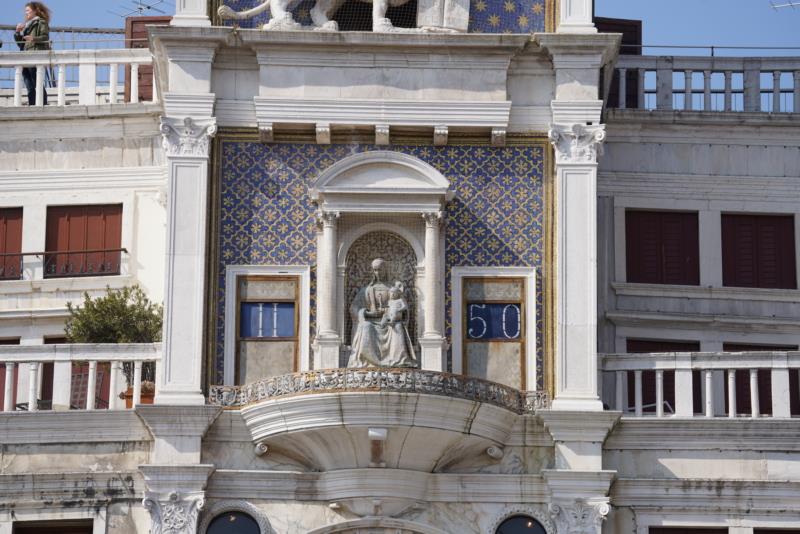
If you take a closer look at the clock tower in St. Mark’s Square, you’ll notice two rectangular digital displays above the large astronomical clock. Between them, in a richly decorated niche, stands a gilded Madonna with the Baby Jesus. The two displays bear a striking resemblance to a modern digital clock. But behind the visible numerals lies not electronics, but a sophisticated mechanical system. This digital time display was installed as early as 1858—more than a century before electronic digital clocks became widespread.
What do the two numerical displays mean?
The left display shows the hours in Roman numerals, such as VIII for 8 o'clock or XII for 12 o'clock. The right display shows the minutes in Arabic numerals, such as 05, 10, 15, or 30. A unique feature: The minutes are not displayed individually, but in five-minute increments. The display therefore advances only twelve times per hour. This allowed people in St. Mark’s Square to read the time much more accurately and easily than they could by relying solely on the large astronomical dial.
How does the mechanical digital display work?
Behind the two windows are two large rotating drums, known as the Tambure. Each drum has twelve display panels, each approximately 80 centimeters high and 50 centimeters wide. The left drum displays the Roman numerals for the hours, and the right drum displays the Arabic numerals for the minutes. A mechanical drive rotates the drums so that the correct number appears in the corresponding window.
What makes this special is that it doesn't involve hands moving across a dial, but rather changing number fields. This is exactly the same principle we see in later mechanical flip-number and digital watches.
Who came up with this unusual ad?
The two number drums were made in the year 1858 by Luigi De Lucia designed and installed. At that time, the historic clock underwent extensive modernization. The new display was intended to allow people to read the time more accurately from St. Mark’s Square. The design is one of the earliest examples of a mechanical digital time display on a public clock.
The Madonna and Child
Between the two numeric displays is a gilded depiction of the Virgin Mary with the Baby Jesus. The Madonna sits on a throne in an ornately designed niche. She is not merely a decorative element between the two displays. Her position holds special significance for the history of the clock tower.
Even at the clock’s dedication in 1499, the Madonna was part of an extraordinary mechanical spectacle. On certain holidays, the Three Wise Men, accompanied by an angel, would pass before her in a procession. The figures bowed before the Madonna and Child and then disappeared back inside the tower.
Why the Digital Display Replaced the Three Wise Men
The installation of the two number drums in 1858 created a technical problem. The new drums took up exactly the space that the moving figures needed for their procession. As a result, the procession could no longer take place regularly. A mechanism was developed that allows the drums to be lifted and moved back for special occasions. This clears the path for the figures once again.
Today, this historic spectacle can only be experienced on two special holidays: January 6, Epiphany, and Ascension Day.
A watch that bridges two eras
The two numeric displays and the Madonna depict two distinct chapters of Venetian history within a very small space. The Madonna and the Procession of the Three Kings evoke the Renaissance and the original clock from 1499. The mechanical digital display, on the other hand, reflects the technological advances of the 19th century. Both systems remain part of the same extraordinary clock tower to this day.
What looks like a simple digital display at first glance is actually a piece of technological history.
The technical details regarding Luigi De Lucia, the drums, and the twelve display panels are taken from the official documentation of the Venetian City Museums.
The Astronomical Clock of Venice
A masterpiece from 1499
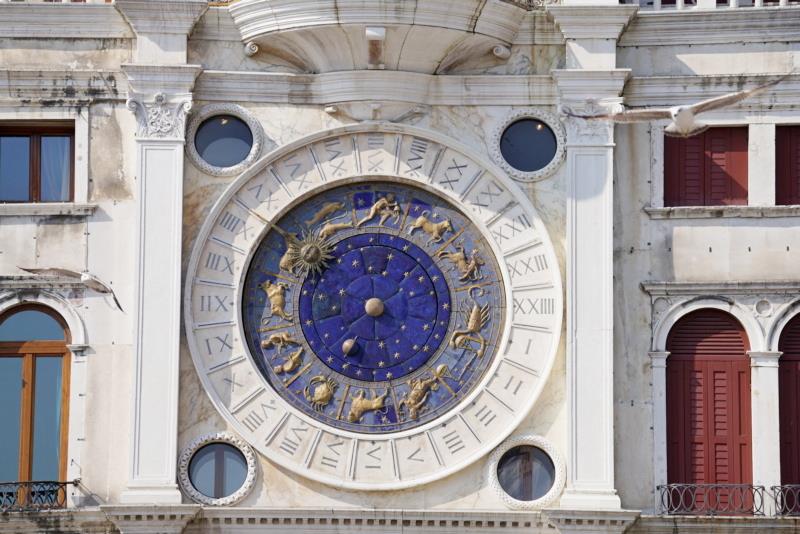
Now we’ve arrived at the very heart of the clock tower! And this is where a detailed description is especially worthwhile. For the large astronomical clock face in St. Mark’s Square is not simply a beautiful historic clock. It is a mechanical representation of the heavens as people understood them during the Renaissance.
The Astronomical Clock in St. Mark's Square—how do you read this extraordinary clock face?
With a diameter of about 4.50 meters The astronomical dial is one of the most impressive features of the Venice Clock Tower. Its bright blue surfaces, gilded zodiac signs, Roman numerals, and moving celestial bodies make it an extraordinary work of art.
But the dial is much more than just a decorative watch.
It displays several pieces of astronomical information at the same time:
- The current time on a 24-hour clock.
- The position of the Sun within the zodiac.
- The passage of the months and days throughout the liturgical year.
- The Moon's motion.
- The current phase of the moon.
The various displays are controlled by interlocking gears and discs rotating at different speeds. This makes the movement of the celestial bodies visible on a single large surface.
1. The outer ring—why does the watch have a 24-hour display?
A fixed marble ring is located at the very edge of the dial. The hours are marked on it with Roman numerals from I to XXIV. While most analog clocks today display only twelve hours, the astronomical clock in Venice features a full 24-hour scale. As a result, the hour hand only needs to circle the entire dial once a day. On a standard 12-hour clock, this happens twice a day. This method of displaying time has a long tradition in Italy.
In the traditional Italian hour system, known as the Italian Mines, hours were originally counted in relation to sunset. The start of the new day was thus based on natural daylight. This differs significantly from our current system of time reckoning, in which the new calendar day begins at midnight. Over the centuries, the measurement of time and clock settings have changed.
It is therefore important to distinguish between the historical Italian system of measuring time and the modern 24-hour clock. Roman numerals alone do not reveal which calendar system was used during a particular era.
2. The Zodiac—Twelve Zodiac Signs Made of Gold-Plated Copper
Inside the hour ring is a large rotating ring bearing the twelve signs of the zodiac.
The signs of the zodiac are not merely depicted as simple symbols. They are intricately crafted, three-dimensional figures made of gilded copper. They depict:
| Zodiac Signs | Latin name |
| Aries | Aries |
| Taurus | Taurus |
| Twins | Gemini |
| Cancer | Cancer |
| Lion | Leo |
| Virgo | Virgo |
| Scales | Libra |
| Scorpio | Scorpio |
| Sagittarius | Sagittarius |
| Capricorn | Capricorn |
| Aquarius | Aquarius |
| Fish | Pisces |
The signs of the zodiac form what is known as the zodiac. The zodiac is a region of the sky along the ecliptic—that is, the apparent path that the Sun follows against the backdrop of the stars over the course of a year. Since the Earth orbits the Sun, the Sun appears, as seen from Earth, to travel through the twelve sections of the zodiac over the course of the year.
The astronomical clock makes this apparent motion visible. The signs of the zodiac are also particularly valuable historical works of art: they date back to the original design of the dial at the end of the 15th century.
3. Why does the zodiac ring rotate?
The zodiac ring is not permanently attached to the marble frame. It is one of the movable parts of the dial. As the clock moves, its position relative to the sun hand and the other indicators changes. These different movements are necessary to display two distinct processes simultaneously: the daily apparent motion of the heavens and the slower annual change in the sun’s position in the zodiac.
The key point is the different speeds of the individual rings.
It appears that the sun takes a year to complete its cycle through the entire zodiac. At the same time, however, the clock must display the hours every day. To make both of these functions possible on a single dial, the movements must be mechanically synchronized. This is one of the most remarkable achievements of historic watchmakers.
4. The Sun Hand—a sun instead of a regular clock hand
The clock does not have a simple, slender hour hand like the ones we are familiar with on modern wall clocks. Instead, an artistically designed, gilded sun with a halo of rays and a long pointer extension is used to indicate the hours. The tip of the hand points to the outer ring bearing the Roman numerals. The sun hand also serves a second function: its position relative to the zodiac ring indicates which section of the zodiac the sun is currently in. Thus, a single mechanical component conveys two pieces of information:
The time of day and the sun's position throughout the year.
This is a particularly vivid example of how Renaissance clockmakers mechanically replicated astronomical phenomena.
5. The Months and Days—A Calendar on the Dial
In addition to the signs of the zodiac, the rotating ring also bears the names of the months and the numbers of the days. This makes the astronomical dial a kind of calendar as well. The position of the sun relative to these markings indicates the passage of the year. The annual cycle and the signs of the zodiac are closely linked. Over the course of the year, the sun appears to be in different sections of the zodiac. Its position shifts by about one degree each day. After approximately 365 days, it appears to have completed a full circuit. The watch replicates this slow change through its mechanical gear train.
For people of the Renaissance, this observation was of particular importance. The sun's path determined the seasons and influenced many aspects of daily life.
6. The Earth at the Center—The Renaissance Worldview
The Earth is at the center of the astronomical clock. This is no coincidence. When the clock was unveiled in 1499, the geocentric model of the universe was still the prevailing view in Europe. According to this view, the Earth stood motionless at the center of the universe. The Sun, Moon, planets, and fixed stars moved around it. This model is named after the ancient astronomer Claudius Ptolemy as Ptolemaic model of the universe referred to as.
It was not until 1543—44 years after the clock was inaugurated—that Nicolaus Copernicus published his famous work, in which he mathematically described the heliocentric model of the universe. According to this model, it is not the Earth but the Sun that is at the center of our solar system. The astronomical clock in Venice is therefore also an impressive testament to the history of science. It illustrates how people at the end of the 15th century conceived of the order of the heavens.
However, it is important to distinguish between the historical worldview and the practical representation: Even today, astronomers often describe the apparent positions of the Sun and the Moon from the perspective of an observer on Earth. A geocentric representation is therefore not automatically astronomically incorrect.
7. The Moon Indicator—a small sphere with great significance
In the inner part of the dial, next to the Earth, there is a depiction of the Moon. The Moon is designed as a small sphere with surfaces of different colors. One half is gold-plated, the other is dark. The sphere can rotate on its own axis. As a result, the viewer sees alternately the light half and the dark half.
This is how the different phases of the moon are depicted. Over the course of a lunar month, the visible appearance of the moon changes from a new moon to a waxing crescent, then to a full moon, and finally back to a new moon via a waning crescent. A complete cycle of the moon’s phases lasts, on average, about 29.53 days.
This period is known as a synodic month. The astronomical clock therefore shows not only where the Moon is, but also how it appears to be illuminated as seen from Earth.
8. Why were the phases of the moon particularly important to Venice?
For a city like Venice, observing the moon was of particular interest. For centuries, Venice was a major maritime trading power. Shipping, port operations, fishing, and conditions in the lagoon played a central economic role. Together with the Sun, the Moon influences the tides. During the new moon and full moon, there can be particularly large differences between high and low tide. These are known as spring tides. During the half moon, however, the tidal differences are often smaller.
However, the phases of the moon alone are not enough to predict the actual water level in Venice. Wind, air pressure, and other meteorological conditions can significantly affect the water level. The moon display was thus a visible symbol of astronomical knowledge that also had practical relevance to the lives of seafarers.
9. How are the Sun, the Moon, and the zodiac related?
One particularly interesting feature of the dial is the interplay of the various movements. The Sun moves slowly through the annual cycle relative to the zodiac. The Moon moves much faster along its orbit around the Earth. As a result, the relative positions of the Sun, Moon, and Earth are constantly changing. This is precisely what gives rise to the phases of the Moon.
During a new moon, the Sun and the Moon appear to be in roughly the same direction when viewed from Earth. During a full moon, they are roughly opposite each other in the sky. The astronomical clock depicts these relationships through mechanical movements. Thus, it is not simply a clock with several decorative displays, but a mechanical model of astronomical phenomena.
10. Why is the watch face blue and gold?
The colors of the dial are among its most striking features. The movable rings are made of wood covered with bold, blue-enameled copper sheets. The stars, figures, and zodiac signs are made of embossed and gilded copper. The intense blue is reminiscent of the night sky, while the golden stars and celestial bodies provide a striking contrast.
The color scheme, therefore, serves more than just a decorative purpose. It reinforces the astronomical significance of the entire dial. At the same time, it visually connects the clock to the Lion of St. Mark above it, set against its own blue, star-studded background. Blue and gold thus form a recurring design motif on the tower’s facade.
11. The original watch was even more complicated
What visitors see today in St. Mark's Square is already a simplified version of the original astronomical clock. When it was inaugurated in 1499, it also displayed the movements of the five planets known at the time:
- Mercury
- Venus
- Mars
- Jupiter
- Saturn
Each of these planets had its own movable ring and an associated mechanism. Together with the sun and the moon, this created an extraordinarily complex representation of the planetary system of that time. The original clock had eight movable concentric sections. The five planetary rings were later removed.
During the major overhaul carried out by Bartolomeo Ferracina between 1753 and 1759, the dial was significantly simplified. Since then, the astronomical display has focused on the time, the sun’s position in the zodiac, and the moon’s motion and phases. Today’s clock is therefore a historical work of art that brings together technical developments spanning several centuries.
12. How is the astronomical clock powered?
Behind the magnificent dial lies a large mechanical movement. The energy comes from heavy weights connected via chains to drums and gears. As the weights slowly descend, the stored potential energy is converted into mechanical motion. The gear train transmits this motion to the various displays. In doing so, different gear ratios must be generated.
The hour hand is designed to complete one full rotation within a day. The position of the sun relative to the zodiac, on the other hand, changes only slowly over the course of a year. The moon display, in turn, requires separate mechanisms for the moon’s position and the moon phases. These different speeds are achieved through carefully calculated combinations of gears.
A balance wheel and an escapement ensure that energy is not released uncontrollably, but rather that the watch runs at a steady pace. The basic system in use today is largely based on the modifications made by Bartolomeo Ferracina in the 18th century.
13. A technical detail: 264 teeth for one revolution per day
A particularly beautiful example of mechanical design is the transmission mechanism for the sun hand. A gear with 22 teeth completes twelve revolutions in a single day. In doing so, it moves a total of 264 teeth. The large gear it meshes with has exactly 264 teeth.
The calculation is: 22 × 12 = 264
This means that the large wheel completes exactly one revolution in a single day. In this way, the daily movement of the hour hand can be derived from the mechanical drive. This example shows how watchmakers were able to create complex movements using simple mathematical ratios.
14. Why was this clock such a sensation in 1499?
At the end of the 15th century, building such an astronomical clock was an extraordinary technical challenge. The clockmakers not only had to build a reliable movement for measuring time; they also had to calculate various astronomical motions and reproduce them using mechanical gears. Added to this were the large dimensions of the dial, the heavy moving parts, and the requirements for a public clock that would function reliably over the long term.
The design required expertise in mathematics, astronomy, metalworking, and precision engineering. For the Republic of Venice, the clock was therefore also a publicly visible symbol of its economic strength, scientific interest, and technical prowess. Anyone standing in St. Mark’s Square in 1499 could admire one of the most remarkable technical achievements of the time.
15. An astronomical clock that still fascinates us today
More than five centuries after its inauguration, Venice’s astronomical clock continues to attract attention. Many visitors admire above all its colors, the golden figures, and the magnificent dial. However, those who take a closer look at how it works will discover much more.
The clock combines the measurement of daily time with the sun's annual cycle, the phases of the moon, and the historical worldview of the Renaissance. It is at once a work of art, an astronomical display, and a testament to centuries of watchmaking craftsmanship.
The astronomical clock in Venice does more than just tell the time. It tells the story of how people have been trying for centuries to understand and visualize the movements of the heavens.
The large entrance gate to the clock tower
From St. Mark's Square to Venice's World of Trade
At the very bottom of Venice's Clock Tower is a large, magnificently designed archway. Through it, visitors can go directly from St. Mark's Square into the Merceria dell’Orologio, the beginning of one of Venice's most historic shopping streets. The archway, however, is much more than just a practical passageway. It was a deliberately planned architectural element even when the clock tower was built at the end of the 15th century.
A Triumphal Arch for the Republic of Venice
The entrance was designed to resemble a Roman triumphal arch. Massive piers, projecting columns, exquisite marble cladding, and decorative circular elements give it a monumental appearance. Renaissance architecture drew heavily on the forms of Greek and Roman antiquity. The clock tower also reflects this stylistic tradition.
The Triumphal Arch, however, was not intended to celebrate a military victory. Rather, it was meant to showcase the economic strength, prosperity, and self-confidence of the Republic of Venice. Anyone entering St. Mark’s Square was meant to realize that they were in a powerful and prosperous commercial metropolis.
Why was the clock tower built right here?
The decision to build a new public clock was made as early as 1493. At first, however, the exact location had not yet been finalized. It was not until 1495 that it was decided to install the new clock above the entrance to the Mercerie. On June 10, 1496, demolition work began on the existing houses to make room for the new building.
On February 1, 1499 The new clock was unveiled in a ceremony. This resulted not only in a clock tower at this location, but also in a stately city gate.
The Mercerie – Venice's Historic Shopping Street
The Merceria dell’Orologio begins just beyond the archway. It is part of the famous Mercerie, a series of narrow shopping streets that connect St. Mark’s Square with the area around the Rialto Bridge. As early as the Middle Ages, this area was one of the city’s most important trade routes. It was home to numerous shops, workshops, and retail spaces. Merchants sold fabrics, clothing, jewelry, and other goods, among other things.
The Name Haberdashery is derived from the Italian word for goods or merchandise. While Venice’s most important political and religious institutions were concentrated in St. Mark’s Square, one of Europe’s most significant commercial and financial centers developed around the Rialto. The Clock Tower thus marked the transition between two central areas of the city.
A goal with two completely different perspectives
If you walk through the archway from St. Mark’s Square, you’ll find yourself in the comparatively narrow, bustling shopping streets. If, on the other hand, you walk from the Mercerie toward the Clock Tower, you’ll get a completely different impression. As you pass through the archway, the vast St. Mark’s Square suddenly opens up before you. This contrast was an intentional architectural choice.
The official description by the Venetian City Museums refers to the tower as a deliberate link between the prestigious St. Mark’s Square and the world of commerce. The passageway thus serves as both a boundary and a connection.
Why is there a big clock above the entrance?
Placing the astronomical clock at this location was also a deliberate decision. The clock was intended to be visible to as many people as possible. St. Mark’s Square was one of Venice’s most important public spaces. Merchants, citizens, dignitaries, and visitors from numerous countries gathered here. The large astronomical clock not only displayed the time but also showcased the Republic’s technical and scientific prowess. Its effect was particularly striking on visitors who arrived in Venice by sea and approached St. Mark’s Square.
The clock tower was one of the city's landmarks visible from afar.
The Archway and the Original Architecture
When the clock tower was completed in 1499, its surroundings looked quite different from what they do today. The two side wings of the building were not constructed until the following years. The neighboring Alte Prokuratien were also extensively remodeled later on. As a result, the clock tower initially stood much more freely and appeared more like a standalone monument. Only gradually did the architectural complex that appears so harmonious today take shape. This is an important distinction: the clock tower was not simply inserted into the current building facade. Rather, the architecture of its surroundings changed over the course of the following decades.
An entrance used by thousands of people every day
Today, the archway is one of Venice’s most famous passageways. Countless visitors pass through here on their way from St. Mark’s Square to the Rialto or from the Mercerie to the square. Many admire the magnificent astronomical clock, the Madonna, the Lion of St. Mark, and the two Moors. Yet few realize that the arch itself is also a significant architectural monument.
For more than 500 years, it has connected Venice’s prestigious city center with one of its most important historic trade routes.
And to this day, it continues to fulfill exactly the purpose for which it was created at the end of the 15th century.
Take a tour of the inside of Venice's clock tower
EA Journey Through 500 Years of Watchmaking
The famous clock tower on St. Mark's Square isn't just something to admire from the outside. On a guided tour, visitors can also explore its interior and learn about the fascinating mechanics of the historic clock.
This tour is especially interesting for people who are passionate about technology, astronomy, history, and Venetian architecture. The tour takes you through five floors, all the way up to the Terrace of the Two Moors.
Where is the entrance to the clock tower?
The entrance is located on the left side of the large archway that leads from St. Mark's Square to the Mercerie. However, you can't just walk in on a whim. The clock tower is accessible only as part of a pre-booked guided tour. Visitors are guided through the historic rooms by a knowledgeable tour guide. The meeting point is not directly at the tower, but at the ticket office of the Museo Correr on St. Mark's Square.
What will you see on the tour?
The tour is a journey of discovery through the history of technology in Venice.
1st Floor – The History of the Clock Tower
After climbing the first stone steps, you reach a small room where the tower’s construction and development are explained. Even here, parts of the mechanism are visible. These include the large weights and counterweights that move slowly up and down inside the tower.
2nd Floor – The Large Mechanical Clockwork
A metal spiral staircase leads to the tower’s true centerpiece: the historic clockwork mechanism. Here, visitors can view the numerous gears, shafts, and mechanical connections up close. The clockwork mechanism controls not only the time display but also the astronomical displays, the numeric displays, and the chimes. This part of the tour is particularly impressive for visitors with an interest in technology.
3rd Floor – The Three Wise Men and the Digital Display
In the next section are the wooden figures of the Three Wise Men and the angel. These figures are part of a mechanical spectacle that takes place on two special holidays. On Epiphany and Ascension Day, they pass in front of the Madonna and Child. You can also see the mechanism of the two large numeric drums here, which display the hours and minutes on the outside of the tower.
4th Floor – Historic architectural elements from the 15th century
Another flight of stairs leads to a room where preserved parts of the original Renaissance clock mechanism are kept. Here, it becomes clear how the technology has changed over the course of more than five centuries. From this level, you can also reach the two side terraces of the clock tower.
5th Floor – The Terrace of the Two Moors
The final ascent leads up a particularly steep and narrow spiral staircase to the top terrace. There stand the two famous bronze figures that strike the hours on the great bell with their hammers. From here, you can view the enormous figures up close. At the same time, an extraordinary view opens up over the rooftops of Venice, St. Mark’s Square, and the lagoon. This view is the crowning finale of the tour.
How long does the tour last?
For the tour, you should allow about one hour Please keep this in mind. Since the interior spaces are narrow and some of the stairs are very steep, tours are only available with a knowledgeable guide.
Is the tour suitable for everyone?
Unfortunately, no. The clock tower is a historic building whose interior was not designed to accommodate modern visitor traffic. The staircases are narrow, steep, and winding in places. The tour is not accessible to people with significant mobility impairments. People who suffer from a severe fear of heights, claustrophobia, or certain heart and respiratory conditions should also refrain from participating. Children must be at least six years old to participate.
Why is the tour worth it?
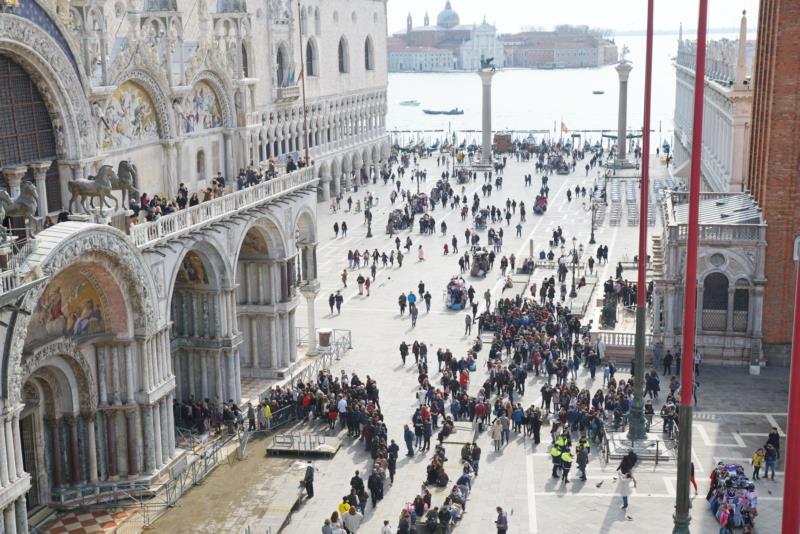
From the outside, the clock tower captivates visitors with its magnificent astronomical dial, the Lion of St. Mark, and the two Moors. But it is only once inside that one realizes the technical masterpiece behind these displays. Here, visitors can see how gears, weights, shafts, and mechanical controls work together. The guided tour thus offers a rare glimpse into the history of technology during the Renaissance and in subsequent centuries.
Anyone who wants to experience Venice not only as a city of churches, palaces, and canals, but is also interested in its engineering achievements, will find an extraordinary attraction here.
Admission Prices and Practical Information
REGULAR ADMISSION 15,00 €
DISCOUNTED 11,00 €
| Duration of the tour | About 60 minutes |
| Languages of Instruction | Italian, English, French |
| Minimum Age | 6 years |
| Reservation | Required |
| Meeting Place | Museo Correr Ticket Office |
As of October 15, 2026. Prices and terms are as listed on the museum's official website.
The clock on the back of the clock tower—why is there a second clock?
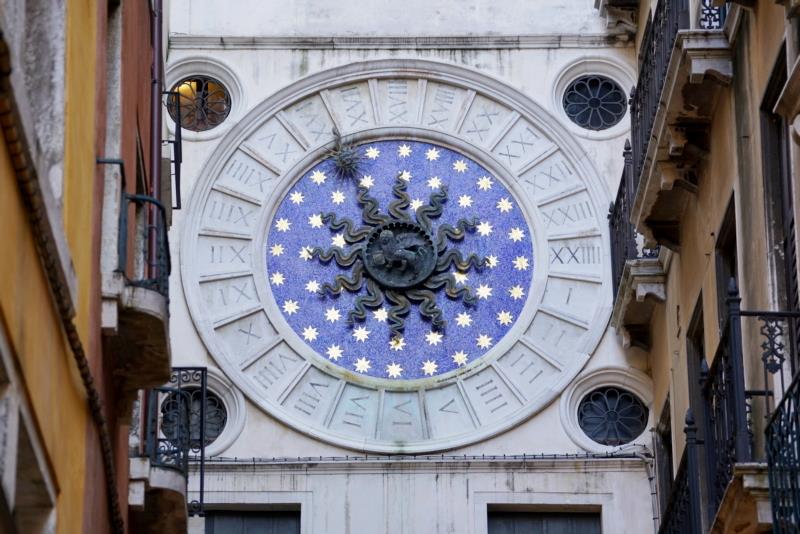
If you walk from St. Mark's Square through the large archway of the Clock Tower into the Mercerie and then turn around, you'll discover a surprise. There is also a large clock on the back of the clock tower. Its design is much simpler than that of the famous astronomical clock on the front. Nevertheless, it has some remarkable features.
Why does the clock tower have a clock on the back as well?
The explanation has to do with the tower’s unique location. In front of it lies St. Mark’s Square, the political and religious center of the former Republic of Venice. Behind it begin the Mercerie, the historic shopping streets leading toward the Rialto Bridge.
Merchants, artisans, and businesspeople worked and conducted their affairs here. A clearly visible public clock was just as useful to them as it was to the people in St. Mark’s Square. That is why the clock tower was equipped with two clock faces when it was built at the end of the 15th century.
While the elaborate astronomical clock faces St. Mark's Square, there is a simpler clock on the Mercerie side that displays only the hours.
Why does the clock have 24 hours instead of 12?
This seems unusual to today's visitors. After all, most analog clocks have only twelve hour markers. In Italy during the late Middle Ages and the Renaissance, however, clocks with 24-hour dials were by no means uncommon. At that time, the so-called Italian hourly rate (Ore Italiane) spread. The hours were counted in a cycle from 1 to 24, based on sunset.
So, unlike today, the new day did not begin at midnight. Since the time of sunset changes throughout the year, a clock operating on this system had to be adjusted regularly. The original astronomical clock on the front also used this historical system.
However, today's display should not be equated with the original time-keeping mechanism. The movement has been modified several times over the centuries and adapted to modern timekeeping.
A dial with golden stars
The clock on the back is also a remarkable work of art. Its outer ring is made of marble and bears the Roman numerals for the hours from I to XXIV. The inner surface is adorned with a deep-blue mosaic featuring numerous golden stars. In front of it moves a large, gilded sun hand. The sun disk, with its flame-like rays, has a diameter of approximately 1.70 meters.
In the center is a face with a diameter of about 70 centimeters. Also mounted in the center of the dial is a copper Lion of St. Mark, which was once gilded. This small lion even serves a technical purpose: it conceals the base of the shaft that transmits the movement of the clockwork to the hands.
Why does this clock also show the sun?
Since ancient times, the sun has been one of the most important symbols of time. Its apparent daily path across the sky marks the transition between day and night. That is why the sun appears on numerous historical clocks as a hand or a central design element. On the back of the Venetian clock tower, it connects the practical hour display with an artistic depiction of the sky. The blue starry background also echoes the color scheme of the astronomical clock on the front.
Is the clock on the back just as old as the astronomical clock?
The clock face on the rear of the tower was already part of the original design of the clock tower from 1499. Its current appearance, however, is the result of several changes. In the 18th century, the originally blue-enameled background was replaced by a mosaic. The clock mechanism has also been modified several times.
The rear clock is thus yet another example of how historical technology and artistic design have evolved over the course of more than five centuries.
One clock for the merchants and one for St. Mark's Square
The two dials illustrate the clock tower’s dual function. Facing St. Mark’s Square, the elaborate astronomical clock stands as a symbol of science, art, and technical skill. Facing the Mercerie, a much simpler clock tells the time to passersby.
Two watches, two different functions—and yet both are part of a single mechanical masterpiece.
Why doesn't Venice's clock tower look like a tower at all?
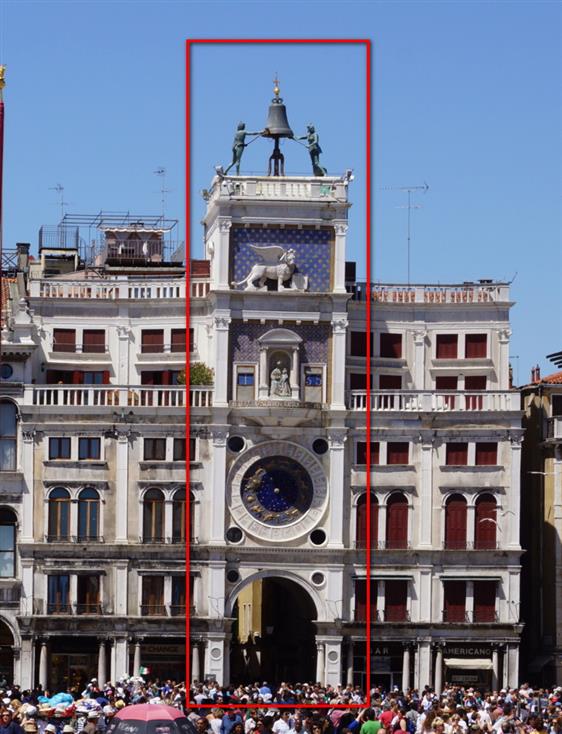
Anyone standing in St. Mark’s Square and looking at the famous clock tower will notice an architectural peculiarity. Unlike the nearly 99-meter-tall, freestanding Campanile of St. Mark’s Basilica, Venice’s clock tower is flanked by buildings on both sides. It appears to be seamlessly integrated into the long row of buildings on the north side of St. Mark’s Square.
At first glance, therefore, it looks more like a particularly ornate section of the facade than a tower in its own right.
But this impression is misleading.
Originally, the clock tower stood in a much more open space
When the clock tower was built between 1496 and 1499, the north side of St. Mark’s Square was laid out differently than it is today. To make room for the tower, several older buildings had to be demolished. The new tower was built as a freestanding, monumental structure above the entrance to the Mercerie.
Even back then, its unusual width and magnificent Renaissance façade set it apart from the narrow, soaring bell towers found in many Italian cities. It was intended not only to house a clock but also to serve as a grand entrance to the commercial district.
The buildings on either side were added later
After the clock tower was completed, additional wings were built on both sides. Construction began in 1500, and the wings were completed in the years that followed. The architecture of the side wings was deliberately modeled after that of the central clock tower.
This created a cohesive facade. In the 18th century, the side wings were altered once again and raised by one story. Thus, the appearance we know today gradually took shape.
The Old Procurator's Offices—an Imposing Row of Buildings
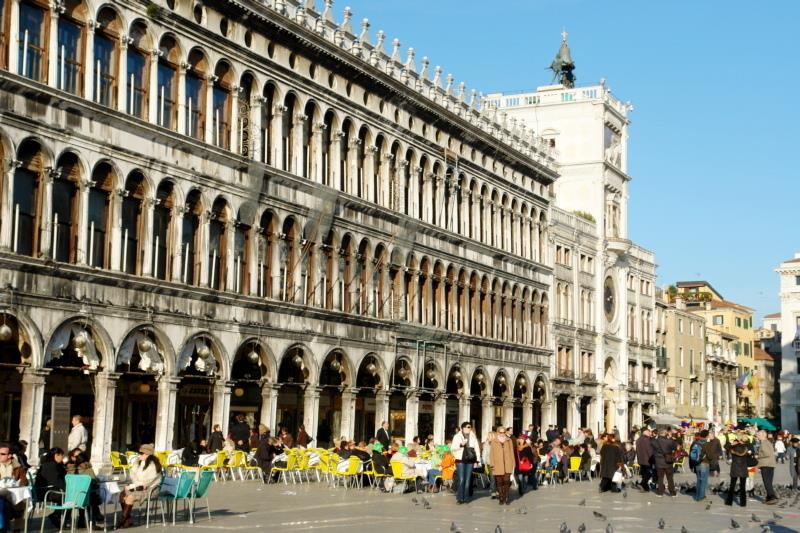
Right next to the clock tower are the Procuratie Vecchie, the Old Procurator's Offices. This long, narrow building with its distinctive arcades forms the northern side of St. Mark's Square. This is where the offices and residences of the Procurators of St. Mark—who were among the highest-ranking officials of the Republic of Venice—were located.
The Renaissance façade of the Old Procurator’s Offices that can be seen today was built primarily in the 16th century. It features several superimposed rows of arches and windows that give St. Mark’s Square its characteristic architectural appearance. The Clock Tower forms a particularly striking conclusion at the eastern end of this long building facade.
Why wasn't the clock tower built as a freestanding structure, like the Campanile?
From the very beginning, the Campanile and the clock tower served different purposes. The Campanile was the bell tower of St. Mark’s Basilica. Its enormous height made it a landmark visible from afar, especially for mariners. The clock tower, on the other hand, was intended to house a large public clock and at the same time highlight the entrance to the Mercerie.
Its location above the passageway was therefore no coincidence. Here, it connected St. Mark’s Square with the city’s most important trade routes. Above all, the astronomical clock was designed to be clearly visible to people in St. Mark’s Square. A wide, monumental structure with a grand facade was particularly well-suited for these purposes.
A tower that also serves as a city gate
The Clock Tower of Venice is therefore an unusual combination of several architectural forms. It is a clock tower because it houses the large astronomical clock and the bell with the two Moors. It is a monumental city gate because the public passageway beneath it connects two important areas of Venice. And it is a Renaissance structure whose magnificent façade was deliberately integrated into the architectural design of St. Mark’s Square. It is precisely this combination that makes it so extraordinary.
Only from the right perspective can one recognize its independence
If you view the clock tower only from the front, from St. Mark’s Square, what you see most of all is the richly decorated facade. Only when you look from the sides or from the back does it become clearer that behind this facade lies a separate structure with several stories, staircases, technical rooms, and a large mechanical clockwork mechanism.
The clock tower, then, is not simply part of the building's facade. It is a historic structure in its own right, around which the architecture of St. Mark's Square has developed over the centuries.
And that is precisely what makes it one of the most unusual clock towers in Europe. Its architectural history is particularly significant: the two side wings of the clock tower were built as early as the beginning of the 16th century. They were later modified, particularly in the 18th century. Its current integration into the northern facade of St. Mark’s Square is thus the result of several phases of construction.

This article was compiled by „Bernd and Christoph – The Venice Guides“ for Venedig.com based on their own visits, photographs, video footage, and historical sources. AI was used to assist with research and editorial preparation. Editorial responsibility lies with Venedig.com.