Here, you'll learn in an easy-to-understand way through text and images:
- When, if at all, the annual (winter) flooding might occur,
- What you should keep in mind as a tourist, and
- What a treat it would be to experience the flood in person at least once.
Venice's Unique Island Location
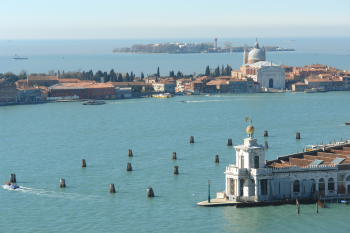
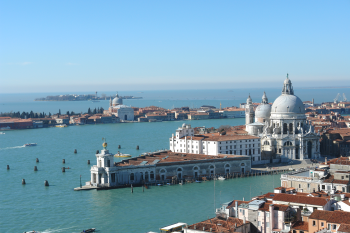
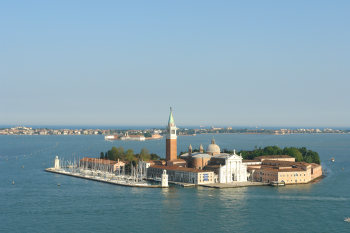
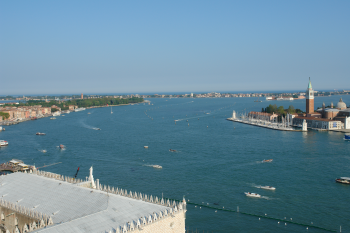
As you’ve probably heard, Venice is a cluster of many small islands located in the middle of the lagoon in the northern Adriatic Sea. You’ve likely read this sentence and this introduction many times on Venedig.com. Nevertheless, it belongs here as well. After all, the city’s island location in the lagoon is the cause of the annual flooding
Important: The flooding occurs only during particularly high tides in the Adriatic Sea and disappears just as promptly with the next low tide.
What the flood is NOT:
- The high water in Venice is NOT a flood,
just as you're used to seeing in rivers and streams. - There is NO dirty brown sludge flowing that makes everything filthy.
- There is NO traveling current that carries everything along with it.
The 5 Causes of Flooding.
Five simultaneous events are required for flooding in Venice
1. The usual daily sights, with the ebb and flow of the tide.
2. A particularly high tide, such as occurs only during a full moon or new moon, and
3. A specific weather pattern over the Adriatic Sea that, combined with strong winds, pushes water into the lagoon.
4. The southerly wind, the sirocco, pushes the water into the lagoon.
5. Water level of the Adriatic Sea, which depends on the rainfall in the preceding period.
Since this particular weather pattern, characterized by low-pressure systems, usually occurs only during the winter months around November, flooding also tends to occur only in the winter.
Given their positions relative to Earth, the Sun and the Moon must exert a particularly strong gravitational pull, thereby causing an exceptionally high tide.
This is only the case on the days before, during, and after the full moon and new moon.
Only on these days can the tide rise high enough to affect parts of Venice.
On the days around the half-moon, high tide is not expected. The difference in water level between high tide and low tide is far too small here.
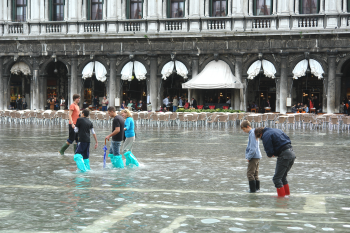
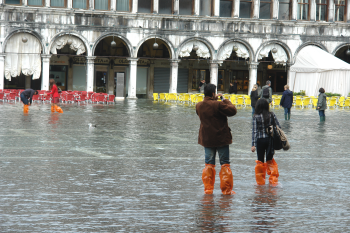
You’ll be surprised at how unremarkable the high water is to the Venetians themselves. Only the tourists with their cameras are excited about it. If you ever visit Venice in the winter—between November and March—and see people wearing tall rubber boots, you’ll know: High water is forecast for today. Even in the media, the situation is often portrayed as much more dramatic than it really is.
The flooding does have its (small) advantages:
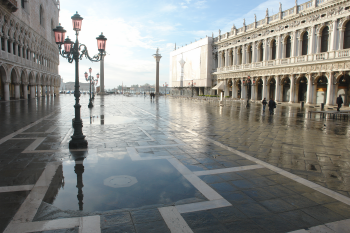
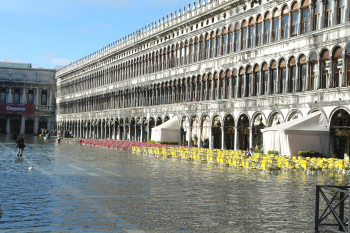
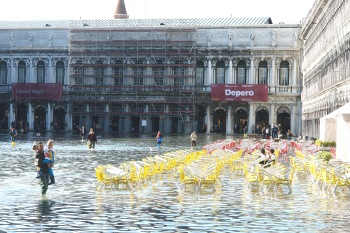
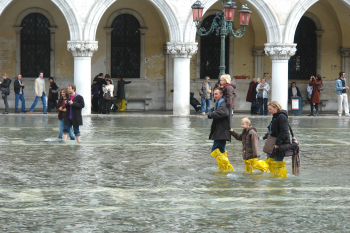
Being the shrewd businesspeople that Venetians are, many shops around St. Mark’s Square sell colorful „disposable“ plastic boots for just a few euros. Children, in particular, love them. As you can see in the picture, the floodwaters cover only a few Zenit meters of the alleys and squares. The water is clean and clear.
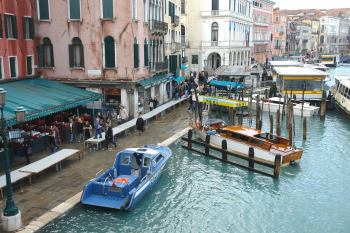
The high tide does NOT flood the entire city for days on end. The water comes in with the rising tide—lasting only a few hours—and recedes again with the next low tide. The high tide is also NOT felt equally throughout the entire city. The lower-lying areas in particular—including St. Mark’s Square and the Rialto Bridge—are the first places where the water becomes visible.
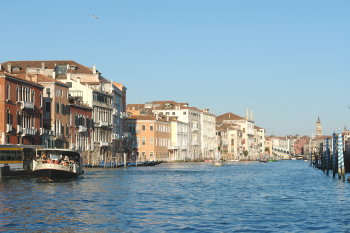
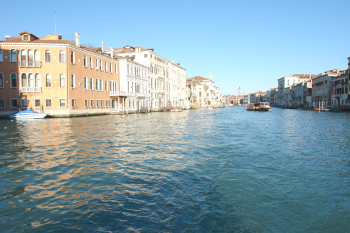
As in all coastal cities around the world, the water level rises and falls with the tides. This is also the case in Venice, an island in the northern Adriatic Sea. Without you even noticing, the water level in the numerous canals that crisscross Venice fluctuates daily. Flooding occurs only when the high tide is particularly high. The only question that remains is: When is the high tide high enough to affect the lower-lying parts of Venice?
The Tide Forecast for Low and High Tides
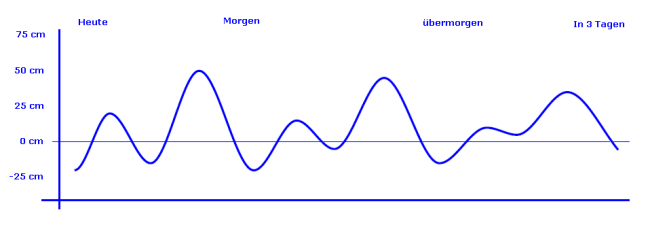
The Venice tide forecast pages state: A high tide of up to 80 cm above normal is considered a normal high tide without flooding. At 100 cm above normal, approximately 5% of the historic center gets wet. At 110 cm, it’s 14%; at 120 cm, it’s 30%; at 130 cm, it’s 45 %, and so on.
The link: http://www.ilmeteo.it/portale/marea-venezia
Wikipedia states that a state of emergency is declared when the level reaches 140 cm. http://de.wikipedia.org/wiki/Acqua_Alta
Additional links to tide forecasts:
Two links to tide forecasts for the next 3 days
http://www.comune.venezia.it/flex/cm/pages/ServeBLOB.php/L/IT/IDPagina/2104
http://www.comune.venezia.it/flex/AppData/Local/bollettinoMaree.pdf (Marea = tides)
When planning your trip to Venice, you can already tell whether or not you'll get to experience this rare natural spectacle.
The First Signs of Flooding
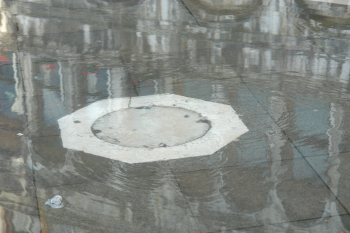
The cobblestones in the narrow alleys and squares—such as St. Mark’s Square—are deliberately NOT laid perfectly flat (100%). A slight undulating pattern has been incorporated here, which you as a tourist may not particularly notice. This allows water to drain away during rain or thunderstorms. Similarly, the surface of the numerous alleys is intentionally slightly arched toward the center and slopes slightly toward the building walls on the sides. In addition, there are small drainage slits in the pavement along the sides, through which rainwater can flow away.
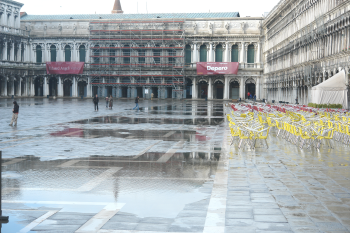
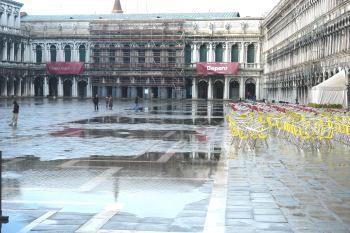
The surface of St. Mark’s Square is slightly undulating. You probably won’t even notice it here. In the slightly sunken areas, there are white marble covers with small openings through which rainwater can drain. If the high water is „only“ one meter above normal sea level, only a few—and only the lowest-lying—parts of the city are affected. 50–79 cm above sea level is normal; 80–119 is already high. Only when the water rises higher are larger areas of Venice affected.
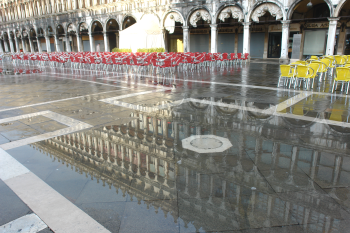
Rainwater flows into these cracks, crevices, and openings and can then drain away through underground pipes. The water rises through the sand and seeps back down through it. There is no drainage system. Conversely, during particularly high tides, seawater enters the city through this rainwater drainage system. Even St. Mark’s Square is not completely level. There is always a small depression where the round manhole covers are located. These manhole covers are not made of cast iron, but of marble.
Is Venice really sinking?
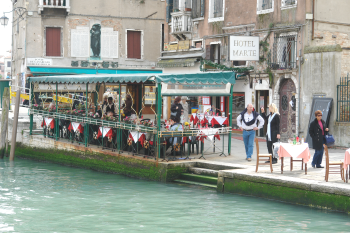
The city's ground has been sinking for many years due to groundwater extraction.
1. Groundwater was extracted for the industrial port of Mestre until the early 1970s, when it was discovered that the artesian wells had run dry. In Venice, this led to the city sinking, so the practice was discontinued.
2. The entire Po Plain has been subsiding at an average rate of 4 cm per century for centuries, and this process cannot be stopped.
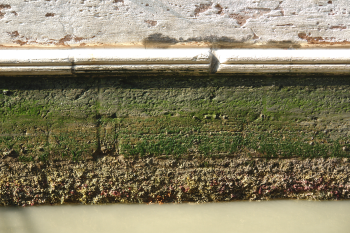
3. Rising sea levels are also a problem for Venice. Even though the city has sunk by only about 20 centimeters over the past 100 years, the effects are noticeable. You can easily see this for yourself: Most of the staircases leading down from the alleys and houses to the canals are overgrown with green seaweed and, even at low tide, are usually still below the water’s surface.
I'm not getting involved in the argument here about
- rescue projects such as Moses,
- the influence of industry in Mestre on the mainland and
- the impact of large tankers and ships.
- The much-cited issue of climate change, with its feared rise in sea levels,
That's not an issue here.
By the way, the Italian name for high water is „Acqua Alta.“
The Police: Your Friend and Ally
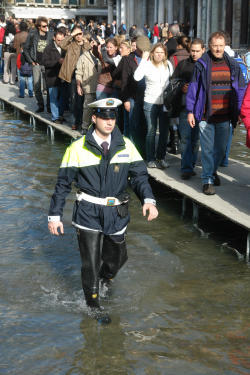
The police, wearing knee-high rubber boots, seem to be enjoying the water. Anyone who lingers on the narrow walkways is asked to:
- not to hold up traffic for too long,
- take his picture and move on.
By the way:
Over the past 10 years, only one guest has canceled a hotel reservation with us, the Venice accommodation agency.
He thought that all of Venice would be flooded for several days and that he therefore wouldn't be able to go on a city tour.
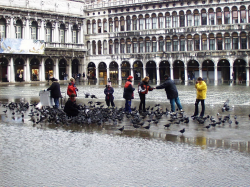
The vendor stands and cafes on St. Mark's Square aren't doing any business during this time.
But as the next low tide rolls in, the water slowly recedes again, and the first vendors are already back!
The pigeons are hungry now, too, and are after their food again!
Partitions as Protection
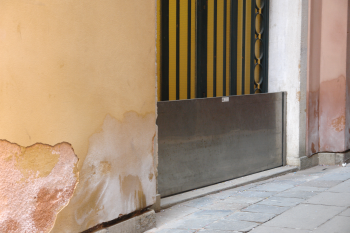
Many businesses protect themselves with special barriers (partition walls) during periods of flooding. At the rear of many buildings, doors that are rarely used are permanently locked and protected year-round. The problem with these partition walls arises only when weather forecasts are inaccurate or incorrect. If the floodwaters do end up rising higher than expected, many homes and stores get flooded. Who pays for the damage then?
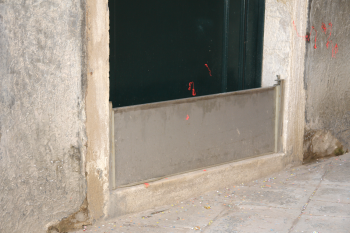
If the forecast is timely and accurate, you can protect yourself by taking additional precautions (such as sandbags, etc.). The floodwater does NOT penetrate the walls of houses on a large scale; the flood is far too brief for that.
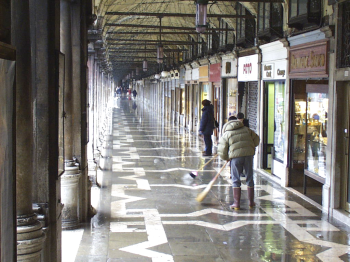
You can tell by the Venetians’ reaction. Everything proceeds very calmly, serenely, and routinely. No rush, no fear, no panic. Flooding is simply part of everyday life in winter. They usually sit in a café until the floodwaters recede, then sweep out their shops and the sidewalk, and daily life goes on as usual. Venetians who are out and about a lot wear rubber boots all day long.
Flood Prevention
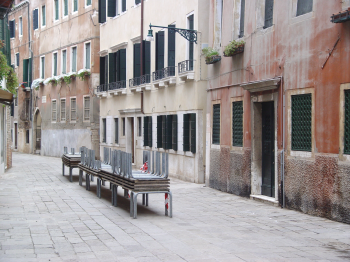
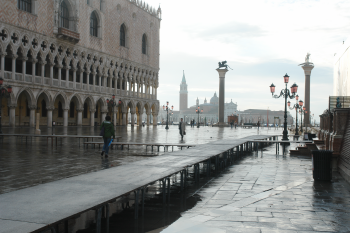
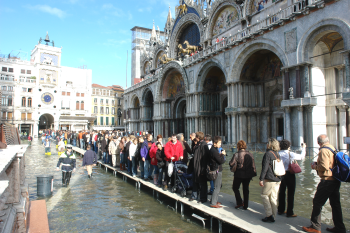
For safety reasons, these joined-together walkways are placed at particularly vulnerable spots in Venice from early September through late April. They often serve as a welcome place to sit for tired tourists. Since high water usually occurs in the winter and the nights are particularly long here, you won’t even notice many high-water situations. You’ll just wonder the next day why some alleys and squares are wet.
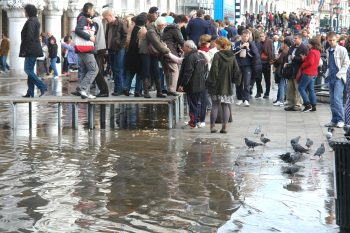
Only certain parts of the city are flooded. Between the neighborhoods that are underwater, there are scattered dry patches from which people use the makeshift walkways.
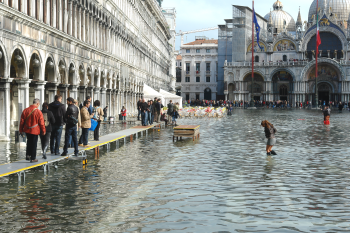
While Venetians have long since learned to cope with „aqua alta“ during the winter months, the flooding is something special—especially for tourists—and offers a chance to wade across St. Mark’s Square in rubber boots, just like they used to as little kids.
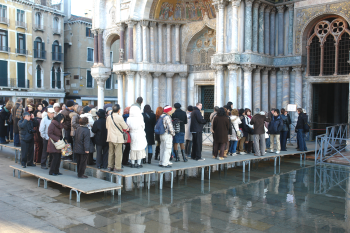
In front of St. Mark’s Basilica, tourists wait patiently to be let in. They can see that only the entrance area of St. Mark’s Basilica is under water. The rest of the square is still dry. The disruption to tourists caused by the flooding is therefore very minimal. In fact, the heavy columns that support the church have been pressing into the lagoon bed for centuries.
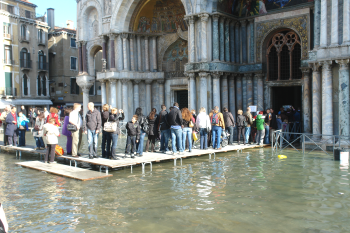
Depending on how high the peak flood level is, only small sections of the alleys and squares will get wet. It takes one to two hours from the first signs of the rising floodwaters to the peak. So you will NOT be caught off guard suddenly, and you will NOT be unexpectedly cut off by the floodwaters.
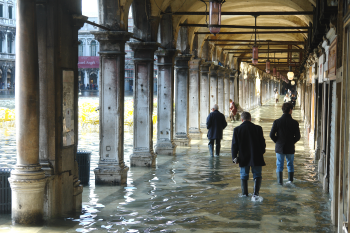
You also don't need to fear for your life. It is NOT comparable to a mudflat hike at low tide far out in the ocean.
Just a few centimeters
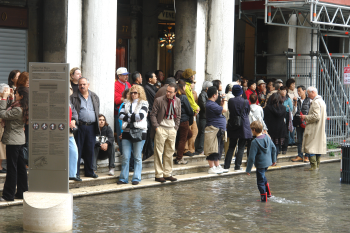
On the west and south sides of St. Mark’s Square, the sidewalk is three steps higher than the square itself. This sidewalk is almost never flooded, so you can take your photos here in peace or easily bypass the flooded area. Many photos of the flooding on St. Mark’s Square were taken from this elevated sidewalk.
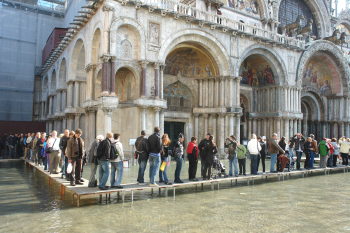
Of course, the flood level isn't always the same.
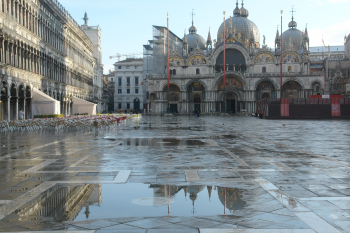
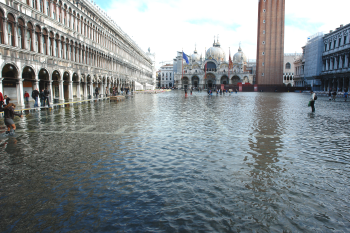
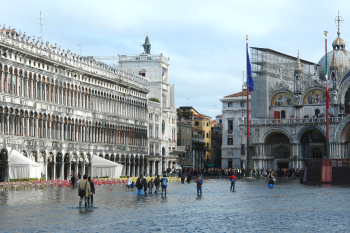
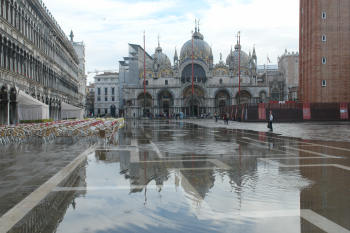
If you're unlucky, only a few square meters will be wet. Of course, it looks especially spectacular when the vast St. Mark's Square is flooded and the historic buildings—such as the tall Campanile and St. Mark's Basilica—are reflected in the water.
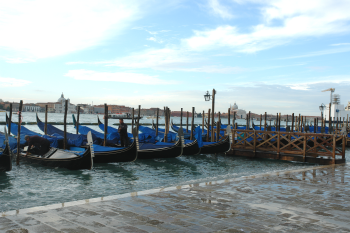
The floodwater does NOT come from the sea, nor does it flow through the city as a raging current from the sea. The water level throughout the Adriatic Sea rises simultaneously; the water always comes from below and does not overflow the banks. The floodwater reaches all of Venice’s low-lying areas at the same time.
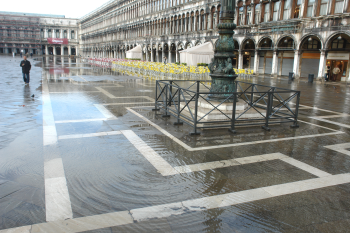
You won't be aware of every other flood. That's because at night you'll be safe in your hotel bed, asleep, and will therefore miss the flood.
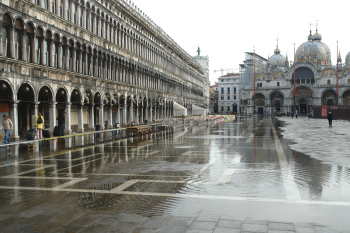
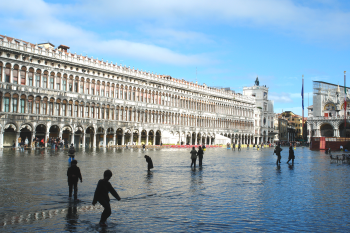
In this photo, only small parts of St. Mark's Square are flooded. The water recedes when the tide goes out.
Flooding Even in „Nice Weather“
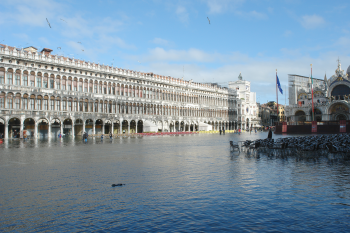
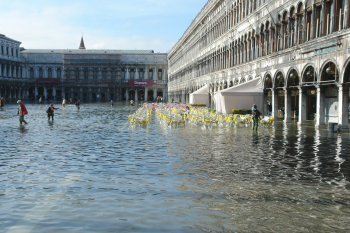
Most of the time, the high water occurs even when the weather is nice and the sky is blue. Here, the entire St. Mark’s Square is underwater. It is one of the lowest-lying areas in Venice. The rest of Venice is perfectly accessible during „normal“ high water.
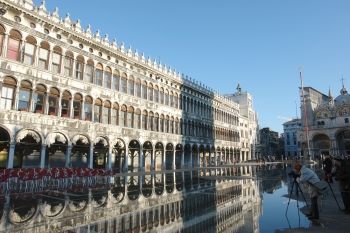
As you may recall: In addition to the normal high tide in the lagoon, general weather conditions—including strong winds over the Adriatic Sea—must also push water into Venice. These general weather conditions do not automatically mean that it is raining or stormy in Venice. As you can see from the picture, there is no wind and the sky is blue.
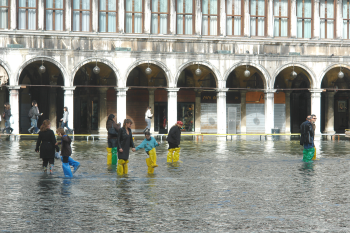
By the way: Not a single basement or underground parking garage will fill up with water or be flooded. The reason is quite simple: There are no basements or underground parking garages in Venice. When Venice was built about 1,000 years ago, waterproof basement walls were not yet possible, and no one had even thought of underground parking garages back then.
Miscellaneous
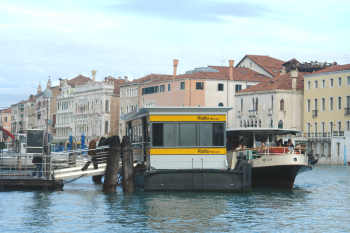
Normally, you walk slightly downhill to the vaporetto stops. Only during high tide do you have to walk slightly uphill. Vaporetto service continues even during normal high tide. Only when water levels are extremely high are there temporary restrictions.
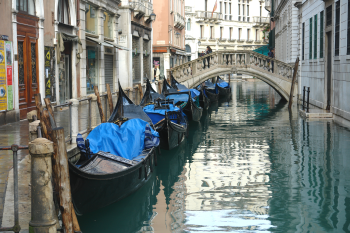
When the water reaches its highest level, even the gondoliers take a short break. The gondolas can no longer fit under the small, low bridges.
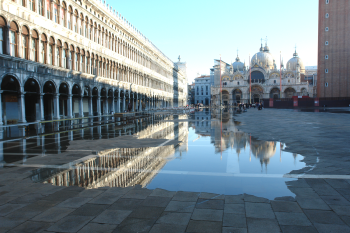
Of course, it looks especially beautiful when the buildings around St. Mark's Square are reflected in the water. Please take your pictures in plenty of time, because you don't know how high the water will rise to cover St. Mark's Square.
More Photos of the Flood