This is Part III of the Canal Grande Trilogy. Please be sure to read Part I and Part II first.. Only there will you learn about the basic architecture of the palazzi, the significance of the decorative elements, and other general information about the sights along the Grand Canal. The order in which the sights are discussed in this guidebook follows a vaporetto ride from the Rialto Bridge to the train station
Sights along the northern part of the Grand Canal

The plan is from http://www.OpenStreetMap.org – © OpenStreetMap contributors
Here on the map, you can see the most beautiful palazzi on the northern part of the Grand Canal, between the Rialto Bridge and the train station. There is actually only one true palace in Venice: the Doge’s Palace. All other palazzi are called ‘houses,” which is “casa” in Italian but is usually abbreviated as “Ca’.”.
Many palazzi are either privately owned or house government offices and agencies (such as city hall or courts). For this reason, unfortunately, a great many of them are NOT open to the public for tours. However, there are a few palazzi that are open to visitors. These are: Fondaco dei Turchi, Ca‘ Pesaro, Ca’ d’Oro, Ca’ Rezzonico, and Ca’ Venier dei Leonie.
Right: Fondaco dei Tedeschi

This used to be the branch office (trading house) of German (Tedesci) merchants in Venice. In the past, Hungarians, Austrians, and Flemings were also considered Germans. The palace is located directly on the north side of the Rialto Bridge and has recently been renovated.
German merchants have long been present in Venice. The earliest records refer to a goldsmith named „Bernardus Teotonicus“ in 1213. The Fondaco dei Tedeschi was first mentioned in 1228. It burned down once and was rebuilt in 1508. Fondaco = warehouse
Among the most famous merchant families who traded here were the Fuggers of Augsburg. Until recently, the building housed the main post office in Venice. Unfortunately, it is currently closed.
Right: Ca da Mosto

This house is the oldest building on the Grand Canal. It is located near the Rialto Bridge. It dates back to the 13th century and still features authentic Venetian-Byzantine architecture. Both the warehouse and the owner’s residence (usually merchants) are located in the same building.
If you look closely, you'll see that the house has three regular stories and another story at the very top, which was added later and isn't as tall as the rest. You'll find this to be the case with many houses in Venice. Often, these small top stories are used solely for storage.
Right: Palazzo Michiel dalle Colonne
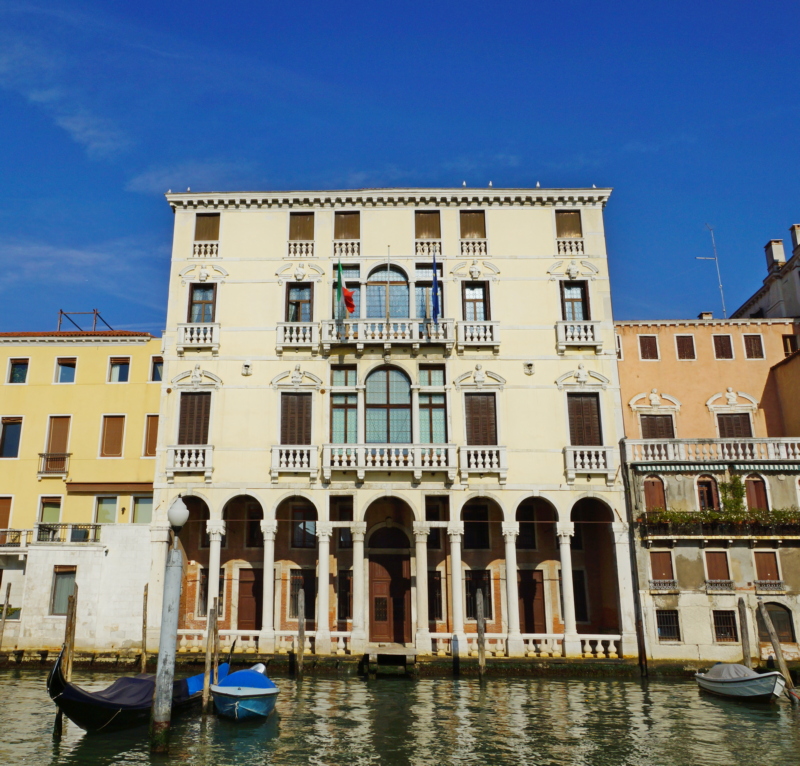
The Palazzo Michiel Dalle Colonne is a palace with a perfectly symmetrical Baroque façade, located on the northern side of the Grand Canal. The palace is also known as the Palazzo Michiel Dalle Colonne a Santa Sofia. It is believed to be of Romanesque origin but has been rebuilt several times. The palace derives its name, „dalle Colonne“ (from the columns), from the colonnade on the ground floor—the magnificent loggia facing the Grand Canal.
Left: The Fish Market

Start at the San Marco end of the Rialto Bridge and cross it, then head back down on the other side. Continue straight ahead for about 100 meters: you’ll first pass through the fruit and vegetable market, where fresh produce from the islands of the lagoon is sold, and then arrive at the fish market. It’s definitely worth seeing. The fish market is open all morning. The individual stalls don’t start clearing out until 11 a.m., so you’ll have plenty of time to explore.
There are plenty of tourists here with cameras and flashbulbs. Maybe you'll get lucky and see a large tuna or swordfish on display. In the Bavarian Broadcasting Corporation's television documentary on Venice titled Venice Gourmet Tour the restaurant will be Poste Vecie Located right behind the fish market, it's considered one of the best seafood restaurants in town. It's easy to find: it's right behind the fish market
Right: Luxury hotel at Ca‘ Sagredo

Ca‘ Sagredo, shown on the right in the picture, is a 14th-century Gothic palace and is now a luxury hotel. The link to this hotel's website is: http://www.casagredohotel.com/de/
Right: Ca‘ d'Oro: The finest example of Gothic architecture in Venice

The Casa del Oro (House of Gold) was once one of the most beautiful, opulent, and magnificent houses—but also one of the most ostentatious. Its name comes from the gilded figures on the facade. Even today, without the gold trim, it is a magnificent palazzo that immediately catches the eye of any tourist passing by on the Grand Canal.
The wealthy patrician Marco Contarini, a member of one of the city’s richest families, had this palace built in the 15th century. The three-part façade, topped by a cornice, is one of the finest examples of Gothic architecture in Venice. It is striking that the two piano nobili—the main floors—are of different heights, thereby expressing a hierarchy. It is unusual, however, that the palace does not feature additional rooms or windows on both sides of the central loggias, but only on one.
You can also get there on foot. It’s located along the route between the train station and the Rialto Bridge, or you can take Line 1 right up to the palace. The vaporetto stop is called Ca‘ d’Oro.
The Ca’ d’Oro is a museum and is open to visitors (closed Monday afternoons). Inside, on the first floor, it offers a magnificent view of the Grand Canal. On the ground floor, you’ll also notice just how far Venice has sunk into the sea. It’s dark, wet, and cold.
Left: Ca‘ Corner della Regina

The Baroque palace of the Corner or Cornaro family. They were among the oldest patrician families in Venice. Their origins date back to the Romans. The patricians were the social—and often political—elite of ancient Rome.
The Queen of Cyprus (Caterina Cornaro) was born in 1454 in a smaller palace that stood on the site of the present-day building. (Della Regina = of the Queen) The Ca‘ Corner della Regina is one of the last grand palaces to be built in Venice. Since space was at a premium, the entire structure was built more vertically than horizontally.
The nearby Ca’ Pesaro apparently served as the model for the Ca‘ Corner della Regina. The palace has two piani nobili, the first adorned with Ionic columns and the second with Corinthian columns.
Right: Palazzo Gussoni

Palazzo Gussoni is the seat of the Administrative Court of the Veneto Region (Venice).
The Palazzo is a Renaissance palace.
President:
Maurizio NICOLOSI
Secretary General:
Luigi Gioacchino Giovanni Ciaccio
Palazzo Gussoni - Cannaregio,
2277/2278, 30121 Venice
Phone: 041/2403911
Left: Ca Pesaro

Ca’ Pesaro is named after the very wealthy Doge Giovanni Pesaro. The Baroque palace on the Grand Canal is located at the point where the Rio delle Due Torri flows into the Grand Canal. In his will, the Doge had once instructed his family to complete the palace that Baldassare Longhena had begun. Work on the façade began in 1673 and was completed in 1710. The entire building corresponds to the original plans.
Felicita Bevilacqua bequeathed the palace to the city of Venice in 1899. The condition was that it be used to provide work and exhibition opportunities for young avant-garde artists. If you look closely, you’ll notice that the marble palace juts out slightly into the Grand Canal. On the second floor is the Museum of Oriental Art, which houses 30,000 objects from Japan, China, and Indonesia.
Left: The Church of St. Stae (San Eustachio)

Note the austere design of the façade, with four Corinthian columns on tall pedestals. The triangular pediment, too, is inspired by the style of Andrea Palladio, the Italian Renaissance architect.
Andrea Palladio built the famous churches—Le Zitelle, Il Redentore, and San Giorgio Maggiore—and thus made a significant contribution to Venice’s cityscape. Above the entrance portal is what is known as a split pediment (Gable) as was customary in the High Baroque period.
Since the church has excellent acoustics, concerts are held here regularly. If you have time and are interested, take a look at the exquisite paintings by Tiepolo and Piazzetta inside. Right next to the church is a vaporetto stop called St. Stae.
Right: Palazzo Vendramin Calergi (casino)

The Palazzo Vendramin Calergi is located near the train station. This magnificent Renaissance palace was commissioned by the nobleman Andrea Loredan. It later passed into the possession of the Vendramin family and then to the Calergi family, who were originally from Greece, and it bears their name to this day. The palazzo is known for Richard Wagner, who died here in 1883.
Work on the main building was completed in 1505. The architect was Mauro Codussi, who also designed other palaces in Venice that can still be seen today. A characteristic feature of Mauro Codussi’s work is the double arched windows, which are framed by a circular segment into which a round window is set. The recessed side wing was built according to designs by Vincenzo Scamozzi and renovated in the 17th century.
Richard Wagner, a great lover of Venice, died in the Scamozzi annex in 1883. His living quarters, as well as the room where he died, are now maintained by the Wagner Society of Venice and are open to interested visitors for a small fee.
The building currently houses the Venice Casino, which first opened its doors to eager gamblers in 1638—though not here, but in the Dandolo family’s palace directly behind St. Mark’s Square (now the Hotel Monaco).
The words „NON NOBIS DOMINE, NON NOBIS“ can be seen on the facade; they come from the Old Testament and are the beginning of a famous saying of the Knights Templar: “Not to us, Lord, not to us, but to You be the glory.” This is a reference to the fact that the Knights Templar fought solely for the glory of the Lord and not for their own interests. Andrea Loredan adopted this as the family motto, suggesting that he was closely associated with the Knights Templar.
Left: Fondaco dei Turchi
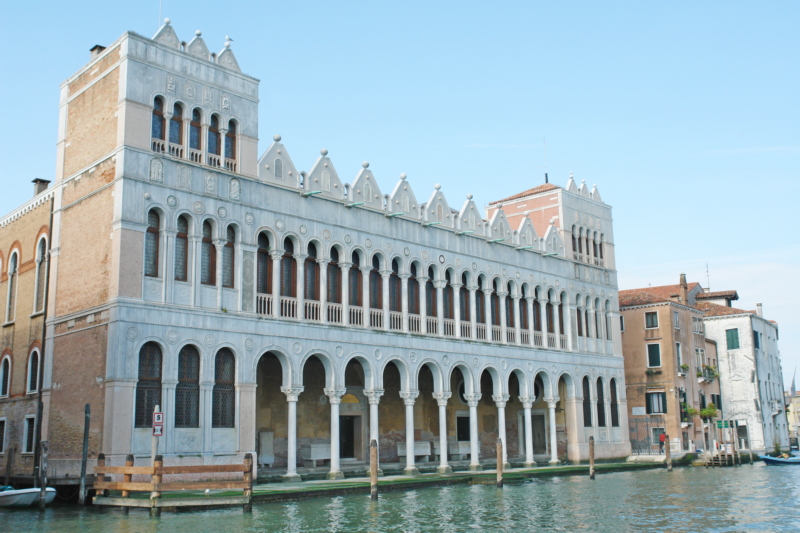
This „Palace of the Turks“ was first mentioned in 1225. It was built in the Venetian-Romanesque style and was once one of the most magnificent palaces in the entire city. Note the double loggia on the ground floor and first floor. The two corner towers are reminiscent of defensive structures commonly found in early medieval buildings. It served as the trading house for all Ottoman merchants but was commonly referred to as the „Palace of the Turks.“.
Today it belongs to the City of Venice and houses the Museum of Natural History, which features an exhibition on the lagoon's flora and fauna
Right: The Church of San Geremia

The 43-meter-high Romanesque campanile is one of the oldest in Venice. It is the only surviving structure from the 12th century. It was founded in the 11th century by Mauro Tosello and his son. A new building was later erected. The present-day church dates from 1753. It houses an arm of Saint Bartholomew, the remains of Saint Magnus of Oderzo, and the remains of Saint Lucy of Syracuse. He is one of the most venerated saints in Christendom.
The remains of Saint Lucy of Syracuse are also housed in the church—although Saint Lucy actually had her own church, which was demolished in the 19th century to make way for the train station. To be honest, no one in Venice really understands why the Bishop of Syracuse believes the Venetians should return Saint Lucy to the city of Syracuse—since she no longer has her own church in Venice and, after all, she suffered her martyrdom in Syracuse…
Even today, from the Grand Canal, you can read the following inscription on the church:
„Lucia, Virgin of Syracuse, rests in this temple.
’May you bring light and peace to Italy and the world.“
(The Virgin Lucia of Syracuse rests in this temple.
Bring light and peace to Italy and the world)
Right: The Church of Santa Maria degli Scalzi

A very beautiful monastery church right next to the train station. Note the marble façade, richly adorned with columns and sculptures. The Church of Santa Maria di Nazareth is popularly known as Santa Maria degli Scalzi because the adjoining monastery was home to the Discalced Carmelites (scalzo—meaning “without shoes” or “barefoot”).
The church is a beautiful example of Baroque architecture—albeit from its late phase, as the façade is very flat. It was designed by Baldassare Longhena, a leading architect of the Baroque period. His student, Giuseppe Sardi, completed the work beginning in the late 17th century. The façade’s design is reminiscent of Roman models, which was likely a requirement of the patrons, the Carmelite nuns, who had just moved from Rome to the lagoon. Incidentally, they were „barefoot“ because theirs was a mendicant order. The coat of arms at the top of the pediment belongs to the Counts of Cavazza, who contributed to the financing of the building.
On October 24, 1915, the church’s vault—and with it one of the most beautiful works by the Venetian painter Giambattista Tiepolo—was irrevocably destroyed by an Austrian bomb. The bridge over the Grand Canal directly in front of the church took on the same name: Ponte degli Scalzi.
Romanesque
Romanesque architecture emerged throughout Europe around the year 1000. It is considered the first major artistic era, which is why we begin with it in this travel guide. Typical features of the Romanesque style include round arches, arched windows, columns with block-like capitals, and walls constructed of massive stone blocks.
The Romanesque style is intended to evoke the omnipotence of God and is therefore deliberately designed to convey grandeur and power. The oldest buildings still standing in Venice today date back to the Romanesque period, the 11th century—for example, St. Mark’s Basilica.
Gothic
The Gothic period is part of the Middle Ages. It began in the mid-12th century and lasted until around the year 1500. You can recognize Gothic art in particular on many of the exterior facades of the numerous palazzi; the Ca’ d’Oro is a prime example of Gothic architecture. Church buildings often served as a demonstration of the power of the ruling kings or bishops of the time.
Of all the architectural periods, it was the Gothic era that had the most lasting influence on Venice’s buildings, as it was particularly well-suited to the typical Venetian „filigree“ style of construction, which was determined not least by the particularly unstable ground.
The Gothic period—that is, the 13th through 15th centuries—also coincided with Venice's economic heyday.
Buildings such as the Doge's Palace and the grand churches of the religious orders became architectural symbols of Venice's political and economic greatness.
Gothic buildings in Venice: Santa Maria Gloriosa dei Frari, Santi Giovanni e Paolo, Ca’ Foscari, the Doge’s Palace, San Giovanni in Bragora, Madonna dell’Orto, Palazzo Contarini del Bovolo, San Zanipolo, Santa Maria Gloriosa dei Frari, Santo Stefano
Renaissance
By contrast, the Renaissance had a hard time gaining a foothold in Venice: after all, the Venetians were staunch traditionalists who liked to cling to the good old ways—and that meant Gothic art.
The Renaissance emphasizes symmetry, proportion, geometry, and the arrangement of all architectural elements. It was not until the second half of the 15th century that Renaissance art—which was already well established in central Italy at the time—gained a foothold in the lagoon city. The facades of the churches of Il Redentore, San Francesco, and San Giorgio Maggiore date from the Renaissance. They were designed by the famous master Palladio himself.
Baroque
There are several reasons why the Baroque period began relatively late in Venice compared to its „birthplace,“ Rome, including the extremely strained relations that existed between the Roman Catholic Church and the Serenissima at the beginning of the century.
Baldassare Longhena was the architect who brought the new Baroque style into the mainstream in early 17th-century Venice: the design for the Church of Santa Maria della Salute dates from 1631.
The Baroque period emerged in Venice during a time of economic decline. During this period, the number of new churches and palaces being built was already lower than during the Renaissance and, above all, the Gothic period.
A hallmark of the Baroque style is the breaking away from the strict order of the Renaissance. Now there are sweeping, concave, and convex forms, domes, groups of columns, pediments, and window surmounts with rich ornamental decoration.
Rococo
In contrast, the Rococo period saw virtually no major construction projects in Venice. The name ‚Rococo‘ likely derives from the French word “rocaille” (“grotto and shell work”), a popular and recurring ornamental motif in Rococo art.
A single palace was built—the Palazzo Grassi—based on designs by the architect Giorgio Massari. Massari completed Longhena’s major project, the Ca’ Rezzonico, on the Grand Canal.
A defining feature of the architecture of this period is renovation and remodeling, with very few new buildings. The end of the republic also marked the end of significant construction activity in the lagoon city.

This page was created with special support from Dr. Susanne Kunz-Saponaro, an officially certified tour guide for Venice. If you are interested in a guided tour of Venice, please visit her website: http://www.stadtfuehrungen-venedig.de